How Much Is The Fifer Worth?
Last updated: January 27, 2026
Quick Facts
- Methodology
- extrapolation
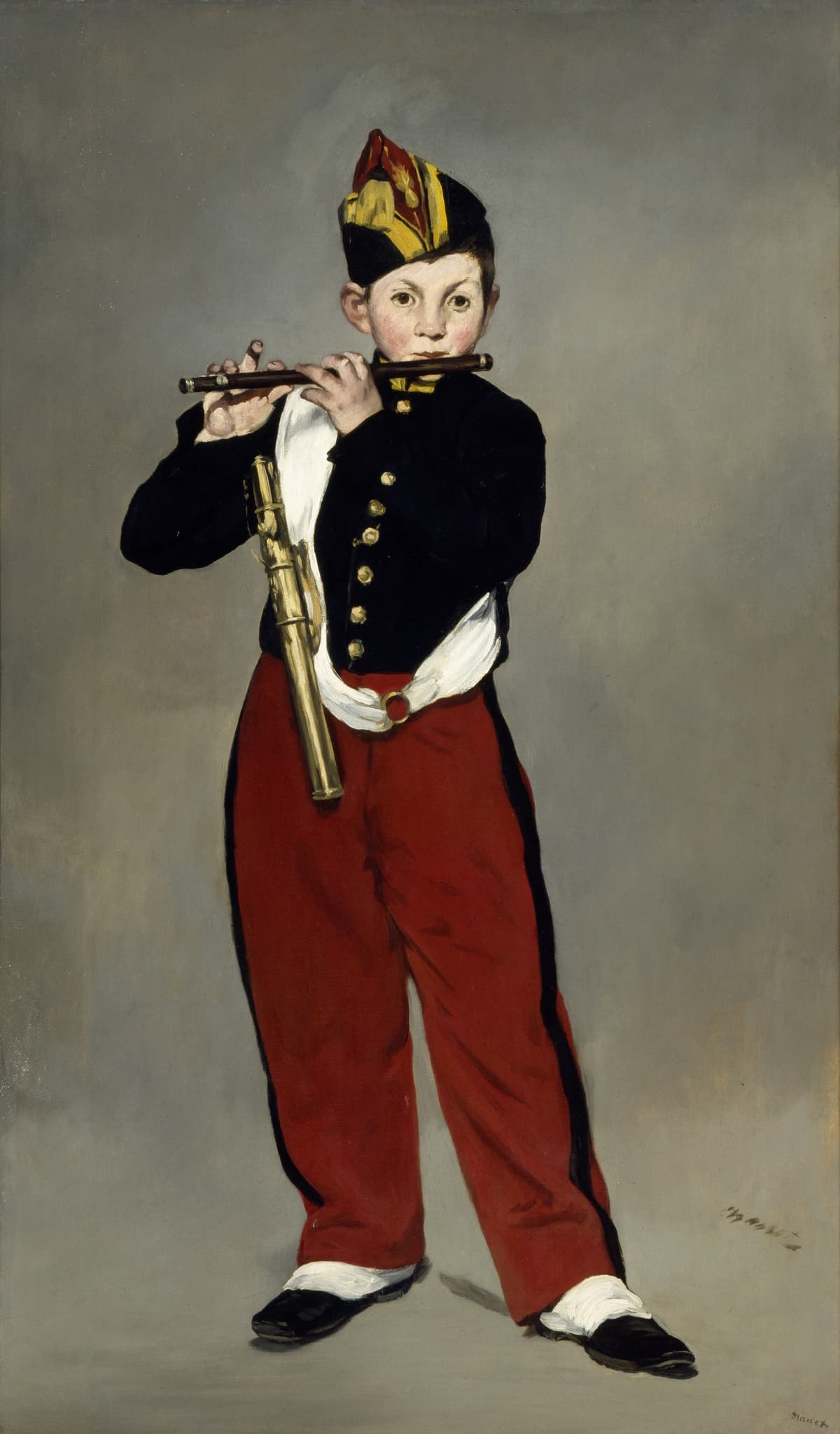
Édouard Manet’s The Fifer (1866) is a canonical, museum-icon painting held by the Musée d’Orsay and inalienable under French law. On a hypothetical open market, its stature and rarity support an extrapolated valuation of $150–250 million, well above Manet’s auction record.
Valuation Analysis
Conclusion: If The Fifer (1866) could be sold on the open market, a defensible fair-market range is $150–250 million. The work is in the French national collections at the Musée d’Orsay and is inalienable under Article L451‑5 of the French Heritage Code; this is therefore a hypothetical valuation for comparative/insurance purposes only [1][3].
Why this range: The Fifer is one of Manet’s defining early masterworks—a radical, full-scale, single-figure statement whose frontal pose, flattened handling, and synthesis of Spanish and Japonisme sources helped set the terms of modern painting. It appears consistently in survey texts and exhibitions and is bracketed with Olympia and Le Déjeuner sur l’herbe as an image that “is” Manet in the public imagination [1]. That canonical status warrants a substantial trophy premium over the artist’s public auction benchmarks.
Comparable market evidence: Manet’s auction record is $65.1 million for Jeanne (Spring) (Christie’s, 2014), acquired by the Getty Museum—proof of institutional demand at the very top [2]. In 2022, Le Grand Canal à Venise realized $51.9 million in the Paul G. Allen sale, underscoring deep, global competition for first-rank Manet oils when supply appears [4]. Even in a selective 2024 market, a late floral still life achieved $10.1 million at Sotheby’s, confirming healthy liquidity for quality works by the artist [5]. Extrapolating from these benchmarks, The Fifer—greater in art-historical weight and public renown—merits a valuation well beyond Manet’s prior records.
Trophy-tier context: Blue-chip demand for singular 19th-century Modern icons has repeatedly reached nine figures. Klimt’s Portrait of Elisabeth Lederer at $236.4 million (2025) is a recent emblem of this appetite for era-defining masterpieces with museum-grade provenance and visibility [6]. While the broader market cooled in 2023–2024 with fewer top consignments, buyers remained highly selective and concentrated capital on the very best works; by 2025, marquee Modern trophies again set landmark prices under robust guarantee structures [7][8]. Within this environment, The Fifer would attract marquee private collectors and global institutions and could exceed the top of the range in the presence of multiple megabidders.
Scarcity and legal status: Major Manet oils of equivalent ambition are exceptionally scarce, with the most emblematic examples in museums. The Fifer’s position in an inalienable national collection compounds effective scarcity, reinforcing its trophy premium even in a hypothetical sale [1][3]. Taken together—canonical significance, acute scarcity, and strong recent comparables—the $150–250 million bracket aligns the work with its true standing in the market and art history.
Key Valuation Factors
Art Historical Significance
High ImpactThe Fifer is a pivotal early statement of Manet’s modernity: a stark, frontal, single-figure composition whose radical flatness and distilled palette synthesize the artist’s study of Velázquez with Japonisme. It is among the most frequently reproduced Manets and sits alongside Olympia and Le Déjeuner sur l’herbe in defining his public and scholarly identity. As a finished exhibition picture that crystallizes Manet’s break with academic convention, it exerts disproportionate influence on later modern painting. This degree of canonical status—core to the narrative of 19th‑century modernism—commands a substantial premium over otherwise excellent works by the artist, positioning The Fifer in the small cohort of “museum‑icon” paintings that anchor collections.
Rarity and Supply
High ImpactFirst‑rank Manet oils of comparable ambition are exceptionally rare in private hands; most are long in museum collections. The Fifer is unique in subject and treatment, and its status within a national museum makes it effectively unavailable. This scarcity is structural—there is virtually no substitutable supply at this level—so demand concentrates intensely on the handful of opportunities remotely near this caliber. In pricing terms, the lack of alternatives supports a trophy premium well above the artist’s public auction record, particularly in a market where global collectors prioritize irreplaceable, brand‑defining works over depth of series or larger quantity.
Provenance, Exhibitions, and Public Iconicity
High ImpactThe painting’s early ownership by leading dealers and collectors (including Durand‑Ruel and Jean‑Baptiste Faure) and its 1911 bequest by Count Isaac de Camondo into France’s national collections confer exemplary provenance and continuous institutional stewardship. Its sustained museum presence and frequent reproduction have made it a public‑facing emblem of Manet, increasing recognizability far beyond the specialist audience. Such visibility functions as a powerful value driver: it reduces perceived risk, elevates cultural capital, and can catalyze cross‑category demand from buyers who compete for only the most recognizable images in art history.
Market Benchmarks and Trophy Demand
High ImpactRecent Manet benchmarks—$65.1m for Jeanne (Spring) (2014) and $51.9m for a Venetian view (2022)—establish a strong base for top‑tier works, while the broader 19th‑century Modern trophy segment has demonstrated repeated nine‑figure capacity. In today’s selective environment, capital concentrates on singular, best‑in‑class works with ironclad provenance and institutional visibility. The Fifer sits above the known auction comparables in importance and public renown, justifying substantial upward extrapolation. Given ongoing trophy appetite and the painting’s unmatched scarcity, a $150–250m range accurately reflects where competitive bidding or private negotiation would likely clear.
Sale History
The Fifer has never been sold at public auction.
Édouard Manet's Market
Édouard Manet occupies a permanent blue‑chip tier with an extremely constrained supply of major oils. The auction record is $65.1 million for Jeanne (Spring) at Christie’s New York in 2014 (acquired by the J. Paul Getty Museum), followed by $51.9 million for Le Grand Canal à Venise in the Paul G. Allen collection sale in 2022. Quality secondary works continue to place well—e.g., a late floral still life brought $10.1 million at Sotheby’s in 2024—showing depth across price bands. When first‑rank, museum‑caliber Manets appear, institutional and marquee private demand is intense and internationally distributed. Pricing is highly stratified by subject, condition, and period, with single‑figure, iconic images commanding the highest premiums.
Comparable Sales
Jeanne (Spring)
Édouard Manet
Same artist; one of Manet’s most iconic single-figure modern-life portraits and current auction record for the artist—closest market proxy for a museum-caliber Manet trophy.
$65.1M
2014, Christie's New York
~$88.0M adjusted
Le Grand Canal à Venise
Édouard Manet
Same artist; top-tier, widely admired work from the 1870s that achieved a landmark price in a marquee sale, evidencing depth for blue-chip Manet oils.
$51.9M
2022, Christie's New York
~$56.8M adjusted
Self-Portrait with a Palette
Édouard Manet
Same artist; major single-figure portrait and a previous auction record. Strong proxy for top-importance Manet figuration, though later than The Fifer.
$33.2M
2010, Sotheby's London
~$48.7M adjusted
Vase de fleurs, roses et lilas
Édouard Manet
Same artist; recent eight-figure result showing current liquidity for high-quality Manet oils in a selective market (subject and importance below The Fifer).
$10.1M
2024, Sotheby's New York
~$10.4M adjusted
Le bal de l’Opéra
Édouard Manet
Same artist; modern-life subject from the 1870s, confirming robust demand for secondary-tier Manet compositions in recent marquee sales.
$3.9M
2022, Christie's New York
~$4.3M adjusted
Ambroise Adam dans le jardin à Pressagny
Édouard Manet
Same artist; early 1860s period (near The Fifer’s date), albeit a small, non-iconic canvas—useful for period adjacency and demonstrating breadth of market depth.
$1.0M
2025, Christie's Paris
Current Market Trends
Impressionist and early Modern works saw a cyclical cooling in 2023–2024 due to fewer trophy consignments, even as demand migrated to mid‑tier price points. Buyers became more selective, with a marked shift to private transactions and tighter guarantees. By late 2025 the market reasserted strong capacity for singular masterpieces, with several record‑level results signaling durable appetite at the top. In this environment, irreplaceable, museum‑icon works with impeccable provenance—such as Manet’s The Fifer—attract concentrated global bidding and can clear well above artist‑specific historical benchmarks despite broader market caution.
Sources
- Musée d’Orsay – Le Fifre (The Fifer) object record
- Christie’s Press – Impressionist & Modern Art Evening Sale Results (includes Manet’s Jeanne (Spring) at $65.1m)
- Legifrance – French Heritage Code, Article L451-5 (inalienability of public collections)
- The Art Newspaper – Christie’s Paul G. Allen sale hits $1.5bn (includes Manet at $51.9m)
- The Art Newspaper – Sotheby’s Modern Evening sale (Manet still life at $10.1m)
- The Wall Street Journal – Klimt portrait sells for $236.4 million at Sotheby’s (2025)
- Art Basel & UBS – The Art Market 2024 (Auctions analysis)
- The Art Newspaper – Global art sales fell 12% in 2024, Art Basel & UBS report