How Much Is Woman Reading Worth?
Last updated: January 17, 2026
Quick Facts
- Insurance Value
- $55.0M (Comparable analysis (assistant synthesis))
- Methodology
- comparable analysis
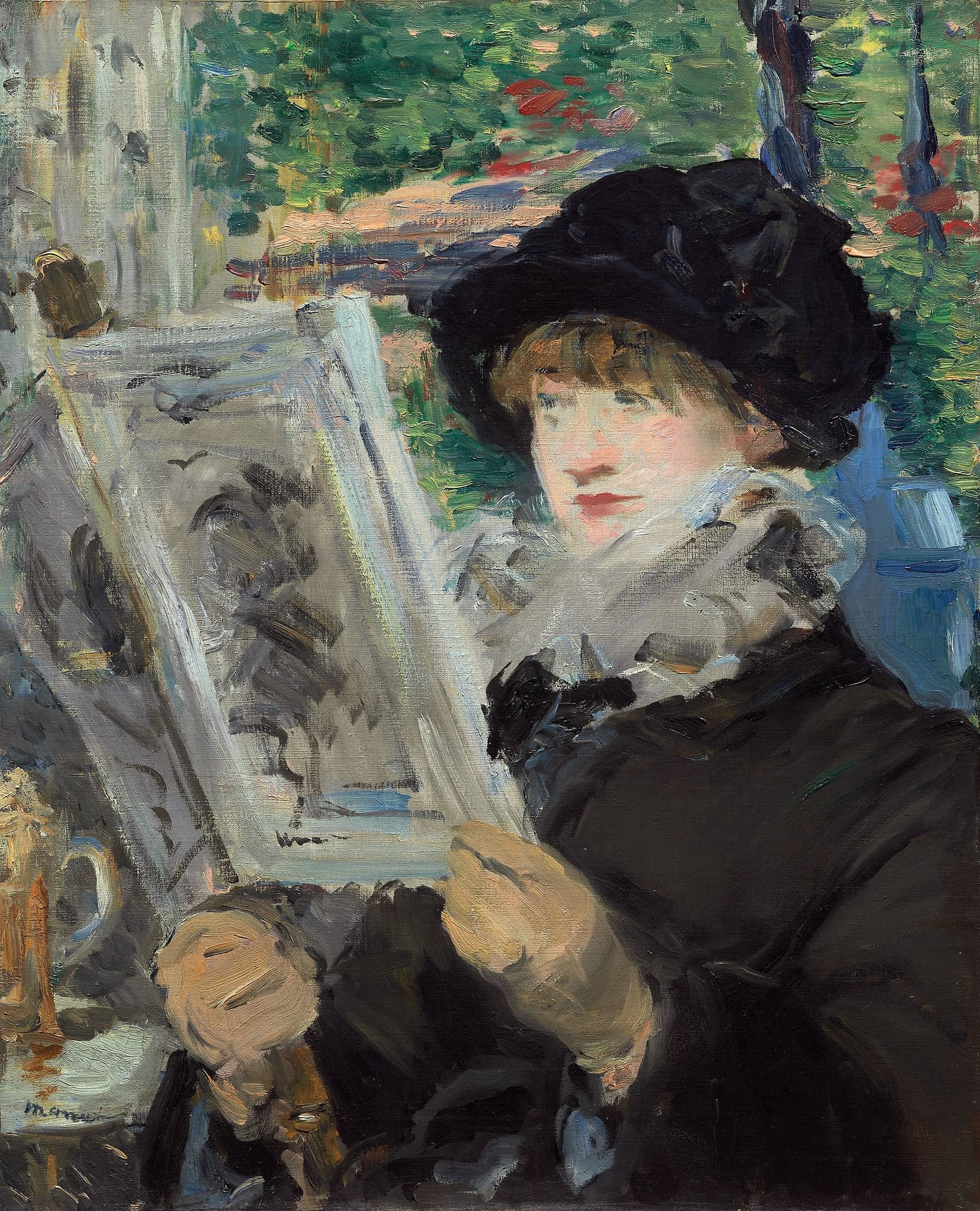
Based on recent late-Manet benchmarks and the work’s strong late-date, subject, and provenance, Woman Reading would likely achieve $32–45 million in a well-promoted evening auction. Replacement insurance should be set higher, around $55 million, reflecting extreme scarcity and museum-level demand.
Valuation Analysis
Conclusion: We estimate Édouard Manet’s Woman Reading (1880–82) at $32–45 million for a hypothetical auction sale, with recommended museum replacement insurance of approximately $55 million. This range is anchored by late-Manet market comparables, the work’s appealing subject and late date, and its impeccable provenance, literature, and exhibition record, including early ownership by J.-B. Faure and long-term placement in the Art Institute of Chicago [1].
Position in the oeuvre and quality: Woman Reading is a refined, intimate late interior featuring a single female figure—one of the most sought-after collecting categories in Manet’s corpus. Its moderate scale (about 61.2 × 50.7 cm) and resolved, elegant finish place it clearly above late still-life benchmarks while below Manet’s handful of universally canonical masterpieces. The AIC entry confirms the late dating (1880–82) and deep literature/exhibition history, both value-additive factors [1].
Comparable sales and pricing logic: The top-of-market anchor for late Manet female figures is Jeanne (Spring), which realized $65,125,000 at Christie’s New York (2014) [2]. At the other end of the late-period spectrum, floral still lifes—desirable but less competitive than late figure paintings—have changed hands at $10.1 million (Sotheby’s New York, 2024) [3] and about $13 million (2018). A late, high-quality figure subject like Woman Reading should command a meaningful premium to the still-life cohort but sits below the highly iconic, public-facing late portraits that set the artist’s record. This bracketing supports a $32–45 million auction range today.
Supply, demand, and liquidity: Manet’s first-rate oils are exceptionally scarce on the market, with most in institutional hands. When strong examples appear, competition is robust, particularly in global marquee sales. Even amid recent auction-cycle selectivity, blue-chip Impressionist names with quality and provenance continue to clear estimates, with broader market studies attributing value softness in 2023–24 largely to a shortage of trophy consignments rather than a structural collapse in demand [4]. In this context, a late Manet figure with ironclad provenance would likely attract multiple third-party backers and international bidding.
Risk and upside factors: Upside beyond the top of our range would be driven by exceptional condition, technical evidence supporting a fully autograph late finish, and high-profile marketing alongside major cross-category collections. Conversely, material condition issues or any diminution of autograph status would lower the estimate. Given current information and institutional stewardship, we assume sound condition consistent with AIC standards [1].
Insurance recommendation: Replacement is set higher at ~$55 million to reflect non-fungibility and the lack of true substitutes for a late Manet figure painting in comparable state and provenance. This aligns with the spread observed between auction value and museum insurance practices for extremely scarce, blue-chip works.
Key Valuation Factors
Art Historical Significance
High ImpactWoman Reading is a late work by Manet, a foundational figure of modern art whose final years produced a concentrated group of refined interiors, portraits, and still lifes. While not among the handful of universally canonical icons (e.g., Olympia), it embodies the poised, intimate late style that underpins strong collector demand. Its subject—a single woman absorbed in reading—aligns with Manet’s celebrated investigations of modern life and domestic interiors, adding cultural resonance and broad appeal that translates directly into price support.
Subject and Oeuvre Position
High ImpactLate, intimate figure paintings are one of Manet’s most sought-after genres, typically commanding significant premiums over still lifes. The painting’s moderate size, resolved handling, and elegant composition place it above decorative or sketch-like works and closer to the refined late portraits that lead the artist’s market. This positioning—desirable subject, late date, and painterly quality—supports a valuation materially above late still-life benchmarks while remaining below the artist’s record-setting, iconic images.
Provenance, Literature, and Exhibitions
High ImpactThe work’s early ownership by J.-B. Faure—Manet’s key patron and a central figure in 19th-century art collecting—followed by its passage to the Coburn collection and eventual bequest to the Art Institute of Chicago, provides exemplary provenance. The painting is well-cited and has an extensive exhibition history, including early posthumous presentations, enhancing its scholarly standing and market confidence. Such documentation reduces transactional risk and tends to improve liquidity and pricing in marquee sales.
Rarity and Supply
High ImpactFirst-rate late Manet figure paintings are extraordinarily scarce, with museums holding a dominant share. The market has seen few directly comparable works in recent years, and those that do appear are met with global bidding. Scarcity is a critical value driver: collectors cannot easily substitute another Manet of similar date, subject, and quality. This tight supply dynamic underpins both the upper bound of the estimate and the elevated insurance recommendation.
Condition and State of Finish
Medium ImpactWhile specific recent conservation details are not published, institutional stewardship at the Art Institute of Chicago typically implies stable condition. For valuation, we assume sound structural integrity and surface preservation consistent with a museum-standard work. Any material condition issues (lining, abrasion, discolored varnish, overpaint) or questions about the degree of finish could compress the range, while exemplary condition with compelling technical analysis (IRR/X-ray) would strengthen bidding and support the high end of the estimate.
Sale History
Direct from the artist (Paris)
Sold by Manet to J.-B. Faure for 500 French francs in 1882; USD shown is an approximate gold-parity conversion. Date approximate.
Art Institute of Chicago
Bequest of Mrs. Lewis Larned Coburn; accession no. 1933.435 (transfer to an institution, not a sale).
Édouard Manet's Market
Manet is a blue-chip pillar of the Impressionist/Modern market with exceptionally limited supply of high-quality oils. His auction record stands at $65.1 million for Jeanne (Spring) (Christie’s New York, 2014), and his refined late portraits and figure paintings lead the segment. Recent transactions show robust demand for strong late works, with still lifes around $10–13 million and significant figures much higher. Institutional holdings constrain supply, so when top-quality pieces emerge, they attract international competition and, frequently, third-party financial backing. Collectors treat the very best Manets as trophies with enduring store-of-value characteristics.
Comparable Sales
Jeanne (Spring)
Édouard Manet
Same artist; late-period (1881) single female figure, high-finish portrait close in size to Woman Reading—best benchmark for top-tier late Manet figure paintings.
$65.1M
2014, Christie's New York
~$88.0M adjusted
Self-Portrait with a Palette
Édouard Manet
Same artist; late-1870s major figure painting (though a male self-portrait), slightly larger scale; anchors pricing for important Manet portraiture in the modern market.
$33.2M
2010, Sotheby's London
~$48.7M adjusted
Lilas et roses
Édouard Manet
Same artist; same late period (1882) and similar midsize oil; while a still life (not a figure), it indicates late-Manet market depth for high-quality works.
$13.0M
2018, Christie's New York
~$16.5M adjusted
Vase de fleurs, roses et lilas
Édouard Manet
Same artist; late period (1882) floral still life, similar scale; the most recent marquee Manet sale, setting a current reference point for late works’ liquidity and pricing.
$10.1M
2024, Sotheby's New York
~$10.4M adjusted
Ambroise Adam dans le jardin à Pressagny
Édouard Manet
Same artist; figure subject (early, 1861) and smaller/less resolved than Woman Reading; included to show the lower bound for non-iconic Manet figures in today’s market.
$1.0M
2025, Christie's Paris
Current Market Trends
Impressionist & Post-Impressionist auction results contracted in 2023–24 primarily due to a shortage of top-tier consignments, not a collapse in demand. Within this selective environment, blue-chip works with quality, provenance, and right-sized estimates continued to clear strongly. By late 2025, marquee sales signaled renewed confidence at the top end when exceptional material surfaced. For a scarce, late Manet figure painting, this climate suggests deep bidder pools and price discipline, with outcomes hinging on condition, marketing, and cross-category competition.
Sources
- Art Institute of Chicago – Woman Reading entry (provenance, dating, dimensions)
- Christie’s – Manet record: Jeanne (Spring), $65,125,000 (Nov 5, 2014), post-sale report
- Sotheby’s – Vase de fleurs, roses et lilas (1882), price realized $10,101,000 (May 15, 2024)
- Art Basel & UBS – The Art Market 2024 (Auctions chapter)