How Much Is The Circus (Le Cirque) Worth?
Last updated: March 29, 2026
Quick Facts
- Methodology
- comparable analysis
Le Cirque (1891) by Georges Seurat is a major late work held in the Musée d'Orsay and is not available on the open market. If, under extraordinary and legally permitted circumstances, it were to appear for sale a realistic preliminary market range is USD 40–150 million, with the most likely outcome in the tens of millions (commonly USD 50–120M). The wide band reflects rarity of comparables, the painting's protected museum status, unknown condition, and market contingencies.
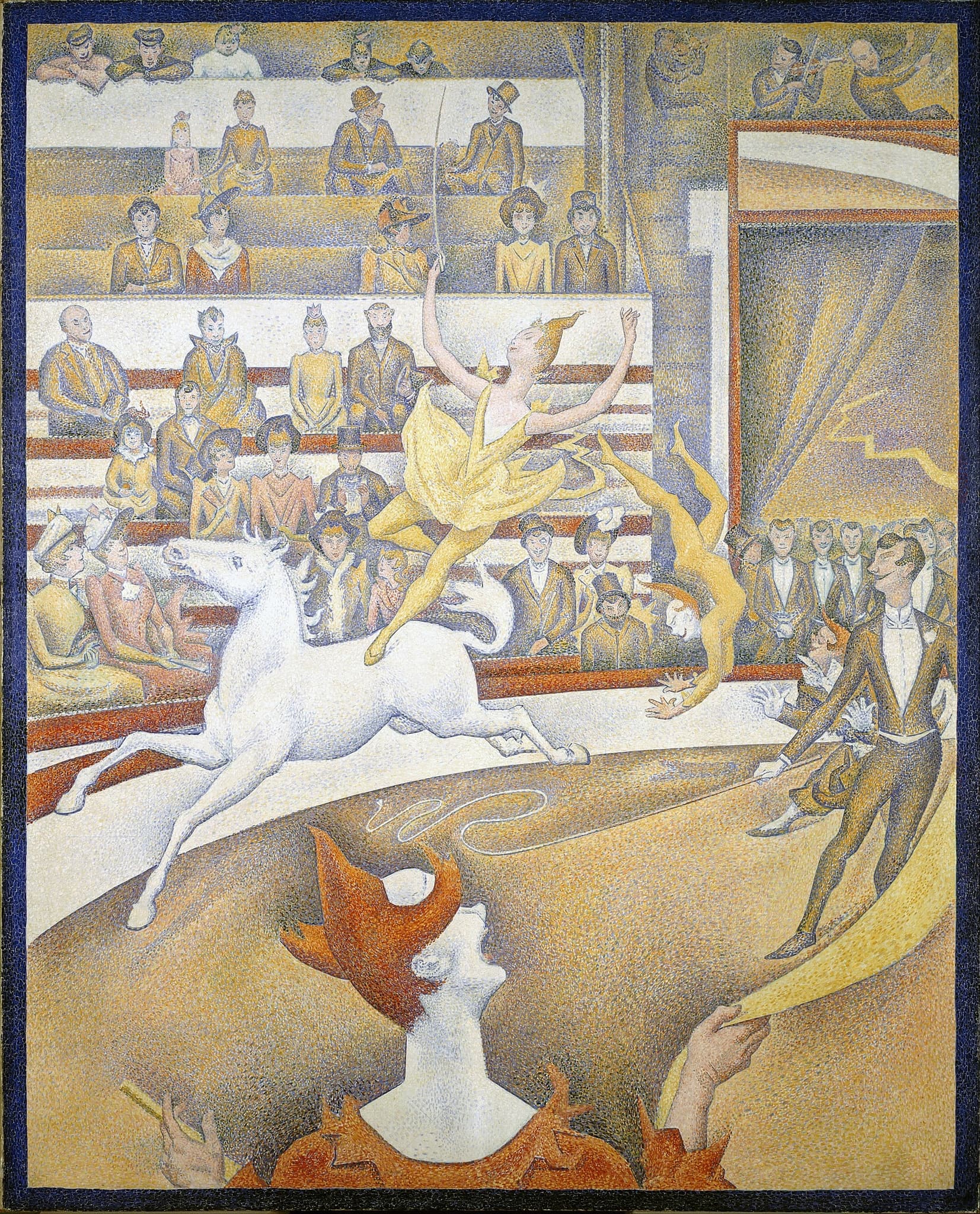
The Circus (Le Cirque)
Georges Seurat, 1891 • Oil on canvas
Read full analysis of The Circus (Le Cirque) →Valuation Analysis
Le Cirque (Le Cirque), 1891 by Georges Seurat is a major late canvas in the French national collection and is held at the Musée d'Orsay (accession RF 2511). Because it has been in public custody since it was accepted for the national collection in 1927 and has a long exhibition provenance, it has no modern public-auction record and is effectively off the open market [1]. That institutional placement both enhances the work's scholarly value and sharply constrains the likelihood and conditions of any sale.
Market calibration must therefore rely on comparables and recent marquee sales rather than a direct transaction history for this canvas. The November 2022 Christie's sale of Les Poseuses (Petite version) for USD 149.24 million established a practical upper bound for what a canonical Seurat masterpiece can achieve under exceptional sale conditions and provenance [2]. Other museum-quality Seurat canvases that have come to market in recent years have sold in the mid-tens of millions (for example La Rade de Grandcamp in 2018), while studies and works on paper more commonly trade from mid-six figures to low millions; these tiers inform the lower and mid points of the range.
Key valuation modifiers for any hypothetical sale are: (1) the painting's institutional and legal status, which may prevent export or limit bidders and thus apply a marketability discount; (2) condition and conservation history, which are unknown publicly and could materially reduce realizable value if complex treatment is required; and (3) sale circumstances — a high-profile single-owner marquee auction with international marketing, guarantees and competitive bidding can push price toward the top of the range, whereas a constrained domestic sale or forced deaccession would compress the result. The valuation below therefore reflects both an aspirational ceiling and realistic discounting for transactional friction.
Buyer profile and sale scenarios are highly consequential. If export permissions were granted and the work were offered in a major international evening sale with pre-sale loans to important exhibitions and strong institutional provenance narrative, the pool of bidders would include global private collectors, foundations and museums prepared to compete at the top end. If, instead, legal or political constraints forced a domestic-only sale or a negotiated institutional transfer, the practical buyer universe and competitive intensity would shrink and reduce realizable proceeds materially.
On balance, a reasonable preliminary market range if the work were to appear under extraordinary and legally permitted circumstances is USD 40–150 million, with the most likely outcome in the tens of millions (commonly USD 50–120 million) depending on condition, the presence of export permissions, pre-sale guarantees and competing institutional interest. To refine this range to higher certainty would require a full condition/conservation report, confirmation of legal/export status from the Musée d'Orsay or French authorities, and direct consultation with senior specialists at major auction houses to test appetite and sale mechanics. Those steps typically move an estimate from a wide preliminary band to a far tighter pre-sale estimate and, if favorable, to a reserve price recommendation.
Key Valuation Factors
Art Historical Significance
High ImpactLe Cirque is one of Seurat's major late works and a key statement of his mature Neo-Impressionist practice. Executed in 1891, it belongs to the set of large, carefully composed canvases that best demonstrate Seurat's pointillist method, chromatic investigations and compositional ambition at the end of his career. Its scale, subject choice and technical refinement make it frequently cited in exhibition catalogues and scholarship; that status increases institutional desire and collector recognition. In market terms that art-historical primacy supports upward pricing pressure, placing the painting among the artist's top-tier lots should it ever be legitimately offered.
Rarity & Market Scarcity
High ImpactSeurat's market is characterized by extreme scarcity of large, museum-quality canvases in private hands. The majority of canonical works are held by public collections worldwide, which compresses supply and produces volatility when a major canvas does appear. Scarcity thus functions as a strong upward driver — attracting deep-pocketed bidders — but it also increases estimate variance because there are few direct comparables. Isolated single-owner or marquee institutional sales can yield outsized results, yet the infrequency of such events forces wide preliminary bands when valuing a museum-held masterpiece hypothetically coming to market.
Provenance & Exhibition History
High ImpactLe Cirque benefits from a distinguished provenance (early ownership connections, passage through Paul Signac and John Quinn, and formal acceptance into the French national collection in 1927) and a long exhibition/publication record. This documented pedigree strengthens attribution confidence and academic value, typically supporting higher market estimates. Simultaneously, acceptance by the French state and long museum custody introduce legal and administrative friction that reduces liquidity. Provenance therefore exerts a dual effect: it enhances desirability among top-tier buyers but diminishes practical saleability, which must be priced as a discount in any hypothetical market estimate.
Condition & Conservation
Medium ImpactNo full public conservation report is readily available for Le Cirque; this absence increases valuation uncertainty. Large late-19th-century oils commonly present issues such as varnish discoloration, craquelure, localized flaking, previous restorations or the need for relining — each with cost and market implications. Substantial conservation requirements can materially lower buyer appetite and price; conversely, a thoroughly documented, stable condition preserves full market value. Securing and disclosing a current condition report is essential to narrow the estimate and remove a primary contingency assumption from the valuation.
Legal/Deaccession & Export Controls
High ImpactThe painting's acceptance into the French national collection creates significant legal and political constraints around sale and export. French patrimony rules and national-interest protections commonly limit deaccession and require export licences that may be refused or tightly conditioned. In practice, such protections make sales rare and procedurally complex; potential buyers may be limited to domestic institutions or require protracted diplomatic and administrative procedures. This legal reality is a principal downward pressure on realizable market value and is the chief reason for a pronounced lower-bound discount in the preliminary range.
Sale History
The Circus (Le Cirque) has never been sold at public auction.
Georges Seurat's Market
Georges Seurat is a blue-chip Post-Impressionist/Neo-Impressionist master with a market defined by scarcity of major canvases and strong institutional ownership. The 2022 Christie's sale of Les Poseuses for USD 149.24M reset the artist's public-auction ceiling and demonstrated the extraordinary prices a canonical Seurat can command. That said, most Seurat material that circulates are drawings, studies and smaller works that trade in mid-six to low-seven figures. Collectors and institutions prioritize attribution certainty, provenance and condition, and the market behaves as a two-tier system: rare masterpieces at the top and a broader, more liquid market for works on paper and studies.
Comparable Sales
Les Poseuses, Ensemble (Petite version)
Georges Seurat
Artist's canonical masterpiece and the artist's auction record; demonstrates the ceiling for a museum-quality Seurat when market, provenance and sale conditions align.
$149.2M
2022, Christie's, New York
~$163.1M adjusted
La Rade de Grandcamp (Le port de Grandcamp)
Georges Seurat
Museum-quality Seurat canvas sold at auction; a mid/high tens-of-millions result that is a useful mid-range comparable for large, finished Seurat oils.
$34.1M
2018, Christie's, New York
~$41.7M adjusted
Paysage et personnages (La jupe rose)
Georges Seurat
High-quality study/figure composition sold in a major evening sale; indicates demand and pricing for studies (lower than full-scale museum canvases) and helps define the lower/mid tier of Seurat market.
$13.2M
2021, Christie's, New York
~$14.8M adjusted
Le Saint‑Cyrien
Georges Seurat
Smaller/less-canonical canvas sold in the same 2021 sale season; useful as a lower-end market signal for Seurat paintings that are not top-tier museum masterpieces.
$4.3M
2021, Christie's, New York
~$4.9M adjusted
Clowns et poney (Conté crayon drawing)
Georges Seurat
Drawing sold via a museum deaccession; demonstrates demand for important works on paper and how deaccessions can produce headline results—relevant for market tone but not directly comparable to a large oil like Le Cirque.
$4.8M
2025, Sotheby's, New York
Current Market Trends
Recent activity shows a bifurcated market: blockbuster, provenance-rich Seurat canvases can command record prices (2022), while drawings and studies generally trade at mid-six to low-seven figure levels. The market experienced selectivity in 2023 and signs of stabilization and renewed interest through 2024–25. Museum exhibitions and scholarly attention have supported demand for canonical works; deaccessions have occasionally increased supply for works on paper but have not altered structural scarcity of major canvases. Overall demand remains robust for top-tier pieces, but realized prices are highly sensitive to sale context and legal feasibility.