How Much Is Young Woman Powdering Herself (Jeune femme se poudrant) Worth?
Last updated: March 29, 2026
Quick Facts
- Last Sale
- $5K (1922, Kélékian sale, Paris)
- Methodology
- comparable analysis
If the Courtauld Gallery oil-on-canvas Young Woman Powdering Herself (c.1889–90) by Georges Seurat were offered on the open market today and accepted as an autograph work in excellent condition with its documented provenance, a realistic estimate is roughly $10–40 million. A small-panel variant or a work with weak attribution, condition issues or incomplete provenance would fall well below this range (often under $2M).
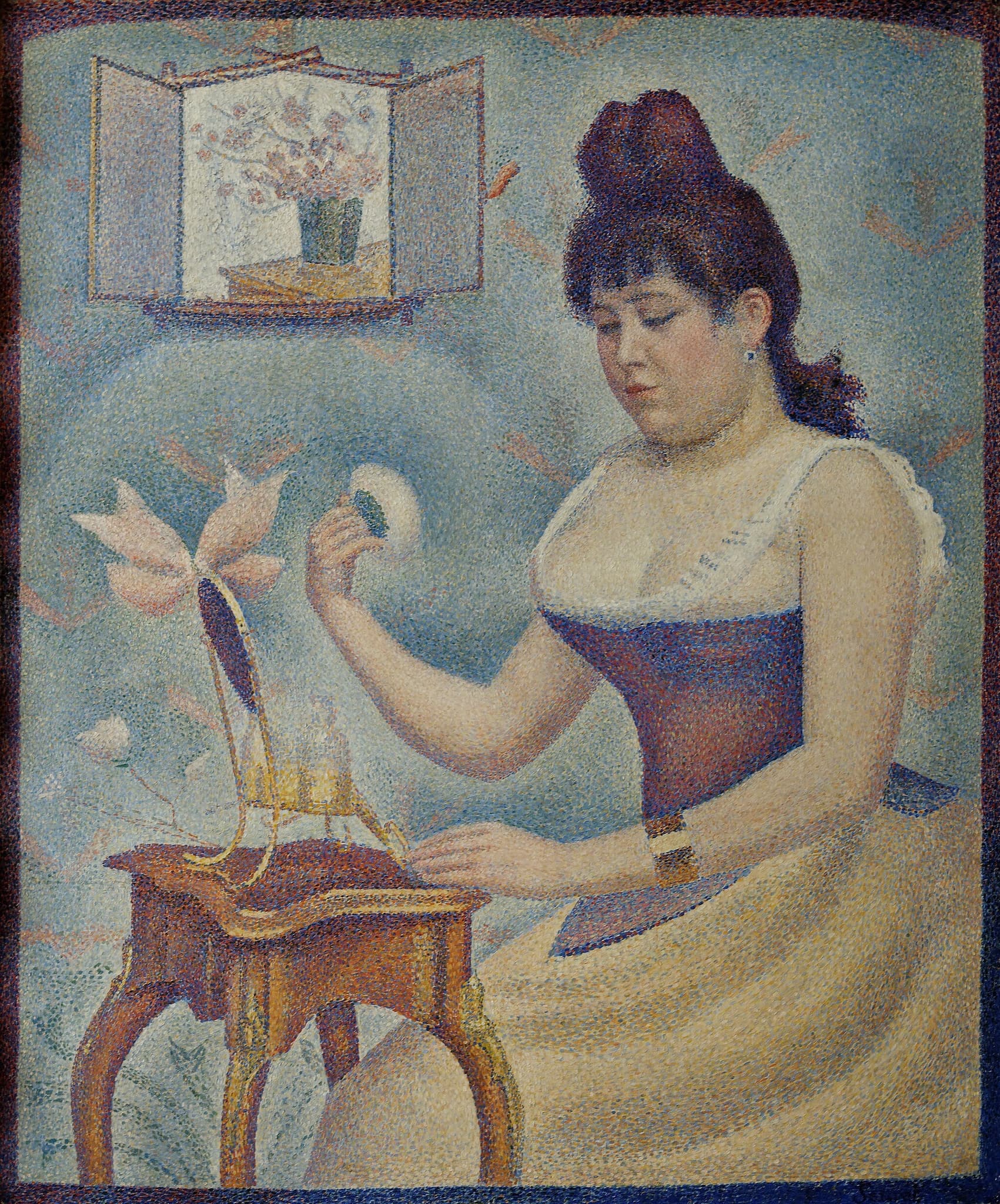
Young Woman Powdering Herself (Jeune femme se poudrant)
Georges Seurat, 1890 • Oil on canvas
Read full analysis of Young Woman Powdering Herself (Jeune femme se poudrant) →Valuation Analysis
Scope and object: This valuation addresses Georges Seurat's Young Woman Powdering Herself (Jeune femme se poudrant). Two autograph works with this title are publicly documented — a larger oil-on-canvas (c.1889–90) in the Courtauld Gallery, London, and a small oil-on-wood panel (1889) in the Museum of Fine Arts, Houston. The principal market estimate below targets the larger Courtauld canvas (ca. 95.5 × 79.5 cm) should it be offered; the smaller MFAH panel is materially less valuable and is discussed in comparative terms [1][3].
Method and comparables: The valuation is derived by comparing seller-relevant factors (size, subject, provenance, condition, exhibition history) against market anchors and recent realizations. The artist’s modern auction ceiling (Les Poseuses, Ensemble — petite version) established a headline benchmark at roughly $149.24M in 2022 and therefore sets an absolute market ceiling for top-tier Seurat oils, but that work is exceptional in scale, subject and rarity [2]. Typical Seurat oils and drawings that have sold publicly since 2022 have realized in the mid-six-figure to single-digit-million range; this stratification informs a mid‑range estimate of $10–40M for a museum-quality, large portrait/genre canvas with strong provenance and condition [4].
Provenance and market uplift: The Courtauld canvas benefits from a strong, documented chain (early ownership and exhibition by notable collectors and dealers, a recorded 1922 sale at the Kélékian sale to John Quinn, and acquisition by Samuel Courtauld), which materially raises market value versus anonymously provenanced works [1][5]. Provenance that ties directly to important modernist collectors and early exhibitions typically yields a premium because it reduces attribution risk and attracts institutional bidders.
Risks and modifiers: Key value drivers that could reduce the estimate are condition problems (heavy restoration, inpainting, or structural issues), weakened or interrupted provenance, or credible scholarly doubts about autograph status. Technical analysis (pigment, canvas weave, IRR/x‑ray) and confirmation in the principal Seurat catalogue raisonné would be required to secure the higher end of the range. If the work were reclassified as a studio piece, copy or later pastiche, market value would likely fall below $2M.
Recommendation: Given the Courtauld painting's documented pedigree, a well-executed market campaign—formal technical authentication, high‑quality catalogue entry, and a staged private sale or evening sale offering through a major house—would be the recommended route to achieve the top of the range. Absent confirmation of condition/attribution or if marketing to private collectors only, a conservative mid-range outcome is most likely. This valuation therefore places the Courtauld canvas at $10–40M (USD) conditional on the assumptions above; the MFAH small panel variant would typically be appraised significantly lower (mid-six‑figures to low millions) due to scale and market comparables [1][2][3][4][5].
Key Valuation Factors
Art Historical Significance
Medium ImpactSeurat’s corpus is dominated in public recognition by a handful of canonical large works; Young Woman Powdering Herself is not one of the movement’s headline, compositionally revolutionary canvases, but the Courtauld example dates to the artist’s mature pointillist period (c.1889–90) and illustrates Seurat’s portrait/genre practice. Its significance is therefore substantial for specialists studying Seurat’s late technique, palette and portrait idiom, but it ranks below multi-figure, large-scale masterworks in museum and market tiering. That places its art‑historical impact at a medium level — important to scholarship and worthy of museum display but unlikely to displace the market ceiling set by the artist’s rare masterpieces.
Provenance & Exhibition History
High ImpactThe Courtauld canvas enjoys a robust documented chain of ownership — early collectors, Félix Fénéon and Kélékian participation in the early 20th century, the 1922 public sale to John Quinn, and subsequent acquisition by Samuel Courtauld — plus museum institutionalization. This continuity materially reduces attribution risk and increases appeal to institutional buyers and major collectors. Works with this sort of demonstrable, prestigious provenance typically achieve a meaningful premium over comparable unattributed or privately circulated examples.
Condition & Technical Authentication
High ImpactCondition and technical authentication are decisive. A clean, stable original paint surface with minimal, well-documented conservation will support higher estimates; conversely, heavy restoration, significant overpainting, or structural weakness will reduce value sharply. Technical confirmation (pigment analysis, IRR, x‑ray and canvas/panel dating) that aligns with Seurat’s known materials and handling is required to secure upper‑range pricing and museum interest.
Market Comparables & Scarcity
High ImpactSeurat’s market is sharply stratified: a single exceptional work (Les Poseuses) set a headline record in 2022 that defines the ceiling, but most public sales since then have been for drawings, studies or small oils realized in the mid‑six‑figure to low‑seven‑figure range. Because high-quality Seurat canvases are rare on the market, a well-provenanced, large canvas can command a multiple‑million dollar price, but precise placement within a $10–40M band depends on condition, exhibition history and whether the work is accepted as an autograph in a principal raisonné.
Sale History
Kélékian sale, Paris (public auction)
Acquisition by Samuel Courtauld (private/dealer transfer)
Wildenstein & Co. (gallery sale) — MFAH panel
Georges Seurat's Market
Georges Seurat is a blue‑chip, highly collectible late‑19th‑century artist whose market is driven by extreme scarcity at the top end and steady collector/institutional interest across study-level works. The 2022 sale of Les Poseuses reset the artist’s auction ceiling and increased market attention, but most Seurat works that appear publicly since then have realized far lower sums (drawings and small oils typically trade in the mid‑six‑figure to single‑digit‑million range). Institutional demand for well‑provenanced, museum‑quality canvases remains robust and supports premium pricing for authenticated examples.
Comparable Sales
Les Poseuses, Ensemble (Petite version)
Georges Seurat
Artist's modern auction record and a museum-quality multi-figure Seurat from the same period; sets the market ceiling for top-tier Seurat oils.
$149.2M
2022, Christie's, New York
~$159.4M adjusted
Clowns et poney (drawing)
Georges Seurat
Recent public sale of a Seurat work on paper; illustrates realized demand and pricing in the low‑millions for small-format Seurat drawings/works on paper.
$4.8M
2025, Sotheby's, New York
Small Seurat oil (1886) — Sotheby's May 2025 lot
Georges Seurat
Small oil sold in a 2025 Modern sale; scale and format make it a practical comparator for the MFAH small panel (24.8 × 16.2 cm) or other Seurat studies that appear at auction.
$610K
2025, Sotheby's, New York
Young Woman Powdering Herself (Jeune femme se poudrant) — Kélékian sale (to John Quinn)
Georges Seurat
Historical public sale of the same Courtauld canvas (65,000 francs ≈ US$5,200 at the time). Valuable for provenance and chain-of-title but not directly indicative of modern prices.
$5K
1922, Kélékian sale, Paris (Jan 1922) — buyer: John Quinn
~$91K adjusted
Current Market Trends
Since the 2022 record, visibility for Seurat and Neo‑Impressionism has increased (major exhibitions and catalogues), but the market remains stratified: headline prices are set by a small number of masterpieces while the broader market for studies, drawings and small oils trades more modestly. Institutional loans and curated sales around exhibitions are currently the most effective way to maximize value.
Sources
- Courtauld Gallery — Young Woman Powdering Herself (object entry)
- Christie's feature — Les Poseuses (artist auction record context)
- Museum of Fine Arts, Houston — Young Woman Powdering Herself (object entry, small panel)
- Sotheby's — example sale listing (drawings / small works market context)
- Courtauld Collection publication (provenance and Kélékian 1922 sale reference)