How Much Is Castelfranco Madonna (Pala di Castelfranco) Worth?
Last updated: April 10, 2026
Quick Facts
- Methodology
- comparable analysis
No public-sale benchmark exists for the Castelfranco Madonna; it remains in situ and is effectively off‑market. If a clean, uncontested Giorgione altarpiece of this importance were legally transferable and in good condition, a defensible market range today is approximately $100–$150 million USD based on trophy Old‑Master comparables and scarcity premium.
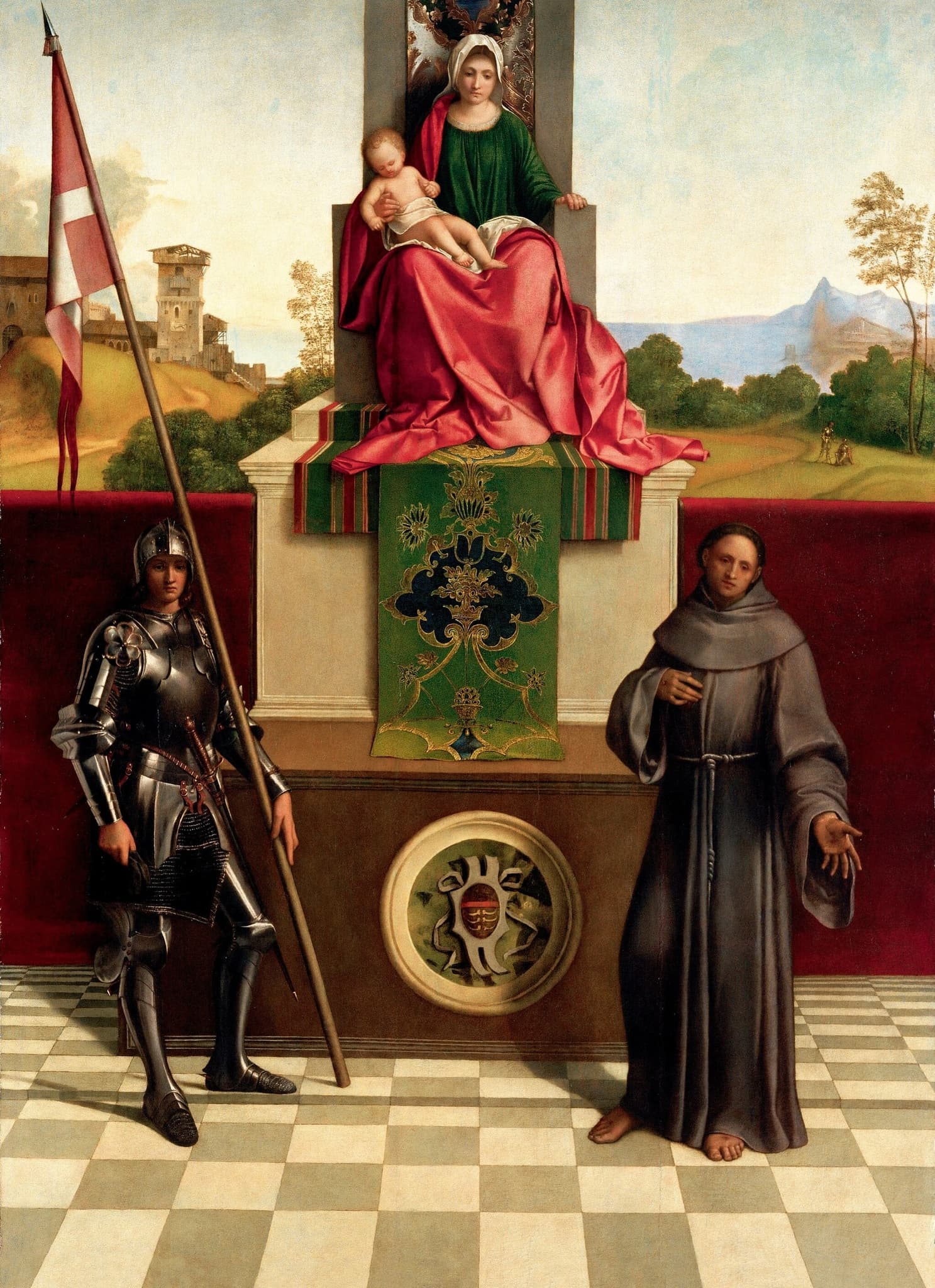
Castelfranco Madonna (Pala di Castelfranco)
Giorgione, 1504 • Oil on wood (panel)
Read full analysis of Castelfranco Madonna (Pala di Castelfranco) →Valuation Analysis
Working valuation: $100–$150 million USD (market‑theory estimate). This range is a market‑oriented, theoretical appraisal for the Castelfranco Madonna (Pala di Castelfranco) by Giorgione under the clear assumptions of an uncontested autograph attribution, a favourable conservation profile, and legal permissibility to transfer/export. The figure reflects scarcity of autograph Giorgione panels, trophy‑level Old Master comparables, and discounts for practical legal/heritage constraints.
The panel was painted for the Costanzo chapel and remains in situ in the Duomo of Castelfranco Veneto; it was stolen and later recovered in 1972 and subsequently conserved — custodial and conservation history are recorded in local sources and cathedral documentation [1]. Its continuous institutional custody strengthens provenance but also creates immediate legal and political hurdles to any commercial disposal.
Direct public‑sale benchmarks for securely attributed Giorgione paintings are effectively absent, so comparables must be drawn from high‑end Old Masters and trophy Renaissance panel sales. Exceptional single‑panel Renaissance trophies have produced prices ranging from the high tens of millions into the low hundreds of millions (some transactions are outliers). Those outcomes demonstrate the ceiling for uniquely important, well‑documented panels when institutions and deep‑pocketed private/sovereign buyers compete.
Two principal modifiers materially affect realizable value. First, Italian patrimony rules, diocesan ownership and likely public opposition would generally restrict export or sale; these constraints reduce the bidder universe and therefore the realizable price. Second, condition and conservation history (including post‑theft interventions and the 2000s restoration) need an up‑to‑date, fully documented condition report — unresolved structural or heavy overpaint issues would deduct meaningfully from market value.
Under those realities the lower bound of $100M represents a conservative trophy valuation reflecting likely legal friction or condition caveats, constrained buyer pools, and the risk that only domestic/museum purchasers could realistically acquire the work. The upper bound of $150M assumes clear legal pathway, unequivocal attribution, excellent conservation, and competitive bidding among major museums or sovereign/state collectors willing to pay a scarcity premium for a canonical Giorgione panel.
Market context supports a strong but conditional top end: the Old Masters segment retrenched in 2024 and partially rebounded in 2025 as a small number of trophy works and private acquisitions re‑established demand at the top of the market — that environment would favour higher realizations for a legitimately transferable Giorgione [2]. Practically speaking, given the Duomo’s custodial status, this valuation should be treated as a reasoned market exercise rather than an immediately actionable reserve price; refining it requires an on‑site conservation report, formal attribution confirmation from leading Giorgione specialists, and legal clearance from Italian cultural authorities and the diocesan owners.
Key Valuation Factors
Art Historical Significance
High ImpactThe Castelfranco Madonna is widely regarded as a major, early Giorgione altarpiece and a key work in the study of Venetian painting. Its role as an in‑situ devotional altarpiece and its frequent citation in scholarly literature give it exceptional cultural and curatorial value. This prominence places it in the top tier of Old Masters from which museums and national collections derive long‑term reputational benefit, and the cultural premium attached to such a work is a primary driver of the valuation. Exhibition history and sustained academic interest increase institutional willingness to pay a premium for acquisition or to intervene to keep the work in situ.
Rarity & Attribution Certainty
High ImpactSecurely attributed Giorgione panels are extraordinarily scarce on the market; many works in the artist’s circle are debated or assigned to followers. A confident, scholarly‑consensus attribution to Giorgione converts the piece from a market curiosity to a museum‑grade trophy, producing a substantial premium. Conversely, any attribution doubts (or a re‑classification as 'workshop' or 'circle') would reduce demand and value sharply. Because public‑sale price discovery for canonical Giorgione paintings is absent, the attribution premium is one of the single largest drivers of valuation uncertainty and upside potential.
Legal / Cultural‑heritage Constraints
High ImpactItalian cultural patrimony legislation, diocesan trusteeship and local/regional heritage protections create high legal barriers to export or commercial sale of historic altarpieces. Even where a sale is theoretically possible, permit processes, export licenses and political/public opposition can delay or prevent transfer and effectively shrink the pool of willing buyers to domestic institutions or buyers prepared to accept severe restrictions. These constraints reduce liquidity and typically lower the realizable price relative to an unconstrained international market price.
Condition, Conservation & Provenance
Medium-high ImpactThe painting’s post‑theft recovery and recorded restorations mean condition is a decisive factor. Panel stability, extent of overpainting, inpaint areas, and any structural repairs materially affect insurability and market confidence. A pristine technical condition and full conservation documentation will support values toward the upper bound; conversely, unresolved structural or visual restoration issues would necessitate a downward adjustment. Continuous provenance and stable diocesan custody strengthen title, but condition still governs marketability and final pricing.
Market Demand & Buyer Pool
High ImpactPotential buyers for a canonical Giorgione panel are few but deep‑pocketed: major museums, state/sovereign purchasers and a handful of ultra‑high‑net‑worth collectors. Competition among these buyers drives trophy pricing, but the actual buyer pool is constrained by export rules and institutional budgets. Market cycles in the Old Masters segment (recent volatility followed by selective appetite for trophy works) mean that timing and the auction/private‑sale vehicle would strongly influence final price realization.
Sale History
Castelfranco Madonna (Pala di Castelfranco) has never been sold at public auction.
Giorgione's Market
Giorgione occupies a paradoxical position: artistically central to the Venetian High Renaissance but commercially scarce. Secure autograph paintings are extremely rare and most canonical works reside in public collections; as a result, public auction benchmarks for Giorgione panels are effectively non‑existent and price discovery is limited. When an undisputed work of this caliber appears, it would attract intense museum and private interest and command a significant scarcity premium. Attribution debates and the small number of autograph works mean the market is driven more by scholarly consensus and institutional demand than by routine auction turnover.
Comparable Sales
Salvator Mundi
Leonardo da Vinci
Highest‑profile public sale of a Renaissance religious figure painting — sets an extreme market ceiling for single‑panel, museum‑grade Renaissance trophies and shows the upper bound of willing private/institutional demand.
$450.3M
2017, Christie's, New York (evening sale)
~$560.5M adjusted
Les Femmes d'Alger (Version O)
Pablo Picasso
Top‑tier modern trophy sale demonstrating market behaviour at the extreme high end (competitive bidding, institutional/private interest). Useful as a ceiling proxy for iconic, scarce works even if period differs from Giorgione.
$179.4M
2015, Christie's, New York (evening sale)
~$230.8M adjusted
Portrait of Dr. Gachet
Vincent van Gogh
A landmark, high‑value sale of a single‑figure masterpiece; shows how canonical artist portraits can command very large sums and provides a trophy‑sale precedent for valuation scaling.
$82.5M
1990, Christie's, New York
~$192.6M adjusted
The Card Players (reported private sale)
Paul Cézanne
One of the largest reported private‑market transactions — useful as a private‑sale ceiling for museum‑quality masterpieces when institutions/sovereign buyers compete.
$250.0M
2011, Private sale (widely reported; buyer: State of Qatar)
~$339.0M adjusted
Portrait of Adele Bloch‑Bauer I
Gustav Klimt
High‑value private/institutional sale of an iconic cultural masterpiece — a useful precedent for how institutions and private collectors value works with major provenance/exhibition profiles.
$135.0M
2006, Private sale (reported; buyer: Ronald Lauder)
~$204.3M adjusted
Current Market Trends
The Old Masters market experienced a pronounced contraction in 2024 followed by a partial rebound in 2025 driven by a small number of trophy works and private acquisitions. At the top end, scarcity and institutional demand remain decisive: well‑provenanced, securely attributed masterpieces continue to attract competitive bids. Market volatility persists below the trophy tier, but the environment for acquisition of singular Renaissance panels remains reasonably strong when clear title, condition and exportability are present.