How Much Is Il Tramonto (The Sunset) Worth?
Last updated: April 10, 2026
Quick Facts
- Methodology
- comparable analysis
Il Tramonto (The Sunset), NG6307, is held by the National Gallery and is materially compromised by loss and heavy restoration. Given the fragmentary autograph attribution and the painting’s museum ownership, a realistic hypothetical market range is approximately $2.0M–$8.0M; a full reattribution as an uncompromised Giorgione would instead place value in the tens of millions or higher.
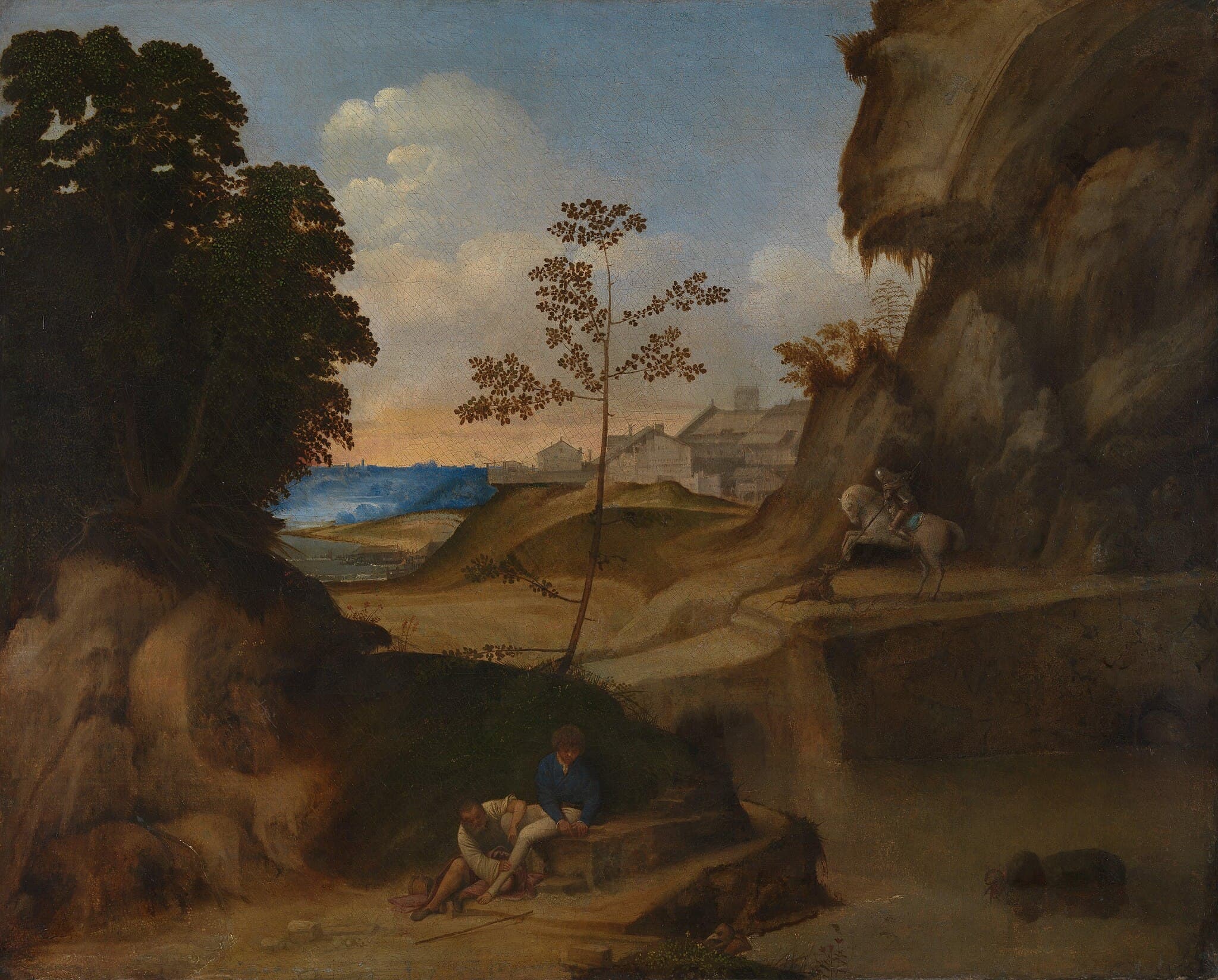
Il Tramonto (The Sunset)
Giorgione, 1505 • Oil on canvas
Read full analysis of Il Tramonto (The Sunset) →Valuation Analysis
Scope and working facts. This valuation applies to the picture catalogued at the National Gallery, London as Il Tramonto (The Sunset) (NG6307), rediscovered in the 1930s and acquired for the Gallery in 1961 [1]. The Gallery’s published technical and conservation material records substantial historic damage, overpainting and restoration; only discrete passages (distant landscape, certain foreground fragments) are confidently regarded as by Giorgione in the Gallery’s consensus account [2]. Those facts — public‑collection status, fragmentary autograph content and condition — dominate the market assessment.
Method and comparables. I used a comparable‑analysis framework that (a) assesses what a securely attributed, museum‑quality Giorgione might fetch on today’s market (inferred from headline Venetian Old Master sales and trophy Renaissance rediscoveries) and (b) discounts sharply for the attribution, condition and legal/marketability constraints specific to this object. High‑end Venetian auction results (Titian/Canaletto) show mid‑to‑high tens of millions for museum‑quality works and illustrate buyer appetite for blue‑chip Venetian names [3]. Those comps set a theoretical ceiling but are only relevant if the picture were an uncontested, well‑preserved Giorgione.
Why the selected range: $2.0M–$8.0M. The lower‑mid range reflects the dominant market reality: Il Tramonto is museum‑held and materially compromised by loss and overpaint; only fragments are autographed with confidence [2]. If hypothetically offered and legally transferable, a work in this state that carries partial autograph status would normally trade in the low millions to single‑digit millions — collectors and institutions price in restoration risk, attribution uncertainty and limited visual integrity. The top of the band ($8M) represents a stressed case in which a buyer with strong scholarly conviction and restoration capability accepts the attribution while still pricing heavy conservation risk and limited market liquidity.
Caveats and actions to refine value. This is a hypothetical, market‑facing estimate: the National Gallery’s ownership and UK export/cultural‑property constraints make actual sale improbable. Should new, published technical evidence or a clear scholarly reattribution emerge (supported by IRR, pigment analysis, dendrochronology or leading written expert opinions), the estimate would need upward revision — potentially into the tens of millions for an undisputed, well‑preserved autograph Giorgione. To materially tighten the band, obtain (1) complete technical reports, (2) up‑to‑date provenance documentation, and (3) formal written opinions from at least two leading Giorgione specialists and an Old Masters house specialist [1][2][3][4].
Key Valuation Factors
Art Historical Significance
High ImpactGiorgione’s oeuvre is tiny and each securely attributed work carries outsized scholarly and cultural value. Il Tramonto has demonstrable historical interest: it contributes to debates about Giorgione’s landscape development and early Venetian poetic painting. Its presence in the National Gallery enhances its provenance pedigree and academic visibility. However, significance does not automatically translate to high market price: museum‑grade importance raises institutional and insurance values but actual market realization depends on condition and attribution certainty. For this picture, the high art‑historical weight is offset by compromised material condition, leaving a net positive but moderated market influence.
Attribution Certainty
Medium ImpactAttribution is the single most determinative monetary factor. The Gallery accepts only fragments as confidently Giorgione, with other passages reattributed or heavily restored. In practice, partial autograph status reduces market bidders to a narrow specialist pool and increases due‑diligence requirements (technical analysis and written scholar endorsements). A firm, published reattribution to Giorgione would vault the picture’s value; conversely, sustained scholarly doubt or classification as 'workshop/after' would place it at the lower end of Old Master trade. The present medium impact reflects that attribution is contested but not wholly ruled out.
Condition / Conservation State
High ImpactThe painting’s extensive losses, overpainting and historic restorations materially depress market value. Buyers price not only current visual quality but the technical risk — irreversible losses, uncertain original paint survival and the prospect that invasive conservation may not recover autograph surface. Condition problems also complicate scientific attribution tests (stratigraphy distorted by inpainting). For Il Tramonto, condition is a high‑impact negative: it reduces competitive bidding, deters museum purchase offers, and forces potential buyers to factor significant conservation liability into any price they would pay.
Provenance & Legal Marketability
Medium ImpactProvenance is relatively strong in that the work has a traceable 20th‑century rediscovery, dealer custody and acceptance into a major public collection — all supportive of authenticity narratives. At the same time, National Gallery ownership effectively removes the object from the collectible market; even hypothetically transferable items in public collections face legal, ethical and export barriers. Provenance therefore supports scholarly value but reduces practical marketability, making provenance a medium‑impact factor that increases academic credibility yet limits transactional liquidity.
Market Liquidity & Comparable Sales
Medium ImpactSecure Giorgione autograph works are vanishingly rare and largely museum‑held, so direct auction comparables are absent. High‑profile Venetian and Old Master sales (Titian, Canaletto) signal robust demand for top quality, but those comps apply only to fully authenticated, well conserved works. For Il Tramonto, the market is specialist and cautious; contested attributions and poor condition reduce competitive bidding and place realistic sale potential in the low‑single‑digit millions unless new scholarship or restoration materially changes appearance and attribution.
Sale History
Private sale (Venice / dealer)
Exhibition loan
Private acquisition to National Gallery
Giorgione's Market
Giorgione occupies one of the most elite and academically contested positions in the market: the corpus is small, many works are museum‑held and authoritative attribution remains debated. These conditions create a market dynamic in which securely attributed Giorgiones command outsized attention and can be priced at the top of the Old Masters spectrum, while uncertain or workshop pictures sell only to specialist buyers at far lower levels. In short, scarcity and scholarly consensus — rather than frequent market activity — primarily determine Giorgione prices.
Comparable Sales
Rest on the Flight into Egypt
Titian
Securely attributed Venetian masterpiece sold at auction in 2024. Titian is Giorgione's near‑contemporary and market results for blue‑chip Venetian works set the high‑end context against which a securely attributed Giorgione would be judged.
$22.2M
2024, Christie's London
~$22.8M adjusted
Venice, the Return of the Bucintoro on Ascension Day
Canaletto
Record sale for a major Venetian‑school master in 2025. Demonstrates renewed strong collector demand for museum‑quality Venetian works and the ability of top Venetian names to drive mid‑to‑high tens of millions at auction—relevant as a market signal for Giorgione‑attributed material.
$44.0M
2025, Christie's London
Salvator Mundi
Leonardo da Vinci
Exceptional, high‑profile rediscovered Renaissance masterpiece that set the modern ceiling for Old‑Master trophy prices. Useful as a theoretical upper bound for what a unique, securely attributed Renaissance masterpiece could achieve in private/auction markets.
$450.3M
2017, Christie's New York
~$531.4M adjusted
Current Market Trends
Recent Old Masters market activity has shown renewed selective appetite for museum‑quality Venetian works; headline sales for Titian and Canaletto have lifted sentiment for well‑provenanced, clearly attributed examples. However, buyers remain conservative about contested attributions and damaged works. That selective market means Il Tramonto’s prospects depend more on scholarly reattribution or technical revelations than on broad market momentum.