How Much Is Pastoral Concert (Fête champêtre) Worth?
Last updated: April 10, 2026
Quick Facts
- Methodology
- comparable analysis
If offered on the open international market as a unanimously authenticated Giorgione, the Pastoral Concert would likely command between USD 150–450 million. Under realistic competitive conditions and with strong attribution/condition, a more probable realized band would be USD 200–350 million, subject to legal and provenance constraints.
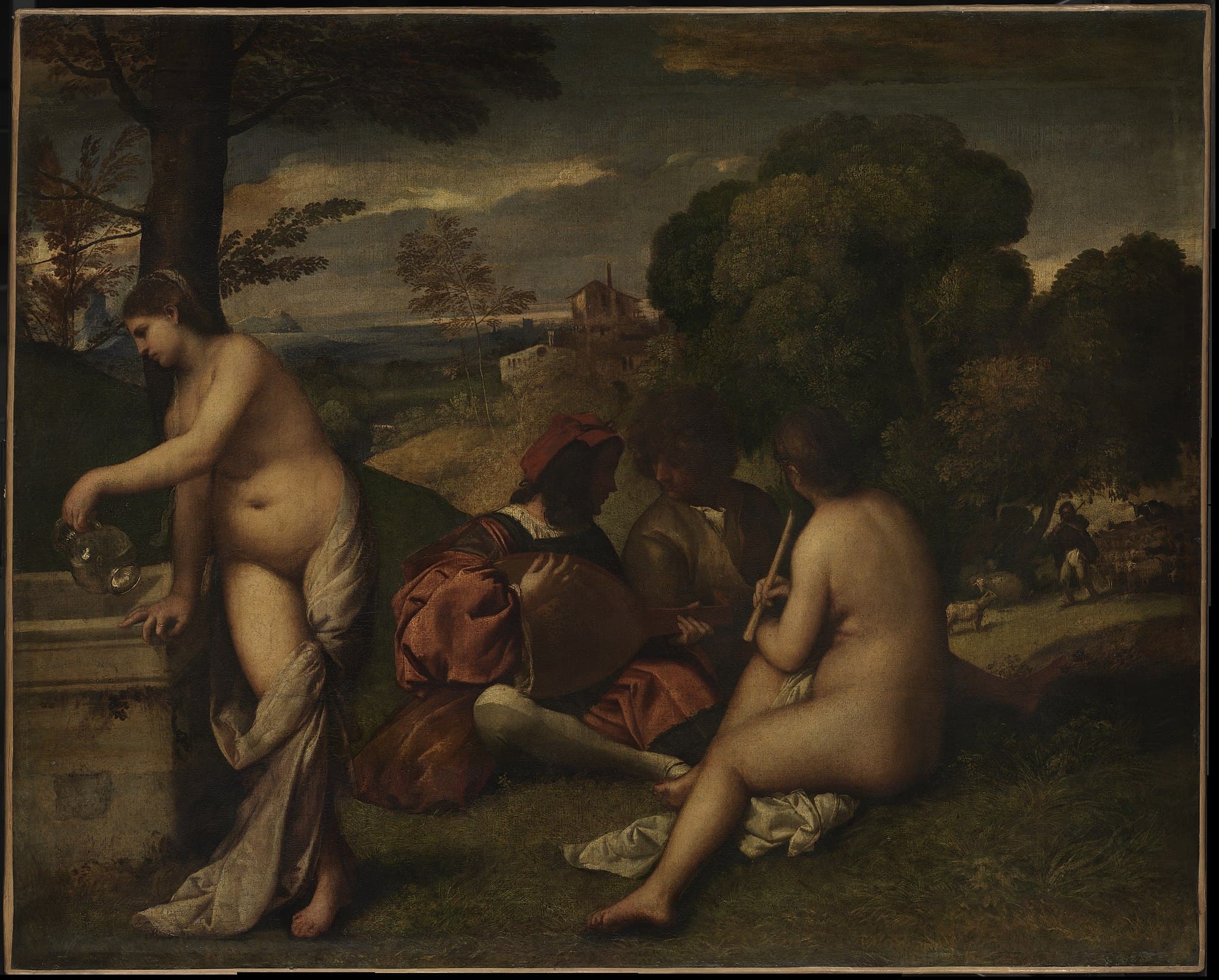
Pastoral Concert (Fête champêtre)
Giorgione, 1509 • Oil on canvas
Read full analysis of Pastoral Concert (Fête champêtre) →Valuation Analysis
Hypothetical market valuation: If the Pastoral Concert (Fête champêtre), the picture long associated with Giorgione and held by the Musée du Louvre, were to be offered on the open international market as an accepted autograph Giorgione, my reasoned market range is USD 150–450 million. This is a market valuation reflecting trophy‑level precedent for unique Renaissance masterpieces, adjusted for attribution uncertainty, museum ownership and export constraints, and condition considerations [1][2].
Upward drivers: The painting's canonical art‑historical status, long presence in high‑profile collections and outsized influence on later fête champêtre compositions create strong institutional and sovereign demand. Securely attributed Giorgione autographs are functionally absent from the open market, so supply scarcity would push competitive buying and permit pricing in the trophy band established by exceptional Renaissance sales [2]. Provenance clarity and high‑quality technical backing would further amplify buyer confidence and bidding intensity.
Downward/mitigating factors: Attribution is highly material. Many modern catalogues and scholarship situate the Louvre composition in the Titian/Giorgione sphere, and a reattribution to Titian, workshop or follower would change the buyer profile and price expectations substantially. Institutional ownership and French patrimonial rules make a practical sale unlikely; deaccessioning a Louvre masterpiece is rare and tightly regulated, which limits market liquidity and could constrain the realizable price even if a sale were negotiated [1][3]. Condition and restoration history also materially affect marketability.
Comparables and rationale: Because there are no recent public‑auction benchmarks for an uncontested Giorgione, valuation relies on a hybrid comparable approach. Public auction realizations for top Venetian Old Masters currently sit in the low tens of millions (a useful public‑market reference), while rare private or auction trophies of universally canonical Renaissance works have reached mid‑ to high‑hundreds of millions; Leonardo's Salvator Mundi establishes a contemporary ceiling that informs the upper bound of this band [2][4]. The broad USD 150–450M range therefore reflects a bifurcated market: routine public comps at one end and exceptional trophy outcomes at the other.
Practical expectation and caveats: If the work arrived on the market with unanimous technical confirmation of Giorgione authorship, excellent condition and clear exportability, a competitive sale would most likely cluster in the USD 200–350M band, with USD 450M as an extreme trophy ceiling. If attribution favored Titian the work would still be valuable but more likely to realize a lower, more conservative figure; workshop or follower attributions would materially reduce value. Final pricing would depend on confirmed attribution, conservation reports, provenance clearance and the chosen sale mechanism (public auction vs private treaty).
Next steps to refine: obtain the Louvre cataloguing and technical reports, full provenance and conservation documentation, and confidential market guidance from Old Master specialists at major houses to move from this reasoned range to a transaction‑specific appraisal.
Key Valuation Factors
Art Historical Significance
High ImpactThe Pastoral Concert is a canonical composition in early Venetian painting. Its poetic atmosphere, ambiguous iconography and compositional innovations have ensured continuous scholarly attention and public familiarity. That cumulative cultural authority creates a 'museum‑quality' premium: works with this level of historical resonance are trophy targets for major museums and sovereign collectors, who will often outbid conventional market multiples to secure them. The painting's symbolic and pedagogical prominence in art history raises its strategic value well above routine Old Master market expectations, making historical significance a primary upward driver of price.
Attribution Certainty
High ImpactAttribution is the single most price‑sensitive factor. The Louvre version has been variably ascribed to Giorgione, Titian or a collaborative atelier; a unanimous, technically corroborated attribution to Giorgione would expand the field of potential buyers and push estimates toward the top of the band. Conversely, a reattribution to Titian or to workshop/ follower status would materially alter the buyer pool and depress realizable value. Robust technical analysis (pigment studies, infrared/radiography, dendrochronology if applicable) and scholarly consensus are prerequisites for unlocking the high end of the valuation range.
Market Rarity and Demand
High ImpactGiorgione's securely accepted oeuvre is extremely small and rarely reaches the market. This acute supply scarcity concentrates demand within a limited set of institutions, foundations and ultra‑high‑net‑worth collectors prepared to compete aggressively for benchmark works. The lack of modern auction comparables for uncontested Giorgione canvases creates a supply‑driven premium and makes realized prices highly contingent on sale context and purchaser identity. Scarcity therefore drives potential for very high outcomes but increases volatility and dependency on private, trophy‑scale transactions.
Ownership and Legal Constraints
High ImpactCurrent institutional ownership (the Musée du Louvre) and national cultural patrimony rules are a major practical impediment to a market transaction. French deaccessioning and export controls make it unlikely that a Louvre masterpiece could be sold and exported freely; such political and legal friction reduces practical liquidity and may cap the realizable price relative to the theoretical market ceiling. Any confident valuation must be conditional upon confirmed legal freedom to sell and export, and the costs, time and risk associated with deaccessioning should be treated as value detractors.
Condition and Conservation
Medium ImpactCondition is a classical determinant for Old Masters. Centuries of varnish, overpainting and past restorations can obscure original paint and complicate attribution and visual impact. A documented conservation history and recent technical verification that confirms original paint and composition will sustain buyer confidence and preserve high estimates. Conversely, extensive restoration, structural issues or unstable surfaces will materially reduce competitive bids. Access to high‑resolution technical imagery and conservation reports is essential to convert a hypothetical range into a transaction‑level price.
Sale History
Pastoral Concert (Fête champêtre) has never been sold at public auction.
Giorgione's Market
Giorgione's market is defined by extreme scarcity and attributional instability. Only a small number of works are widely accepted as autograph and most reside in museum collections, producing very few modern market comparables. That scarcity elevates theoretical value for authenticated works but increases buyer caution and reduces liquidity. Many historically attributed Giorgiones are reattributed to Titian or workshop hands, so market outcomes depend heavily on technical confirmation and scholarly consensus. In practice, Giorgione behaves as a trophy/ institutional market segment rather than a regularly traded auction category.
Comparable Sales
Salvator Mundi
Leonardo da Vinci
Record Old‑Master trophy sale — establishes a realized modern ceiling for a unique, universally canonical Renaissance masterpiece; useful as an upper bound for trophy pricing of one‑off, uncontested masterpieces.
$450.3M
2017, Christie's New York
~$576.9M adjusted
Rest on the Flight into Egypt
Titian
High‑quality Venetian High‑Renaissance painting by Titian sold at public auction — a direct period/market comparable showing typical top‑end auction realizations for major Venetian works (public market), markedly below trophy‑sale ceilings.
$22.2M
2024, Christie's London
~$22.7M adjusted
The Card Players (one version, reported private sale)
Paul Cézanne
One of the largest reported private‑sale trophies in modern art — although cross‑period, it demonstrates buyer willingness to pay mid‑hundreds of millions for a single, canonical masterpiece; useful for sizing the trophy‑sale band that a securely attributed Giorgione could enter.
$250.0M
2011, Private sale (reported to Royal Family of Qatar, 2011)
~$349.0M adjusted
Portrait of Dr. Gachet
Vincent van Gogh
Canonical masterpiece sold at public auction (1990) — when inflation‑adjusted it sits in the high‑double to low‑hundreds of millions, illustrating how market perception and rarity can elevate a single famous work to the mid‑hundreds range.
$82.5M
1990, Christie's New York
~$198.2M adjusted
Current Market Trends
The Old Masters market has shown renewed institutional appetite for high‑quality Venetian works in recent seasons, with notable auction highs for Titian and an uptick in museum acquisitions. Demand is strongest for well‑provenanced, technically verified masterpieces; attribution and transferability remain the gating factors for Giorgione material. Overall, market sentiment is favorable for benchmark Venetian pieces, but practical liquidity for a Giorgione masterpiece is low without clear attribution and exportability.