How Much Is The Storm Worth?
Last updated: March 28, 2026
Quick Facts
- Methodology
- comparable analysis
Giorgione’s The Storm (La Tempesta) is a museum‑held, canonical masterpiece of the Venetian High Renaissance with no modern auction history. On a fully legal, open‑market basis, it would command $300–600 million, anchored by the top Old Master price tier and the work’s extreme rarity and art‑historical primacy. In practice it is Italian state cultural property and effectively inalienable.
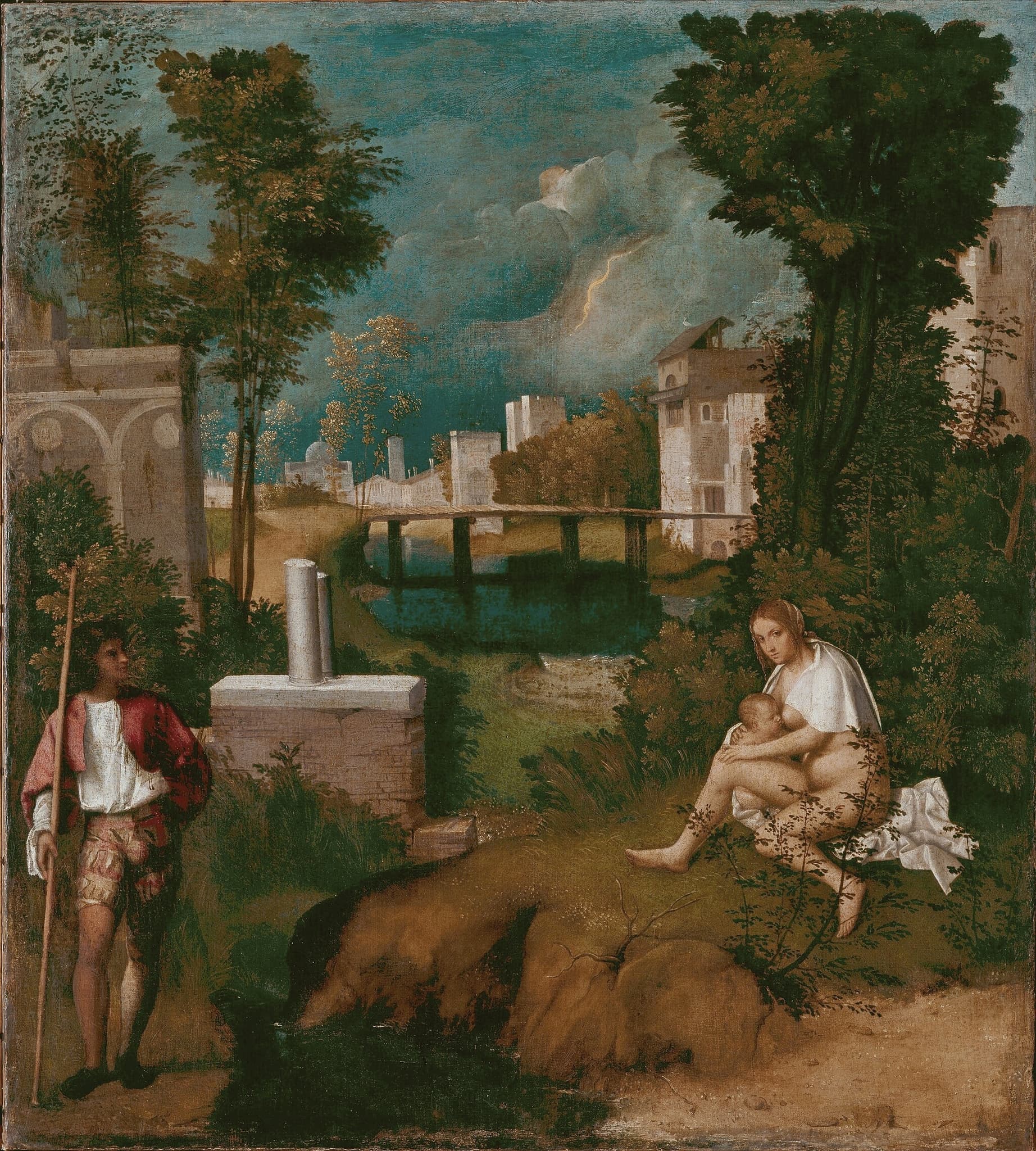
The Storm
Giorgione, c. 1505–1508 • Oil (with traces of tempera) on canvas
Read full analysis of The Storm →Valuation Analysis
Work: Giorgione, The Storm (La Tempesta), c. 1505–1508, oil on canvas, 82 × 73 cm; Gallerie dell’Accademia, Venice. The painting’s early provenance (recorded in 1530 in Gabriele Vendramin’s collection) and its status as a signature icon of Venetian painting are firmly established; it has been in the Accademia since the Italian state’s 1856 purchase [1][2].
Market context: There is no modern auction record for an undisputed Giorgione painting. Fewer than a dozen autograph works are widely accepted and virtually all reside in museums, making supply effectively zero and pushing any hypothetical pricing into the trophy tier where scarcity is decisive [3].
Comparable anchors: At the summit of Old Masters, Leonardo da Vinci’s Salvator Mundi realized $450.3m in 2017, setting the modern anchor for a canon‑defining Renaissance picture [4]. A recent high for Italian Renaissance portraiture—Sandro Botticelli’s Young Man Holding a Roundel—achieved $92.2m in 2021 [5]. The most relevant school comparables are Titian’s Venetian poesie, secured by UK museums at £50m (Diana and Actaeon) and £45m (Diana and Callisto) via private treaty [6][7]. Institutional capacity for best‑in‑class Old Masters is further evidenced by the Louvre/Rijksmuseum’s joint €160m acquisition of Rembrandt’s pendant portraits [8].
Valuation: The Storm is arguably Giorgione’s most famous painting and a foundational image in Western art—pioneering the poetic, landscape‑led mode that shaped Venetian painting. Given its extreme rarity, canonical status, and near‑total museum captivity, a fully transferable example of this caliber would price well above the Botticelli/Titian benchmarks and within striking distance of the category’s very top tier. A $300–600 million range reflects those anchors, weighted for Giorgione’s scarcity and art‑historical importance while acknowledging slightly lower mainstream name recognition than Leonardo.
Practical constraints and market positioning: As Italian state cultural property, the painting is effectively inalienable under the Code of Cultural Heritage; any sale/export is, for practical purposes, barred [9]. This legal reality makes the valuation theoretical but consistent with insurance‑style or indemnity frameworks for peer masterpieces. Current Old Master market data show resilience at the top end, with the category growing in 2025 even as other sectors softened, underscoring robust demand for truly canonical works when (hypothetically) available [10].
Key Valuation Factors
Art Historical Significance
High ImpactThe Storm is among the most influential images in Renaissance art and a keystone of the Venetian poetic mode (poesie). Its enigmatic subject, atmospheric landscape, and painterly handling represent a decisive shift from narrative clarity to lyrical evocation, making it a landmark in the evolution of landscape‑led painting. It is widely reproduced, taught, and written about, and stands alongside the Sleeping Venus, the Castelfranco Madonna, and the Three Philosophers as the apex of Giorgione’s output. As a signature masterpiece—arguably his most iconic—it commands a valuation premium comparable to the most celebrated pictures of the period.
Extreme Rarity and Market Supply
High ImpactFewer than a dozen autograph Giorgione works are widely accepted today, and essentially all are in museum collections. No undisputed Giorgione painting has traded at modern public auction, and even peripheral attributions surface only rarely. This near‑absolute scarcity eliminates conventional price discovery and shifts valuation into the trophy realm, where competition among museums, sovereign entities, and ultra‑high‑net‑worth collectors determines outcomes. In such a context, a universally accepted and canonical Giorgione would command a substantial scarcity premium over other major Old Masters that still appear occasionally on the market.
Comparative Benchmarks
High ImpactPricing is anchored to the top Old Master benchmarks: Leonardo’s Salvator Mundi at $450.3m (public sale), the Botticelli Roundel portrait at $92.2m, Titian’s poesie at £45–50m via private treaty, and the €160m joint institutional purchase of Rembrandt pendants. Against these, The Storm warrants a level well above Botticelli and Titian due to Giorgione’s extreme scarcity and the work’s canonical status, while below Leonardo, whose global name recognition is unparalleled. This matrix supports a $300–600 million range in an open, fully transferable scenario.
Ownership, Provenance, and Legal Status
High ImpactThe painting’s early documentation (in the Vendramin collection by 1530), historic passage through notable Venetian collections, and its 1856 state acquisition for the Gallerie dell’Accademia form an exemplary provenance that enhances confidence and value. At the same time, Italy’s cultural heritage laws render the work effectively inalienable and non‑exportable, making any sale theoretical. While that removes practical marketability, it does not diminish the hypothetical or insurance‑style valuation; if transfer were legally possible, bidding dynamics would likely be intense, influenced by museum‑level and sovereign buyers prepared to pay premium prices for national‑treasure‑grade works.
Sale History
The Storm has never been sold at public auction.
Giorgione's Market
Giorgione (Giorgio Barbarelli da Castelfranco, d. 1510) is one of the rarest and most coveted figures of the High Renaissance. His oeuvre is extraordinarily small, with fewer than a dozen widely accepted autograph works and almost complete museum captivity. As a result, there is no modern public auction record for an undisputed Giorgione painting; market references bearing his name are typically workshop, circle, or after, and therefore not valid pricing anchors for autograph masterpieces. Scholarship and institutional demand remain exceptionally strong, particularly for works defining the Venetian poetic and landscape tradition. In any hypothetical scenario where a prime Giorgione became transferable, pricing would be determined at the apex of the Old Master market, driven by scarcity, canonical status, and competition from top museums and sovereign buyers.
Comparable Sales
Salvator Mundi
Leonardo da Vinci
Ultimate Old Master price anchor; one of very few autograph Leonardos. Demonstrates what the market will pay for a canon-defining Renaissance painting with extreme rarity and global name recognition—useful upper bound for The Storm’s hypothetical value.
$450.3M
2017, Christie's New York
~$569.6M adjusted
Portrait of a Young Man Holding a Roundel
Sandro Botticelli
Top-tier Italian Renaissance master with strong brand recognition; a museum-caliber, autograph painting sold publicly and recently. Provides a modern, open-auction benchmark below Leonardo but well above most Old Masters—helpful as a ‘floor’ for a canonical, museum-grade Venetian work.
$92.2M
2021, Sotheby's New York
~$105.6M adjusted
Pendant portraits of Maerten Soolmans and Oopjen Coppit
Rembrandt van Rijn
Museum-level private-treaty benchmark for an undisputed Old Master trophy. Although Dutch Baroque (not Venetian), it shows what institutions/sovereign-level buyers will pay for canonical, best-of-category works with impeccable importance.
$180.0M
2016, Christie's Private Sales (joint acquisition by the Louvre and Rijksmuseum)
~$232.6M adjusted
Diana and Actaeon
Titian
Early 16th-century Venetian masterpiece intimately connected to Giorgione’s milieu; mythological poesia at the pinnacle of the Venetian High Renaissance. Strongest school/period analog, signaling what top Venetian pictures can command in institutional deals.
$71.0M
2009, Private treaty (National Gallery, London & National Galleries of Scotland)
~$102.6M adjusted
Diana and Callisto
Titian
Companion Venetian High Renaissance poesia to Diana and Actaeon. Offers a paired data point for prime Titian mythology—directly relevant to pricing a canonical Venetian work of near-absolute scarcity like Giorgione’s The Storm.
$71.7M
2012, Private treaty (National Gallery, London & National Galleries of Scotland)
~$96.8M adjusted
Current Market Trends
The Old Master category remains supply‑constrained and increasingly polarized: canonical, best‑in‑class works attract aggressive bidding and set records, while middling material is price‑sensitive. After a softer 2024, 2025 data showed renewed momentum, with Old Masters the only sector to post growth mid‑year, reflecting a flight to quality and historical blue‑chip names. Recent benchmarks—from Botticelli’s $92.2m portrait to institutional private‑treaty acquisitions of Titian and Rembrandt—demonstrate sustained capacity at the top of the market. In this context, a masterpiece of exceptional rarity and art‑historical weight like Giorgione’s The Storm would be positioned to command a price in the high hundreds of millions under open, transferable conditions.
Sources
- Gallerie dell’Accademia, Venice — The Tempest (La Tempesta)
- Smarthistory — Giorgione, The Tempest
- Wikipedia — Giorgione (overview of oeuvre and scarcity)
- Christie’s — Leonardo da Vinci, Salvator Mundi sells for $450.3m
- Sotheby’s — Botticelli Portrait of a Young Man Holding a Roundel achieves $92.2m
- National Gallery (UK) — Diana and Actaeon secured for the nation (£50m)
- National Gallery (UK) — Diana and Callisto secured (£45m)
- Center for Art Law — Joint Louvre/Rijksmuseum acquisition of Rembrandt pendants (€160m)
- UNESCO — Italy’s Code of Cultural Heritage (export/inalienability framework)
- Artnet — Mid‑Year Intelligence Report 2025 (Old Masters growth)