How Much Is The Three Philosophers Worth?
Last updated: April 10, 2026
Quick Facts
- Methodology
- comparable analysis
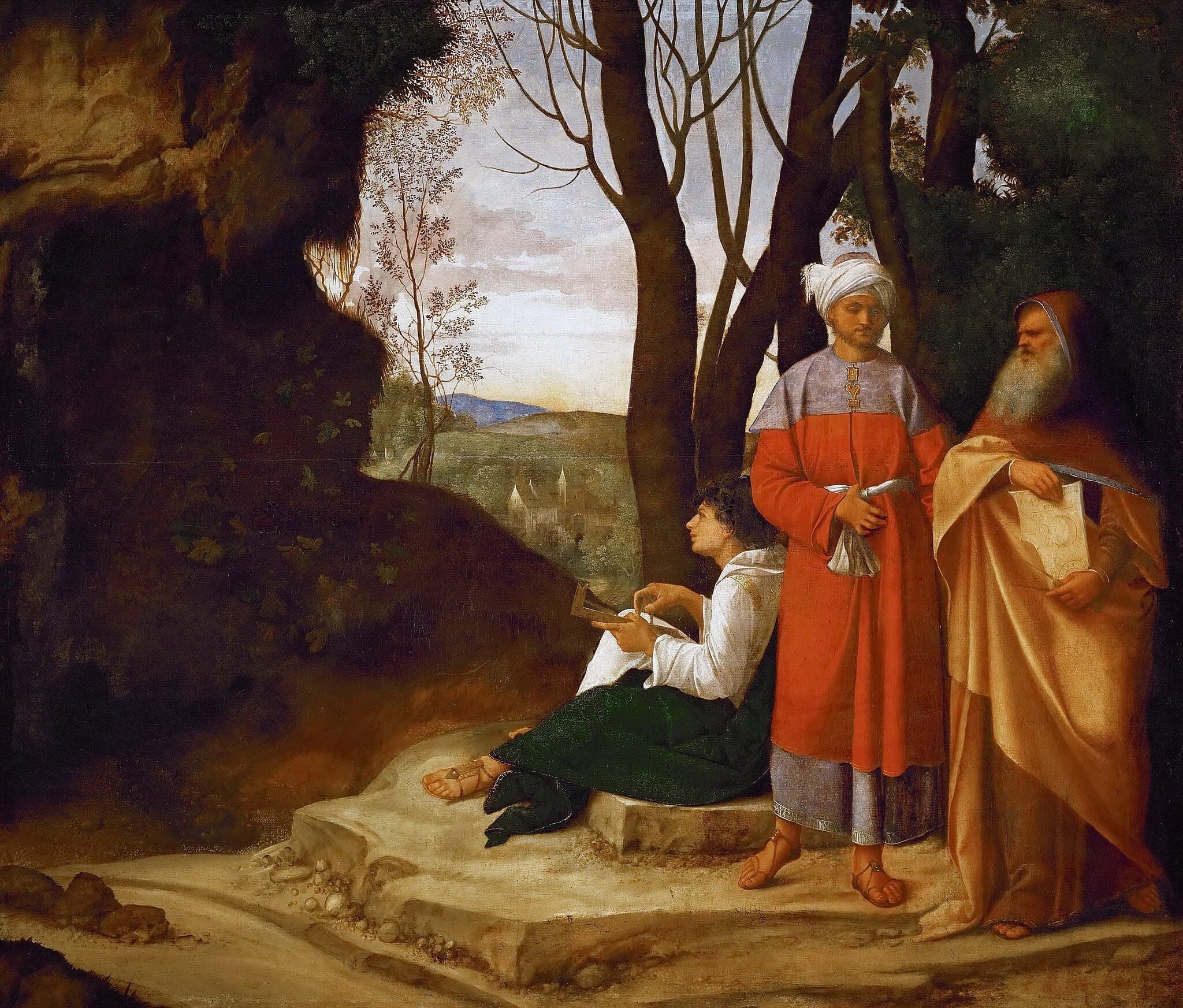
If securely accepted as an autograph Giorgione and offered on the private market to a deep‑pocket buyer or institution, The Three Philosophers would reasonably be valued at approximately $100–150 million. If attribution or condition is downgraded (workshop/follower or major restoration), market value would fall sharply into the single‑ to low‑double‑digit millions.
Valuation Analysis
Final valuation (private‑treaty hypothetical): $100–150 million. This band reflects a reasoned, conservative positioning for a museum‑quality, securely attributed Giorgione in private sale, derived by applying high‑quality Venetian and Old Master comparables, scarcity premia, and observed behavior of institutional and sovereign buyers [1][2]. The painting is effectively off‑market in public records (Kunsthistorisches Museum, Vienna), so any figure is theoretical until provenance, technical condition, and buyer interest are confirmed [1].
Why this range: undisputed Giorgione oil paintings are vanishingly rare and held predominantly by public collections, creating a pronounced scarcity premium. Because no modern public auction benchmark exists for an uncontested Giorgione oil, valuation must rely on proximate high‑end Venetian and Old Master precedents (Titian and other top Renaissance masters) and documented nine‑figure private purchases of irreplaceable masterworks. Recent high‑quality Venetian sales and an Old Masters market uptick provide context for a top‑tier private treaty figure in the low hundreds of millions under optimal conditions [2]. At the same time, documented public sales labelled “Giorgione” have been modest and/or limited to drawings, illustrating the practical absence of direct comparables and the attendant uncertainty [3].
Risk and scenario adjustments: the high end ($150M) assumes clear, consensus autograph attribution, strong technical reports (original paint, limited overpainting), unencumbered exportability, and competitive interest from multiple museums/sovereigns/collectors. The low end of the band ($100M) assumes a securely held attribution but conservatively reflects that museum objects rarely reach the open market and that private treaty pricing is typically lower than headline auction mania; extraordinary competition could push a price above $150M, while any downgrade to "workshop/follower" or discovery of heavy restoration would reduce value into the $5–40M band.
Practical caveats and next steps: this valuation is a working market opinion, not a formal appraisal. Material refinement requires access to the KHM provenance file and conservation/technical reports, consultation with leading Giorgione specialists, and canvassing Old Masters private‑sales desks at major auction houses for likely buyer interest and reserve guidance. Legal/patrimonial restrictions on major museum holdings in Austria also strongly limit real‑world liquidity, and therefore theoretical prices must be read against the practical unlikelihood of the painting being offered openly [1][4].
In short: $100–150M is an analytically defensible, conservative private‑market valuation for The Three Philosophers as a securely attributed Giorgione; deviations above or below that band depend almost entirely on attribution certainty, condition, provenance clarity and the competitive intensity of potential buyers.
Key Valuation Factors
Art Historical Significance
High ImpactThe Three Philosophers is widely treated in scholarship as one of Giorgione’s principal, enigmatic compositions and ranks with works such as La Tempesta and the Sleeping Venus in terms of historical and iconographic interest. Its status as a major, canonical composition means it has outstanding cultural value beyond mere market fungibility: museums and national collections regard it as irreplaceable. That status both elevates theoretical commercial value (because buyers prize rarity and narrative) and reduces market liquidity (museums seldom sell irreplaceable highlights). In short, outstanding art‑historical importance is a primary upward driver of value and also a practical constraint on saleability.
Attribution Certainty
High ImpactAttribution is the single biggest market lever for Giorgione. A confident, widely accepted autograph attribution (supported by technical imaging, pigment analysis and consensus among leading scholars) commands a large premium and puts the work in the tiny buyer universe willing to pay nine figures. Conversely, any credible downgrading to workshop, follower or collaborative execution would collapse the painting’s market standing and price expectations, typically into the single‑ to low‑double‑digit millions. Because Giorgione scholarship remains fluid and attributions are contested, robust technical and curatorial documentation is essential to sustain the top‑end estimate.
Provenance, Ownership & Legal Constraints
High ImpactThe work’s long Habsburg/imperial and Kunsthistorisches Museum provenance is a strong positive for authenticity and cultural importance, but its institutional ownership is simultaneously a major liquidity constraint. Museum possession typically means restrictions on export or sale, legal patrimony protections, and extremely low probability of a market offering. Even if a hypothetical sale were possible, potential buyers are mostly sovereigns, national museums or ultra‑wealthy collectors capable of political and financial negotiation, which narrows the buyer pool and makes realized prices contingent on exceptional circumstances rather than open‑market discovery.
Condition & Conservation History
Medium ImpactCondition and conservation history materially affect value. Stable original paint, minimal overpainting and a sound support favor the high end of the band; extensive restorations, consolidation issues or loss of original surface reduce both scholarly confidence and commercial desirability. Museums typically steward works to high conservation standards, but hidden issues revealed by X‑ray/infrared reflectography or pigment degradation can shorten the valuation range. A full technical report is required to convert a theoretical number into a market‑grade appraisal.
Market Scarcity & Buyer Universe
High ImpactUndisputed Giorgione oils are so scarce that supply is effectively zero on the open market; scarcity drives extreme premiums when a canonical work becomes available. Comparable pricing must therefore be extrapolated from the behaviour of buyers for top Venetian and Old Master masterpieces (Titian, Raphael, exceptional private treaty purchases). The buyer universe for nine‑figure lots is narrow — national museums, sovereign funds and a handful of ultra‑high‑net‑worth collectors — and transactions are typically negotiated privately, making realized prices highly contingent on competitive bidding and institutional willingness to pay.
Sale History
The Three Philosophers has never been sold at public auction.
Giorgione's Market
Giorgione occupies an exceptional position in the Old Masters market: artistically canonical but commercially rare. Secure autograph oil paintings attributed to Giorgione are almost entirely museum‑held, producing no modern public‑sale benchmark. Public auction results carrying the Giorgione name are generally drawings or disputed attributions and fetch modest sums, which forces appraisers to model values from high‑quality Venetian and Old Master precedents. The net effect: very high theoretical valuations for uncontested autographs, substantial attribution risk, and a tiny, specialized buyer universe.
Comparable Sales
Rest on the Flight into Egypt
Titian (Tiziano Vecellio)
Securely attributed Venetian High‑Renaissance masterwork sold at public auction in 2024; close period/style (Venetian school) and museum quality make it a useful market proxy for demand in top‑tier Venetian paintings—shows that a high‑quality Venetian painting can clear the tens of millions at auction.
$22.1M
2024, Christie's London
~$22.8M adjusted
Salvator Mundi
Leonardo da Vinci
Extraordinary outlier and the modern market ceiling for a single Old Master painting; not stylistically or regionally comparable but demonstrates the extreme upper bound that a unique, heavily contested masterpiece can reach when deep‑pocket buyers and intense competition converge.
$450.3M
2017, Christie's New York
~$576.4M adjusted
Portrait of Adele Bloch‑Bauer I
Gustav Klimt
Nine‑figure purchase of a single, museum‑calibre work by a deep‑pocket buyer/institution; while 20th‑century rather than Renaissance, it is a directly relevant precedent for the scale institutions/collectors will pay for an irreplaceable masterpiece with a compelling provenance/exhibition narrative.
$135.0M
2006, Private sale / Neue Galerie (Ronald Lauder)
~$210.6M adjusted
Portrait of Dr. Gachet
Vincent van Gogh
Another nine‑figure example for a single iconic painting sold to a deep‑pocket buyer; not an Old Master but useful to illustrate the buyer profile and price band that an undisputed, museum‑quality masterpiece can attract.
$82.5M
1990, Christie's (noted public sale)
~$198.8M adjusted
Red‑chalk drawing (attributed to Giorgione)
Giorgione (attributed)
Actual public‑sale result carrying the Giorgione name (drawing, 2005) — a modest realization in the low six figures. Highlights the empirical problem: public auction evidence for Giorgione in oils is essentially non‑existent, so valuation must rely on cross‑category proxies and private‑treaty theory.
$270K
2005, Christie's London (drawing)
~$434K adjusted
Current Market Trends
The Old Masters market saw a selective recovery in 2024–2025 led by high‑quality, museum‑grade works; demand for Venetian Renaissance paintings strengthened following notable Titian results and blockbuster loans/exhibitions. That environment supports elevated private treaty pricing for exceptional works, but attribution scrutiny and provenance remain decisive gatekeepers for top prices.
Sources
- Google Arts & Culture — The Three Philosophers (Giorgione) / Kunsthistorisches Museum
- Artnet News — Titian sale and Venetian market context (2024)
- Christie's — example Giorgione‑attributed red‑chalk drawing (public sale record example)
- Observer / ArtTactic reporting on Old Masters market recovery (2025–2026 coverage)