How Much Is The Floor Scrapers Worth?
Last updated: January 20, 2026
Quick Facts
- Methodology
- comparable analysis
The Floor Scrapers (1875) is a canonical Caillebotte and one of the defining images of modern Parisian life, held by the Musée d’Orsay. Benchmarking against the artist’s $53.03m auction record and a €43m museum acquisition for another masterpiece, we estimate a hypothetical open‑market value of $90–130 million. If ever saleable, it would almost certainly set a new artist record.
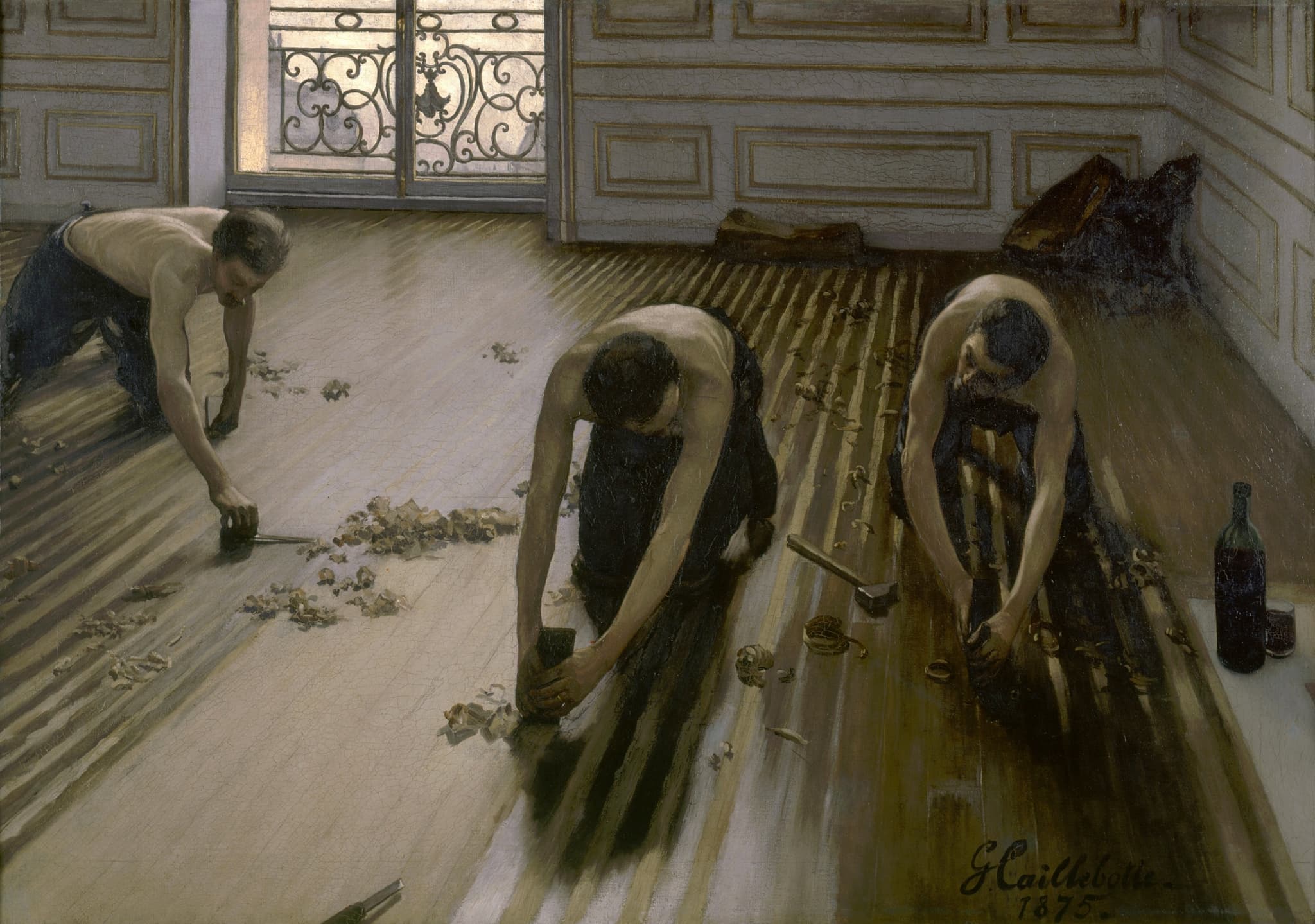
The Floor Scrapers
Gustave Caillebotte, 1875 • Oil on canvas
Read full analysis of The Floor Scrapers →Valuation Analysis
Final estimate: $90–130 million (hypothetical open‑market value). Gustave Caillebotte’s The Floor Scrapers (Les Raboteurs de parquet, 1875) is a cornerstone of the artist’s oeuvre and a key image in the story of modern urban realism, owned by the Musée d’Orsay. As a work in a French national collection, it is legally inalienable; this valuation reflects what the painting would command in an unrestricted international sale under optimal conditions (excellent condition, clear title, full global marketing) [1][4].
Method and anchors. We benchmark this estimate to two hard price signals and then apply a masterpiece premium. First, Caillebotte’s current auction record is $53.03 million for Young Man at His Window (1876; Christie’s New York, 2021), acquired by the J. Paul Getty Museum—evidence of deep institutional demand for top‑tier, mid‑1870s figural interiors [2]. Second, the Musée d’Orsay’s acquisition of Boating Party (La Partie de bateau) at €43 million in 2022 provides a private, institutional yardstick for a masterpiece‑level Caillebotte, further underscoring scarcity and willingness to pay at the highest level [3]. Given The Floor Scrapers’ superior canonical status, breakthrough subject, and scale (102 × 147 cm), a substantial premium to the $53m auction record is justified [1].
Why this work commands the premium. The Floor Scrapers is widely regarded as one of Caillebotte’s defining statements—rejected by the Salon and exhibited with the Impressionists in 1876, it reframed modern Paris by dignifying urban labor through radical viewpoint, cropping, and light. It is reproduced in virtually every survey of the artist, has a strong loan and publication record, and sits at the center of recent scholarly reassessments of Caillebotte’s modern‑life project [1][5]. While a related 1876 variant exists, the 1875 Orsay canvas is the prime, canonical version [5]. Within Caillebotte’s market, subject quality, art‑historical weight, and scale drive outsized competition; this picture unites those attributes at the highest level.
Positioning versus peers and market conditions. At the top end of late‑19th‑century painting, true icons continue to attract global, institution‑caliber competition. Compared with the 2021 record interior and the €43m museum purchase, The Floor Scrapers should clear these benchmarks decisively under ideal sale mechanics (competitive guarantee, international touring, and top‑tier scholarship). The indicated $90–130 million range reflects both the artist’s recalibrated ceiling and cross‑artist pricing for modern‑life icons by leading Impressionist‑era masters [2][3].
Notes. This valuation presumes excellent material condition; undisclosed structural or condition issues would compress the range, while pristine condition and peak market timing could bias results to the upper band. Legal inalienability means this is a theoretical fair‑market indication rather than a trading level [4].
Key Valuation Factors
Art Historical Significance
High ImpactThe Floor Scrapers is a breakthrough depiction of modern Parisian labor and among Caillebotte’s most reproduced images. Rejected by the Salon and then shown with the Impressionists, it helped redefine acceptable modern subjects and pictorial strategies (radical cropping, floor‑level vantage, natural light across polished parquet). Its centrality to scholarship, teaching, and exhibitions places it in the top tier of the artist’s oeuvre, often ranked alongside Paris Street, Rainy Day and Pont de l’Europe. That degree of canonical status commands a substantial premium over even excellent works by the artist that lack this singular historical importance.
Rarity and Institutional Caliber
High ImpactMasterpiece‑level Caillebottes seldom reach the market; top examples have increasingly moved to museums. The Musée d’Orsay’s €43m acquisition of Boating Party and the Getty’s purchase of Young Man at His Window at $53m underscore both scarcity and institutional appetite for the best mid‑1870s works. The Floor Scrapers is held by a national museum—effectively removing it from supply—which typically magnifies hypothetical market demand in the event of any opportunity to acquire or exchange. This rarity and institutional validation underpin a valuation well above the artist’s last public record.
Subject, Scale, and Composition
High ImpactLarge‑scale, fully worked figural interiors from the mid‑1870s are the sweet spot of Caillebotte’s market. At roughly 102 × 147 cm, The Floor Scrapers has the presence of a museum centerpiece. The intense, choreographed depiction of three workers, the sheen and geometry of the parquet, and the modern apartment setting create a visually and intellectually powerful composition. This aligns squarely with what top collectors and institutions prioritize: ambitious subjects that encapsulate the artist’s key innovations and the spirit of modern Paris.
Market Benchmarks and Competitive Demand
High ImpactThe artist’s current auction ceiling ($53.03m, 2021) and the Orsay’s €43m private acquisition provide firm anchors below which this work would not logically trade in an unrestricted sale. Given The Floor Scrapers’ greater fame and art‑historical weight, a substantial premium is warranted. In today’s selective but competitive trophy market, such a universally recognized image would attract cross‑category buyers and institutions, making a nine‑figure outcome credible, especially with strong marketing, a financial guarantee, and favorable macro sentiment.
Sale History
Hôtel Drouot, Paris
Offered in a mixed sale; marked 'repris par l’artiste' (bought-in/withdrawn); no sale recorded.
Gustave Caillebotte's Market
Gustave Caillebotte’s market has strengthened markedly over the past decade as scholarship and major exhibitions have elevated his standing alongside the most important Impressionist‑era innovators. Supply is inherently limited, with many leading works in museums. The artist’s auction record stands at $53.03 million (Christie’s New York, 2021, Young Man at His Window, acquired by the Getty), while the Musée d’Orsay’s 2022 acquisition of Boating Party at €43 million set a private, institutional benchmark. Demand is deepest for large, fully worked modern‑life interiors and top river/boating scenes from the mid‑to‑late 1870s. Market depth is thinner than Monet or Renoir, but the very best subjects now command intense competition.
Comparable Sales
Young Man at His Window
Gustave Caillebotte
Same artist; museum‑quality figural interior from the mid‑1870s, closest recent market ceiling for Caillebotte.
$53.0M
2021, Christie's New York
~$61.0M adjusted
Chemin montant (Rising Road)
Gustave Caillebotte
Same artist; major, fully worked composition sold on the open market, establishing pre‑2021 pricing for high‑tier Caillebottes.
$22.1M
2019, Christie's London
~$27.2M adjusted
Un Balcon, Boulevard Haussmann
Gustave Caillebotte
Same artist; urban Paris modern‑life subject. Useful for calibrating demand for strong, non‑masterpiece works in today’s market.
$3.0M
2025, Christie's Paris
The Boulevard Montmartre on a Spring Morning
Camille Pissarro
Iconic Impressionist modern‑life urban scene; high auction benchmark for a peer artist, helpful cross‑artist yardstick for an urban‑modern masterpiece.
$32.1M
2014, Sotheby's London
~$42.7M adjusted
Jeanne (Spring)
Édouard Manet
Top‑tier, canonical modern‑life figure by a leading Impressionist‑era master; anchors the upper bound of pricing for late‑19th‑century icons.
$65.1M
2014, Christie's New York
~$86.6M adjusted
Current Market Trends
At the trophy end of Impressionist and late‑19th‑century art, demand remains robust and selective, with buyers concentrating capital on singular, museum‑level works. Auction records and high‑profile institutional acquisitions since 2021 show sustained willingness to pay for canonical images with strong provenance and exhibition histories. While mid‑tier material has faced more disciplined bidding in recent seasons, scarcity of top masterpieces continues to support strong outcomes when quality and marketing align. In this context, an icon like The Floor Scrapers would likely draw cross‑category interest, broad international bidding, and competitive guarantees, supporting a nine‑figure valuation.
Sources
- Musée d’Orsay – Les Raboteurs de parquet (The Floor Scrapers) collection entry
- The Art Newspaper – Christie’s sells Caillebotte’s 'Young Man at His Window' for $53m (Getty purchase), Nov 2021
- Associated Press – Musée d’Orsay acquires Caillebotte’s 'Boating Party' for €43m (LVMH funding), 2022
- Legifrance – Code du patrimoine (inalienability of public collections)
- National Gallery of Art – Gustave Caillebotte: The Painter’s Eye (exhibition overview)