How Much Is At the Moulin Rouge: The Dance Worth?
Last updated: March 30, 2026
Quick Facts
- Methodology
- comparable analysis
At the Moulin Rouge: The Dance (c.1889–1890) is a large, museum‑quality oil by Henri de Toulouse‑Lautrec in the Philadelphia Museum of Art. If offered as an uncontested autograph oil in good condition with full provenance and catalogue‑raisonné acceptance, a reasoned market range is approximately USD 8–30 million; final placement depends on condition, exhibition history and sale context.
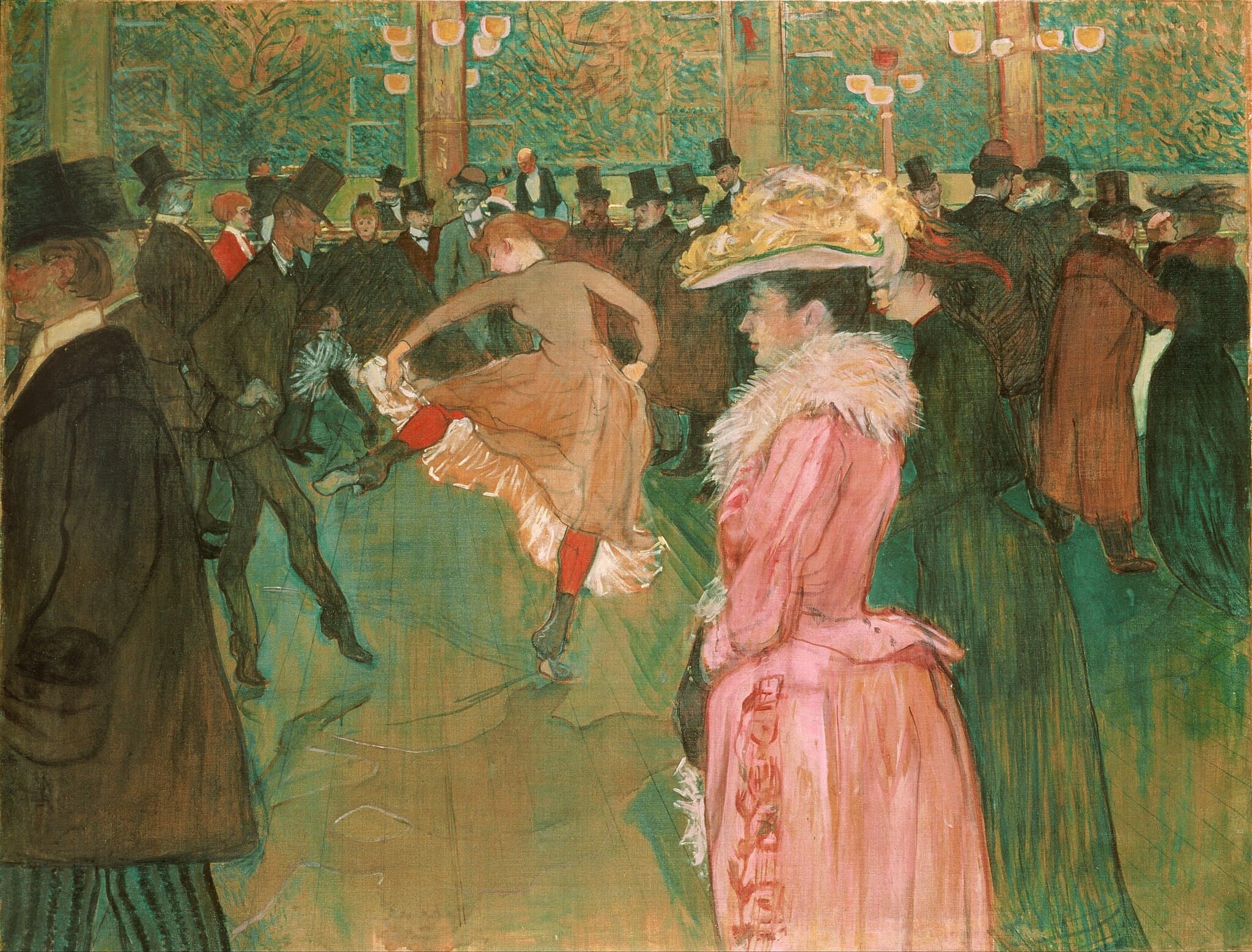
At the Moulin Rouge: The Dance
Henri de Toulouse-Lautrec • Oil on canvas
Read full analysis of At the Moulin Rouge: The Dance →Valuation Analysis
At the Moulin Rouge: The Dance is a canonical Moulin Rouge oil by Toulouse‑Lautrec now in the Philadelphia Museum of Art’s Henry P. McIlhenny collection (accession 1986‑26‑32). The work’s scale, subject and documented early association with the club place it among the artist’s most marketable cabaret canvases and justify treatment as a top‑tier oil rather than a study or sheet [1].
My valuation follows a comparable‑analysis approach. Public sales for large, museum‑quality Lautrec oils are rare but instructive: the artist’s auction record, La Blanchisseuse, sold at Christie’s New York in 2005 for roughly USD 22.4M and remains a high‑water benchmark for premium oils [2]. More recent examples demonstrate a tiered market: Pierreuse (Christie’s New York, 2020) realized about USD 9.06M and represents a strong mid‑range anchor for late‑1880s oils [3]; a maison‑close composition, Au lit: Le baiser, achieved mid‑to‑high single‑digit/low‑double‑digit millions when offered by Sotheby’s, showing appetite for exhibition‑ready subject works with provenance [4]. High‑profile drawings and preparatory works (e.g., Jane Avril at Christie’s Paris, 2025) indicate continued collector demand for canonical Moulin Rouge imagery even when medium differs, which supports pricing power for authentic large oils tied to that iconography [5]. Taken together, these comparables support a realistic market band for a well‑provenanced, authenticated Lautrec Moulin Rouge oil in the region of USD 8–30M.
Key value drivers that would move a result within this band are condition and conservation history (structural or heavy restorations can materially reduce buyer confidence), catalogue‑raisonné acceptance and completeness of provenance (gaps or disputes lower liquidity), and pre‑sale context (major evening sale with exhibition tie‑ins and institutional interest versus private treaty). The painting’s institutional provenance and exhibition record are significant positives and would likely attract competitive bidding if legitimately placed on the market [1].
Countervailing risks include museum deaccession restrictions, potential export constraints, or any unresolved attribution/technical questions — any of which could require sale by private treaty or reduce the competitive auction dynamic and push value toward the lower end of the band. Market timing also matters: the market has become more selective at the very top end since 2022, so exceptional presentation, scholarly backing and targeted marketing will be necessary to maximize realization [2][5].
In summary, for a fully authenticated, well‑conserved, museum‑quality autograph oil with complete provenance and catalogue‑raisonné citation, I place the reasoned market estimate at USD 8–30 million
Key Valuation Factors
Art Historical Significance
High ImpactThis painting represents one of Toulouse‑Lautrec’s central subject groups—the Moulin Rouge cabaret scenes that define his public reputation. As a large oil from c.1889–1890 capturing club life, it functions as both a documentary record of Belle Époque entertainment culture and a mature expression of Lautrec’s palette, composition and figure handling. Because Moulin Rouge canvases are culturally emblematic and readily recognized by museums and informed collectors, the piece carries a built‑in premium relative to ordinary portraits or undistinguished studies. Its importance in the artist’s oeuvre directly supports a higher market position and strong institutional interest in acquisitions or loans.
Provenance & Exhibition History
High ImpactProvenance materially strengthens this work’s marketability. Documentary links to the Moulin Rouge’s ownership and early display above the club bar, subsequent passage through notable dealer/collector hands, and final inclusion in the Henry P. McIlhenny gift to the Philadelphia Museum of Art provide a continuous provenance chain that substantially reduces title and authenticity risk. Works with sustained exhibition histories and institutional custody are judged more favorably by buyers and insurers; this painting’s museum accession and public record significantly elevate bidder confidence and support pricing toward the upper portion of the valuation band.
Rarity & Market Scarcity
High ImpactLarge, autograph Toulouse‑Lautrec oils of iconic cabaret scenes are infrequently offered in the secondary market because many are already held in major museums or prominent private collections. Scarcity concentrates collector demand when a qualifying canvas appears, creating competitive bidding and the potential for outsized results relative to more common works on paper. This scarcity effect is a central rationale for the painting’s multi‑million dollar band: when supply is limited and provenance/exhibition pedigree is strong, prices tend to reflect that imbalance.
Condition & Conservation
Medium ImpactCondition has a direct, quantifiable effect on value. Structural issues (split or weakened support, heavy relining), extensive overpainting, disfiguring inpaint or unstable varnish can all reduce realized price substantially. While a well‑conserved canvas retains premium value, significant interventions or unresolved conservation problems introduce buyer uncertainty and can shift comparable bids downward. A professional condition report, including any restoration history and technical imaging, is therefore essential to support the high end of the estimate and to set an appropriate reserve.
Market Comparables & Timing
High ImpactComparable auction results establish the frame for valuation: high‑quality oils have realised mid‑single to low‑double‑digit millions (e.g., Pierreuse c. USD 9.06M; La Blanchisseuse USD 22.4M) while smaller or less iconic works fetch less. Timing, sale format and house choice (major evening sale with institutional marketing versus a private treaty) will move a final price within the band. In the current selective market environment, careful placement—ideally with exhibition backing—will be a decisive factor in achieving the high end of the estimate.
Sale History
At the Moulin Rouge: The Dance has never been sold at public auction.
Henri de Toulouse-Lautrec's Market
Henri de Toulouse‑Lautrec occupies a canonical position in the late‑19th‑century French market. His posters, prints and drawings are highly collectible and frequently offered; however, authentic large oils are comparatively scarce and therefore command disproportionate attention when they reach the market. Auction records show a tiered market: prints and drawings trade in mid‑to‑low six figures up to a few million for rarities, whereas museum‑quality oils can achieve mid‑single to low‑double‑digit millions depending on subject, size and provenance. Institutional demand and exhibition history drive premium pricing for top examples.
Comparable Sales
La Blanchisseuse (The Laundress)
Henri de Toulouse-Lautrec
Large, museum-quality oil by Lautrec and the artist's auction record — a top-tier benchmark for late-19th-century Lautrec paintings.
$22.4M
2005, Christie's New York
~$34.7M adjusted
Pierreuse
Henri de Toulouse-Lautrec
Late-1880s oil sold in a major evening sale; similar period and medium — useful as a mid-to-high single-digit/low-double-digit million anchor for museum-quality oils.
$9.1M
2020, Christie's New York
~$10.7M adjusted
La femme tatouée (The Tattooed Woman)
Henri de Toulouse-Lautrec
Recent sale (2024) of a late-figure oil — lower realized price reflecting smaller scale/less iconic subject; useful as a lower-bound comparable within the market for Lautrec oils.
$2.9M
2024, Christie's London
~$3.0M adjusted
Au lit: Le baiser (In Bed: The Kiss)
Henri de Toulouse-Lautrec
Iconic maison-close/bedroom composition that sold mid-teens USD — a strong precedent for high-quality, exhibition-ready Lautrec oils of similarly provocative subject matter.
$16.4M
2015, Sotheby's London
~$20.0M adjusted
Jane Avril au Divan Japonais (study/drawing)
Henri de Toulouse-Lautrec
High-profile 2025 sale for an iconic Moulin Rouge subject (drawing/study). Demonstrates strong collector demand for major Moulin Rouge compositions though medium (paper) differs from a large oil.
$6.1M
2025, Christie's Paris
Current Market Trends
Since 2022 the blue‑chip auction market has been more selective and less tolerant of speculative guarantees, but truly scarce, well‑provenanced works with museum exhibition potential continue to attract competitive bids. Demand remains strong for canonical imagery (Moulin Rouge subject matter) and for pieces with clear scholarly backing; prints and drawings retain steady interest as relatively accessible entry points, while major oils require targeted placement and marketing to reach top estimates.