How Much Is At the Moulin Rouge Worth?
Last updated: January 29, 2026
Quick Facts
- Methodology
- extrapolation
Henri de Toulouse-Lautrec’s At the Moulin Rouge is a canonical, museum-caliber masterpiece that would command a nine-figure price if offered today. We estimate $100–150 million, extrapolating well beyond the artist’s $22.4 million auction record given the painting’s scale, fame, and extreme scarcity of comparable oils. This positioning reflects cross-category trophy demand and the work’s unrivaled status within Lautrec’s oeuvre.
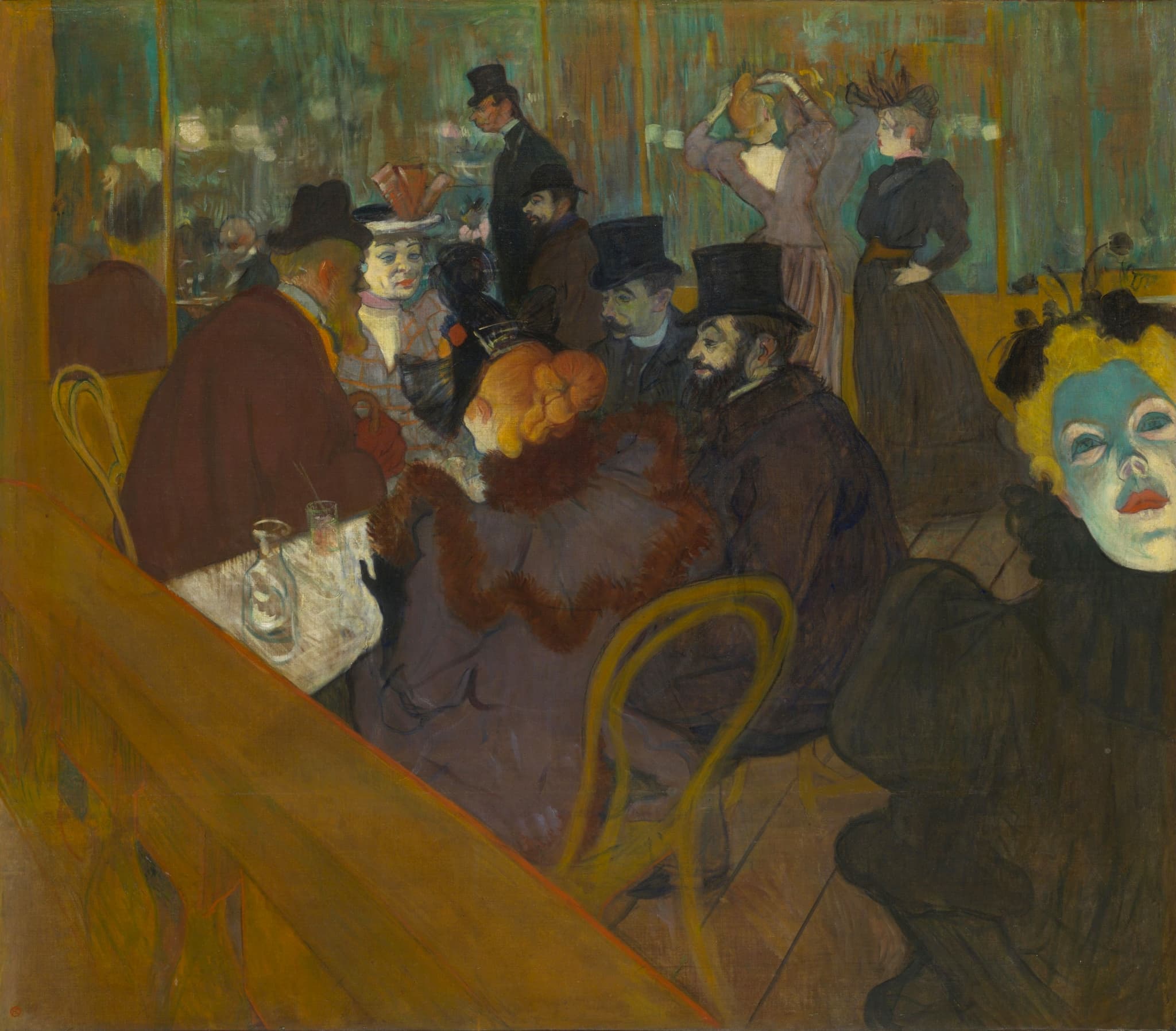
At the Moulin Rouge
Henri de Toulouse-Lautrec, 1892–1895 • Oil on canvas
Read full analysis of At the Moulin Rouge →Valuation Analysis
Opinion of value: $100–150 million. At the Moulin Rouge (1892–95; oil on canvas; 123 × 141 cm) is among Henri de Toulouse-Lautrec’s most important paintings and one of the definitive images of fin-de-siècle Paris. It is a flagship of the Art Institute of Chicago’s collection, widely published and exhibited, and occupies a singular position within the artist’s oeuvre for its ambition, scale, and iconic Montmartre subject matter [1].
Methodology: This estimate is an upward extrapolation from the artist’s public auction record of $22.4 million for La Blanchisseuse (2005), anchored by recent high-quality comparables and adjusted with a substantial “masterpiece premium.” While strong Lautrec oils typically transact in the high‑seven to low‑eight figures, no canvas of this fame and scale has come to auction in the modern era. Pierreuse achieved $9.06 million in 2020, and the intimate masterwork Au lit: Le baiser realized about $16.2 million in 2015; a prime unique work on board, Jane Avril au Divan Japonais, brought €5.34 million in 2025—all demonstrating depth at the upper end of Lautrec’s market for notable but less iconic works [2][3][4][6].
Why this work warrants nine figures: The painting’s art-historical stature, large format, and instantly recognizable cabaret iconography place it among the two or three most important Lautrec oils, with sustained institutional demand and visibility (including recent loans) reinforcing its canonical status [1][7]. Market behavior for truly singular late‑19th‑century masterpieces supports a step‑change in pricing when trophy‑motivated bidders converge. The broader Modern category has demonstrated the viability of nine‑figure outcomes for best‑in‑class works, underscoring the headroom above Lautrec’s historical benchmarks when a masterpiece of this caliber is at stake [5].
Positioning and sensitivities: The $100–150 million range assumes a marquee sale platform or top-tier private-sale campaign, comprehensive global outreach, and multiple engaged trophy buyers. The estimate reflects the combination of masterpiece quality, scarcity of peer canvases, and cross‑collector appeal. Final price outcomes for objects of this caliber are typically most sensitive to competitive dynamics and timing rather than to conventional artist‑record anchors—hence the extrapolative approach, firmly grounded in the known comp set and category context [2][3][4][5][6].
Conclusion: Given its unmatched status within Lautrec’s oeuvre, At the Moulin Rouge would justifiably command a nine‑figure price today. A $100–150 million estimate appropriately captures both the masterpiece premium and current trophy‑level demand while remaining consistent with observable pricing for lesser—but still important—works by the artist.
Key Valuation Factors
Art Historical Significance
High ImpactAt the Moulin Rouge is one of Toulouse-Lautrec’s most celebrated paintings and a cornerstone of fin-de-siècle imagery. Executed at the height of his powers, it synthesizes his signature cabaret subject matter, modern cropping, electric color, and incisive social observation. The composition has been endlessly reproduced in scholarship and exhibitions, shaping the global image of Montmartre nightlife and of Lautrec himself. Its stature is reinforced by long-term museum stewardship at the Art Institute of Chicago and frequent institutional loans, cementing its status as a canonical reference point in Post‑Impressionist studies. This level of art-historical centrality commands substantial premiums far beyond routine artist benchmarks.
Scarcity of Comparable Works
High ImpactLarge, fully resolved Lautrec oils with iconic Montmartre subject matter almost never appear at auction. The market typically sees works on paper, posters, or smaller oils; the handful of major oils that do emerge set the upper pricing structure for the artist. Because At the Moulin Rouge is widely regarded as one of the two or three most important Lautrec canvases, there is effectively no direct market substitute. In trophy markets, this kind of supply scarcity is decisive: when multiple global buyers pursue a singular, unrepeatable object, outcomes can leap materially above historical artist records, justifying a nine‑figure estimate.
Scale, Medium, and Iconography
High ImpactThe work’s substantial size (approximately 123 × 141 cm), ambitious multi‑figure composition, and immediately recognizable cabaret iconography maximize its wall presence and cultural resonance. An oil on canvas of this ambition sits at the top of Lautrec’s medium hierarchy and collector preference, eclipsing even exceptional unique works on board. The combination of large scale and signature subject produces broad cross‑category appeal—from Impressionist and Post‑Impressionist collectors to contemporary trophy buyers—expanding the potential bidding universe and supporting a valuation multiple over more intimate or secondary subjects.
Provenance and Museum Prestige
Medium ImpactThe painting’s provenance traces through leading dealers and collectors before its 1928 gift to the Art Institute of Chicago, where it became a flagship of the Helen Birch Bartlett Memorial Collection. Museum ownership and decades of scholarship, exhibition, and loan activity confer exceptional credibility and brand value. While museum stewardship also means the work is unlikely to be deaccessioned, the institutional imprimatur significantly enhances perceived quality and cultural importance. In a hypothetical sale scenario, this pedigree would be a powerful driver of bidder confidence and willingness to pay a masterpiece premium.
Category Trophy Demand
Medium ImpactTop-tier late‑19th‑century masterpieces continue to attract diversified global capital, with recent marquee results in the Modern category demonstrating capacity for nine‑figure prices for singular works. In a market characterized by a flight to quality, historically validated names and iconic images outperform. At the Moulin Rouge sits squarely in this demand pocket: a blue‑chip artist, a museum‑defining picture, and a universally recognizable subject. These demand dynamics, combined with strategic sale positioning and guarantees, can catalyze competition that drives pricing well beyond the artist’s prior record.
Sale History
At the Moulin Rouge has never been sold at public auction.
Henri de Toulouse-Lautrec's Market
Henri de Toulouse-Lautrec occupies a blue-chip position in the late‑19th‑century canon. While his lithographs and posters provide deep liquidity at accessible price points, the upper market is defined by scarce, high‑quality oils and unique works from the early 1890s. The artist’s public auction record remains $22.4 million for La Blanchisseuse (Christie’s New York, 2005) [2]. Since then, strong oils have typically realized high‑seven to low‑eight figures (e.g., Pierreuse at $9.06 million in 2020) [3], and intimate masterworks in peinture à l’essence have reached the mid‑eight figures (e.g., Au lit: Le baiser at ~$16.2 million in 2015) [4]. A prime unique work on board achieved €5.34 million in 2025 [6]. Against this backdrop, a truly canonical, large‑scale oil would command a substantial premium.
Comparable Sales
La Blanchisseuse (The Laundress)
Henri de Toulouse-Lautrec
Artist’s all-time auction record; major lifetime oil on canvas from the core period. Calibrates the upper market for Lautrec oils versus works on board/paper.
$22.4M
2005, Christie's New York
~$36.3M adjusted
Pierreuse
Henri de Toulouse-Lautrec
Oil on canvas, 1889, closely related Montmartre/nightlife subject matter and a strong lifetime painting; shows recent pricing for good-quality Lautrec oils.
$9.1M
2020, Christie's New York
~$11.1M adjusted
Au lit: Le baiser
Henri de Toulouse-Lautrec
1892 intimate, signature subject in peinture à l’essence on panel—an apex non-canvas work from the same era; benchmarks high prices for top unique works beyond posters.
$16.2M
2015, Sotheby's London
~$21.6M adjusted
Jane Avril au Divan Japonais
Henri de Toulouse-Lautrec
1892 unique work on board featuring a marquee Montmartre performer; directly linked to the cabaret milieu of At the Moulin Rouge and the same creative peak.
$5.9M
2025, Christie's Paris
La femme tatouée
Henri de Toulouse-Lautrec
1894 peinture à l’essence on board tied to Lautrec’s brothel/nightlife iconography; recent, public price for a notable unique work from the core years.
$2.8M
2024, Christie's London
~$2.9M adjusted
Current Market Trends
Impressionist and Post‑Impressionist markets experienced thinner trophy supply and softer headline totals in 2023–2024, followed by renewed strength at the top end in late 2025 as collectors rotated into historically validated names. The overarching theme is a flight to quality: masterpiece‑level works with strong provenance and institutional visibility continue to outperform, while mid‑market liquidity remains healthy. Record‑level outcomes across the Modern category, including nine‑figure prices for best‑in‑class works, confirm robust capacity for exceptional property and support extrapolations above historical artist records when true icons appear.
Sources
- Art Institute of Chicago: At the Moulin Rouge (object record)
- Antiques and The Arts Weekly: Impressionist/Modern Art Sale totals $160.9m at Christie's (Lautrec record $22.416m)
- Christie’s: December 2020 20th Century Marquee Week results (includes Pierreuse at $9,062,000)
- The Guardian: Sotheby’s achieves highest total; Lautrec’s Au lit: Le baiser at £10.8m (2015)
- Wall Street Journal: Klimt portrait sells for $236.4m, reinforcing top-end Modern market strength (2025)
- Christie’s Press: Paris 20/21 sales—Lautrec’s Jane Avril au Divan Japonais achieves €5.34m (2025)
- Minneapolis Institute of Art Press: Exhibition centered on Lautrec’s At the Moulin Rouge (2024–25 loan)