How Much Is The Englishman at the Moulin Rouge Worth?
Last updated: March 30, 2026
Quick Facts
- Methodology
- comparable analysis
Hypothetical fair‑market value for Henri de Toulouse‑Lautrec’s The Englishman (William Tom Warrener) at the Moulin Rouge (Met accession 67.187.108) is estimated at $3.0–$8.0 million. This range reflects its status as a mid‑sized preparatory oil on cardboard, strong museum provenance, and recent auction comparables for similar Lautrec oils and studies.
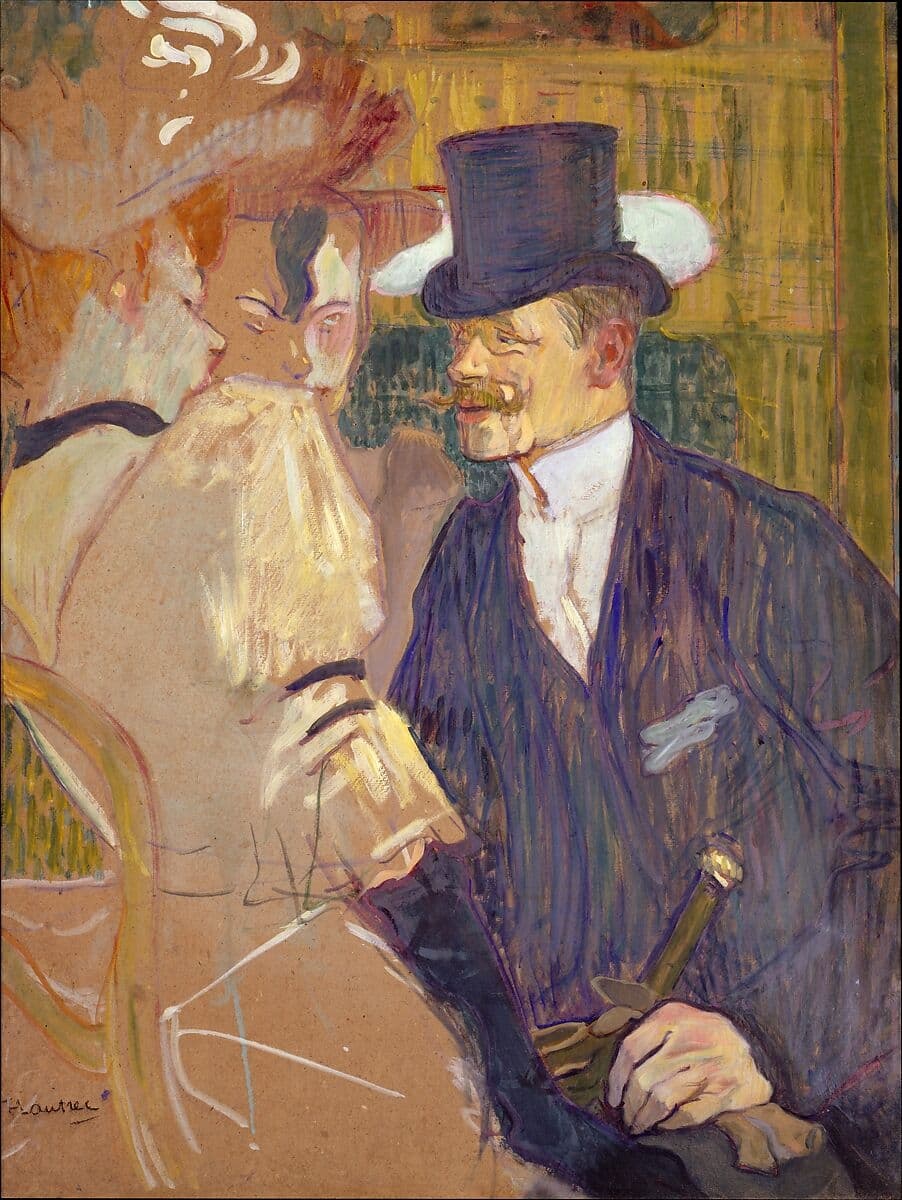
The Englishman at the Moulin Rouge
Henri de Toulouse-Lautrec, 1892 • Oil
Read full analysis of The Englishman at the Moulin Rouge →Valuation Analysis
Valuation conclusion: For a hypothetical market offering of Henri de Toulouse‑Lautrec’s The Englishman (William Tom Warrener) at the Moulin Rouge, oil on cardboard, 1892 (Met accession 67.187.108), the fair‑market range is estimated at $3,000,000–$8,000,000. The painting is a mid‑sized preparatory oil on cardboard held in the Metropolitan Museum of Art (bequest 1967); museum ownership strengthens provenance but also makes an actual market sale unlikely absent a formal deaccession process [1].
Comparables and rationale: The top public benchmark for a Lautrec oil remains La blanchisseuse (Christie’s New York, 2005, reported ~$22.42M), which establishes the artist’s auction ceiling for major, canonical oils [2]. More recent, directly relevant comparables include mid‑single‑million results for mature studies and mid‑sized oils (for example Le Lit at roughly $3.66M, Christie’s 2022) and strong works‑on‑paper/studies such as the Jane Avril study that realized ~€5.34M in Paris in 2025 [3][4]. Taken together, those sales indicate (a) a high ceiling for museum‑quality iconic oils and (b) a realistic mid‑market band for high‑quality preparatory oils/studies in the low‑to‑mid single‑millions. Given this picture, plus the painting’s preparatory/study character and cardboard support, $3M–$8M is a pragmatic, evidence‑based band.
Key price drivers: The strongest positive is the museum provenance (Met accession and long‑term public ownership), which removes title risk and elevates desirability to institutional and well‑capitalized private buyers. Offsetting factors are the work’s support (cardboard vs. canvas), which can introduce conservation vulnerability and buyer caution, and the fact that the painting functions as a preparatory study rather than one of Lautrec’s canonical large‑scale Moulin Rouge masterworks. Condition, catalogue‑raisonné listing, and exhibition history would materially move the estimate upward or downward.
Sale dynamics and route: Were the painting to come to market, the most likely successful routes would be: (1) a major auction house sale in an Impressionist/Modern evening or single‑owner sale with substantial pre‑sale marketing, or (2) a discreet private‑treaty transaction brokered by specialists. Auction interest would likely produce strong competitive bidding given the subject and museum provenance; however, buyer’s premium, lot presentation and timing (market appetite) will affect final hammer and price realized.
Recommended next steps to tighten value: obtain the Met’s full provenance and exhibition record, a detailed condition and conservation report, catalogue‑raisonné confirmation, and technical analysis (pigment, X‑ray/IR) and then seek confidential pre‑sale estimates from Impressionist & Modern specialists at Christie’s and Sotheby’s. With that information the range can be narrowed and a sale strategy chosen with greater confidence [1][2].
Key Valuation Factors
Art Historical Significance
High ImpactThis painting depicts William Tom Warrener, a known acquaintance of Toulouse‑Lautrec, at the Moulin Rouge and therefore ties directly into the artist’s most marketable subject matter. Lautrec’s Moulin Rouge compositions are among his most reproduced and widely recognized works, and pieces that document his social circle and print‑related studies carry enhanced scholarly interest. Because this picture is a study related to a printed composition, its art‑historical value sits above a generic studio copy but below his most finished canonical oils. The subject and relation to his print practice elevate desirability among collectors and institutions focused on Belle Époque and Parisian nightlife iconography.
Provenance & Museum Ownership
High ImpactThe painting’s continuous museum provenance (Metropolitan Museum of Art, accession 67.187.108, bequest 1967) is a decisive positive for market confidence: it removes common title risks, is evidence of institutional vetting, and signals long‑term scholarly recognition. Works with major museum provenance typically command a premium over equivalent privately‑held works because buyers accept lower risk. Conversely, museum ownership also makes any sale contingent on institutional deaccession policy, legal/ethical review, and public scrutiny, which can complicate or lengthen a disposal and influence the sales route (private treaty vs. public auction).
Condition & Medium (oil on cardboard)
Medium ImpactThe support—oil on cardboard—must be evaluated closely. Cardboard is inherently more sensitive than canvas and can show structural weakness, past flattening or relining issues, and age‑related discoloration; these conditions can materially reduce market value. Conversely, a well‑preserved cardboard work in the Met’s collection may have been conserved and stabilized, mitigating the risk. A formal condition and conservation report is therefore essential: it will determine whether the support or surface requires treatment that could affect buyer confidence and pricing and whether the work is saleable without substantial restoration.
Comparable Sales & Market Appetite
High ImpactPublic auction comparables establish both ceiling and realistic selling bands. The artist’s painting record (La blanchisseuse, ~ $22.4M, 2005) sets the high end for canonical oils, while mid‑single‑million results for notable studies and mid‑sized oils (examples in 2022–2025) demonstrate the active mid‑market. The market’s appetite for Toulouse‑Lautrec remains strong for museum‑quality oils and well‑provenanced studies, and recent stronger results have clustered around works with exhibition histories or fresh scholarship. Comparable sales therefore anchor the $3M–$8M estimate.
Rarity, Exhibition & Catalogue Status
Medium ImpactInclusion in a catalogue raisonné, prominent exhibition histories, and high‑quality reproductions in scholarship materially increase value. The Met’s ownership suggests the work is documented and has been available to scholars, which is favourable. If the painting is frequently reproduced in monographs or has a positive exhibition record it could push the estimate upward toward the top of the band; absence from the canon or limited exhibition exposure would restrain its market performance. Verification of catalogue and exhibition citations is therefore critical to final valuation.
Sale History
The Englishman at the Moulin Rouge has never been sold at public auction.
Henri de Toulouse-Lautrec's Market
Henri de Toulouse‑Lautrec is a blue‑chip late‑19th‑century artist whose posters and works on paper are widely traded and whose oils are comparatively scarce. The market prizes his Moulin Rouge and Montmartre subject matter; top oils have sold in the multi‑millions (record ~ $22.4M in 2005) while high‑quality studies and works‑on‑paper commonly trade in the mid‑to‑high single‑digit‑millions when provenance and condition are strong. Institutional interest remains robust, and museum provenance or exhibition history can meaningfully lift pricing.
Comparable Sales
La blanchisseuse
Henri de Toulouse-Lautrec
Artist's auction record and a museum-quality, full-scale Lautrec oil — useful as the top-of-market ceiling for Toulouse-Lautrec paintings.
$22.4M
2005, Christie's New York
~$36.7M adjusted
Le Lit
Henri de Toulouse-Lautrec
Mid-sized Lautrec oil sold in the low single-digit millions (2022) — similar scale/genre (bedroom scene) and a direct mid-market painting comparable.
$3.7M
2022, Christie's New York (Ann & Gordon Getty sale)
~$4.0M adjusted
Jane Avril au Divan Japonais
Henri de Toulouse-Lautrec
High-profile study/pastel by Lautrec sold in 2025 for mid-single millions — a strong comparable for studies/works-on-paper and preparatory pieces.
$6.0M
2025, Christie's Paris
Current Market Trends
Since 2024 the market has been selective at the upper tier while works on paper and well‑provenanced mid‑market paintings have shown resilience. Anniversary exhibitions and renewed scholarship (160th anniversary programming) boosted interest in Lautrec prints and studies in 2024–2025; scarcity of top oils continues to support prices when museum‑quality works appear.
Sources
- The Metropolitan Museum of Art — Collection: The Englishman (William Tom Warrener) at the Moulin Rouge, accession 67.187.108
- Christie’s press release — La blanchisseuse (auction record context, 2005)
- Christie’s Paris press — Spring 2025 sales (Jane Avril au Divan Japonais, €5.34M)
- Christie’s press / sale reporting — Le Lit (Ann & Gordon Getty sale, 2022)