How Much Is The Storm (Seascape) Worth?
Last updated: March 29, 2026
Quick Facts
- Methodology
- comparable analysis
Fair-market value for Ivan Aivazovsky’s The Storm (Seascape), 1850 (National Gallery of Armenia), is estimated at $2.5–4.5 million if offered today in a marquee London/European sale. This base-case assumes medium-to-large scale, prime quality, and sound condition/literature; if the larger 120 × 190 cm size is confirmed with top condition, upside toward $5–7 million is supportable.
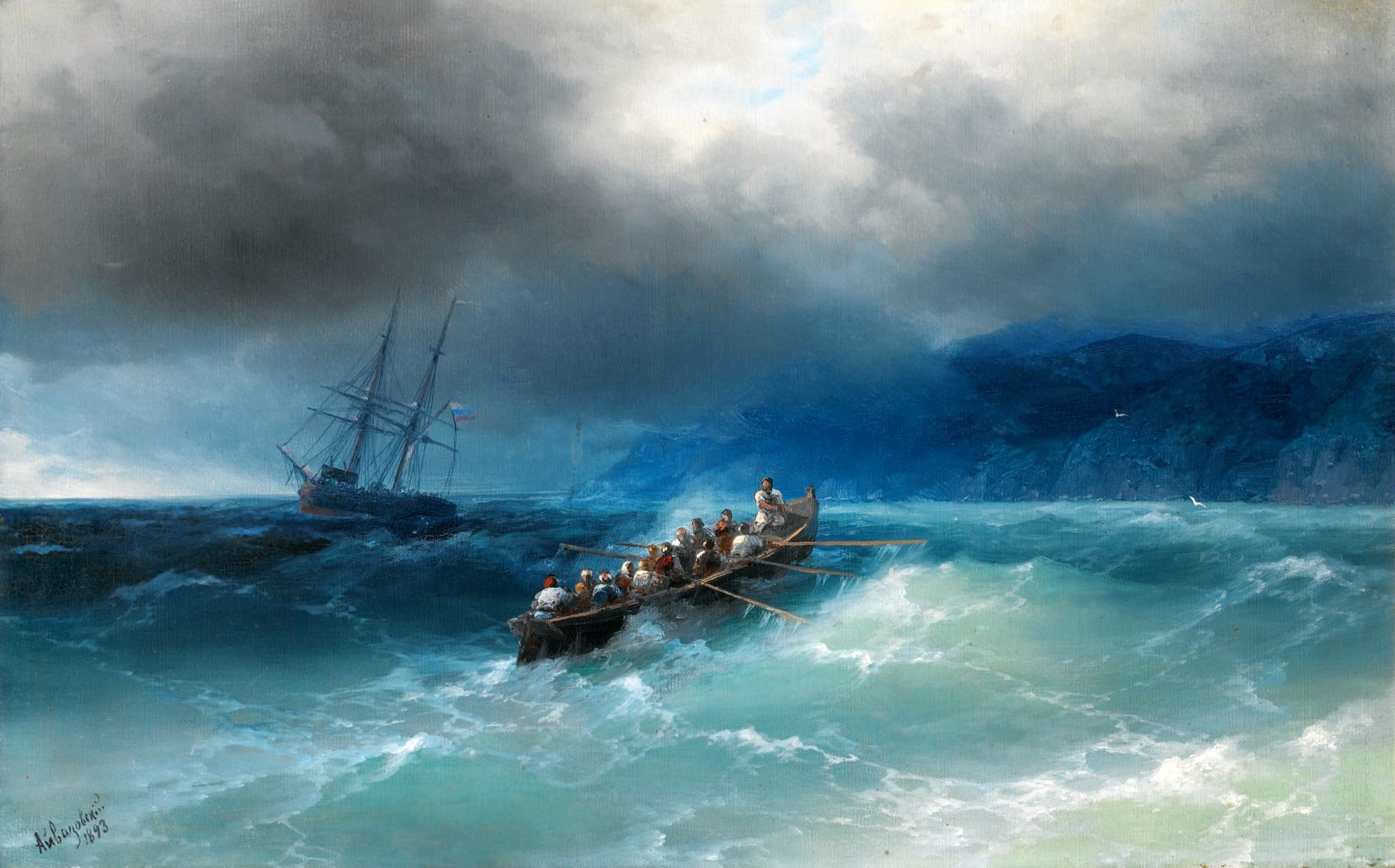
The Storm (Seascape)
Ivan Aivazovsky, 1850 • Oil on canvas
Read full analysis of The Storm (Seascape) →Valuation Analysis
Final estimate: $2.5–4.5 million (fair market value) for Ivan Aivazovsky’s The Storm (Seascape), dated 1850 and held by the National Gallery of Armenia. This range synthesizes recent auction evidence for prime-period Aivazovsky marine pictures, with specific weight on storm/shipwreck subjects and scale-driven premiums. The painting has no modern public sale; it is museum-held, with its identity and location recorded in the NGA’s catalogue and Wikidata entry [2].
Method and benchmarks: The estimate is derived from direct comparables and recent price leadership. In late 2025, Aivazovsky’s record rose to approximately $5.53 million at Sotheby’s London for a monumental storm-rescue composition, The Survivors (c. 195 × 266 cm), establishing the current market ceiling for best-in-class, large-scale seascapes [1]. A closely aligned subject, Shipwreck off the Black Sea Coast (Sotheby’s London, 2020), realized about $3.1 million, confirming sustained depth for dramatic storm pictures of substantial size [3]. Quality mid-to-large works have continued to sell in the $1.25–1.6 million band (e.g., Clouds, 1865, and a high-seas swell painting in Zurich, both 2025) [4], situating the middle of the market and underscoring the premium that storm drama and scale command.
Scale and subject are decisive: Conflicting public data list the NGA picture as either roughly 120 × 190 cm or circa 82 × 117 cm. This is the single largest value swing factor. Storm at Sea is a signature Aivazovsky theme, and 1850 is a prime year; if the painting is indeed the larger size and presents in excellent, well-restored condition with literature/exhibition history, a revised expectation toward $5–7 million is warranted by recent record pricing and the long-observed size multiplier for the artist’s oeuvre [1][3]. If instead the painting is medium-sized (c. 80–120 cm width), the advanced base case of $2.5–4.5 million reflects 2025 pricing for strong works uplifted by a prime date and storm subject.
Condition, literature, and provenance: At the top end of this market, surface preservation (varnish, retention of original paint film, minimal overpaint) and conservation history can easily shift outcomes by 20–40%. Museum provenance provides credibility, while publication in authoritative monographs and inclusion in major exhibitions can add a further premium. Given post‑2022 compliance sensitivities in the Russian pictures category, clear provenance and exportability are now commercial essentials; houses have successfully placed Aivazovsky into broader Old Masters/19th‑century frameworks to access international demand [5].
Conclusion: Anchored to 2025 price leadership and 2020 storm comparables, and calibrated for scale/condition, the $2.5–4.5 million range is an appropriate fair‑market estimate for The Storm (Seascape) today. Confirmation of the larger dimension and exemplary condition/literature would justify an upward revision into the mid‑single‑digit millions in line with recent record-setting storm scenes [1][3].
Key Valuation Factors
Scale and Compositional Ambition
High ImpactFor Aivazovsky, physical scale is a primary price driver: large canvases (c. 1–2 meters wide) with complex, dramatic storm compositions regularly achieve two to three times the prices of smaller or calmer scenes. Monumental formats allow the artist’s atmospheric effects, wave architecture, and light phenomena to read at their most compelling, and such works are scarcer. In recent seasons, the artist’s top results were for very large, theatrically staged shipwreck/rescue scenes—an exact match to the subject and likely ambition of The Storm (Seascape). If the National Gallery of Armenia’s painting is confirmed at approximately 120 × 190 cm with strong condition, it sits in the sweet spot where international bidders pay a significant premium for wall power and drama.
Prime Date and Signature Subject
High ImpactThe painting’s 1850 date places it in Aivazovsky’s prime period, the same year as his most iconic canvas, The Ninth Wave. Storm-at-sea subjects are central to his brand and highly collected. Works from the late 1840s–1860s exhibit the crisp brushwork, pearlescent light, and theatrical seas that connoisseurs prize, and storm imagery heightens narrative stakes and visual contrast. Prime-year attribution compounds demand effects, making a storm picture from 1850 inherently more desirable than later repeats. This temporal positioning is a key reason why the estimate sits above the mid-market band established by calmer, later scenes and aligns with pricing observed for dramatic Black Sea/shipwreck subjects of stature.
Condition and Conservation History
High ImpactSurface integrity and conservation approach materially affect value in 19th‑century marine painting. Collectors scrutinize varnish saturation, retention of delicate scumbles and spray, the handling of the sky’s glazes, and any flattening from heavy relining. Overcleaning of the horizon or overpaint in foam passages can suppress prices sharply. Conversely, a painting that retains lively impasto, balanced tonality, and coherent craquelure—supported by a recent, transparent conservation report—can command a substantial premium. For The Storm (Seascape), a museum-level condition standard (with minimal, well-integrated retouch) would support the upper half of the range; notable structural or aesthetic compromises would require discounting into the lower band or below.
Provenance, Literature, and Exhibition History
Medium ImpactPublic-collection provenance confers authenticity confidence and market credibility, but price impact is maximized when the work is also well-documented: early publication, inclusion in catalogues raisonnés and scholarly monographs, and loans to significant exhibitions. Such literature builds the artwork’s scholarly footprint and visibility, drawing wider bidder interest. For Aivazovsky, citations in authoritative sources and presence in major shows (especially outside the post‑Soviet sphere) provide a clear premium. If the NGA canvas carries a robust bibliographic trail with color plates and notable exhibitions, that would meaningfully support the high end of this valuation. Sparse literature would not be punitive, but it would cap upside relative to equally strong, well-published peers.
Market Liquidity and Geopolitical Context
Medium ImpactAivazovsky remains among the most liquid 19th‑century seascapists, with strong demand in Eastern Europe, Turkey, the Caucasus, and an active Western base. Since 2022, sanctions and compliance constraints reshaped sale formats: top works now appear within Old Masters/19th‑century auctions to broaden participation, and provenance/export clarity has become paramount. Despite thinner pools in dedicated “Russian Art” contexts, blue‑chip Aivazovskys continue to realize robust prices in London, Zurich, and Scandinavia. This environment rewards prime-period, storm-subject pictures with transparent ownership and museum-grade condition—precisely the profile of The Storm (Seascape)—supporting confidence in the $2.5–4.5 million base-case and the potential for higher outcomes in peak scenarios.
Sale History
The Storm (Seascape) has never been sold at public auction.
Ivan Aivazovsky's Market
Ivan Aivazovsky (1817–1900) commands one of the strongest markets among 19th‑century marine painters. His best large-scale seascapes—especially dramatic storm and shipwreck subjects—regularly achieve seven figures at auction, with a new record set in 2025 around $5.53 million for a monumental storm-rescue composition in London. Quality mid-to-large works often range from roughly $1.2–1.6 million, while calm scenes and smaller canvases cluster below that. Demand is international, with notable depth in Eastern Europe, the Caucasus, Turkey, the Middle East, and a steady Western collector base. Post‑2022, leading houses have repositioned top Aivazovskys into Old Masters/19th‑century evening sales to maximize global participation, and trophy works continue to perform strongly.
Comparable Sales
The Survivors
Ivan Aivazovsky
Same artist; dramatic storm/shipwreck-rescue subject; monumental scale (c. 195 x 266 cm). Sets the current market ceiling for top-tier Aivazovsky seascapes.
$5.5M
2025, Sotheby's London
Ship at Anchor in Calm Waters
Ivan Aivazovsky
Same artist; strong, mid-to-large format (c. 70 x 110 cm), late period. Calmer subject provides a useful mid-range benchmark below storm scenes.
$1.4M
2025, Sotheby's London (Old Master & 19th Century Evening)
Wellengang auf hoher See (Swell on the High Seas)
Ivan Aivazovsky
Same artist; stormy/high-seas subject close to The Storm (Seascape); late period example showing robust demand for dramatic marine scenes in Europe.
$1.6M
2025, Koller, Zurich
The Shipwrecked
Ivan Aivazovsky
Same artist; shipwreck/storm subject. Useful for the lower bound of storm-themed works at a Nordic venue; smaller scale/lesser quality than major London/Zurich trophies.
$701K
2022, Bukowskis, Helsinki Winter Sale
~$771K adjusted
Shipwreck off the Black Sea Coast
Ivan Aivazovsky
Same artist; large, dramatic storm/shipwreck composition closely aligned in subject and market tier to The Storm (Seascape). Strong late 19th-century example.
$3.1M
2020, Sotheby's London (Russian Art)
~$3.8M adjusted
Clouds
Ivan Aivazovsky
Same artist; mid-size atmospheric marine/sky study from a strong period. Not a storm, but a relevant quality benchmark in 2025 pricing.
$1.3M
2025, Sotheby's London (19th & 20th Century European Art)
Current Market Trends
The broader Old Masters/19th‑century segment has been selective but firm: great works, priced to estimate, sell well, while middling quality underperforms. For Russian pictures, compliance and logistics since 2022 reduced dedicated sales but did not suppress demand for blue‑chip names—Aivazovsky foremost among them. Auction houses now emphasize cross‑category placement to tap wider bidding pools, and buyers prize clear provenance and exportability. Within this context, storm seascapes and large formats command premiums, with 2025 London and Zurich results reaffirming pricing power at the top end. The near-term outlook remains stable to positive for prime-period, high-impact marine paintings with museum-standard condition and literature.
Sources
- Sotheby’s London – The Survivors (Aivazovsky) sale result (2025)
- Wikidata – The Storm at Sea (1850), National Gallery of Armenia (inv. 1002)
- Sotheby’s London (2020) – Shipwreck off the Black Sea Coast result
- HENI – Sotheby’s 19th & 20th Century European Art (Dec 4, 2025) sale roundup
- Overstone Art – Russian art market dynamics post-2022
- Bukowskis – Winter Sale result for Aivazovsky (Nov 27, 2022)