How Much Is Dido building Carthage (The Rise of the Carthaginian Empire) Worth?
Last updated: April 10, 2026
Quick Facts
- Methodology
- comparable analysis
Dido building Carthage (1815) by J.M.W. Turner (NG498) is held in the National Gallery as part of the Turner Bequest and is effectively not for sale. Hypothetically saleable with clear title and excellent condition, a reasoned market range is USD 15,000,000–35,000,000, with a likely auction outcome toward the mid‑point depending on condition, provenance and institutional interest.
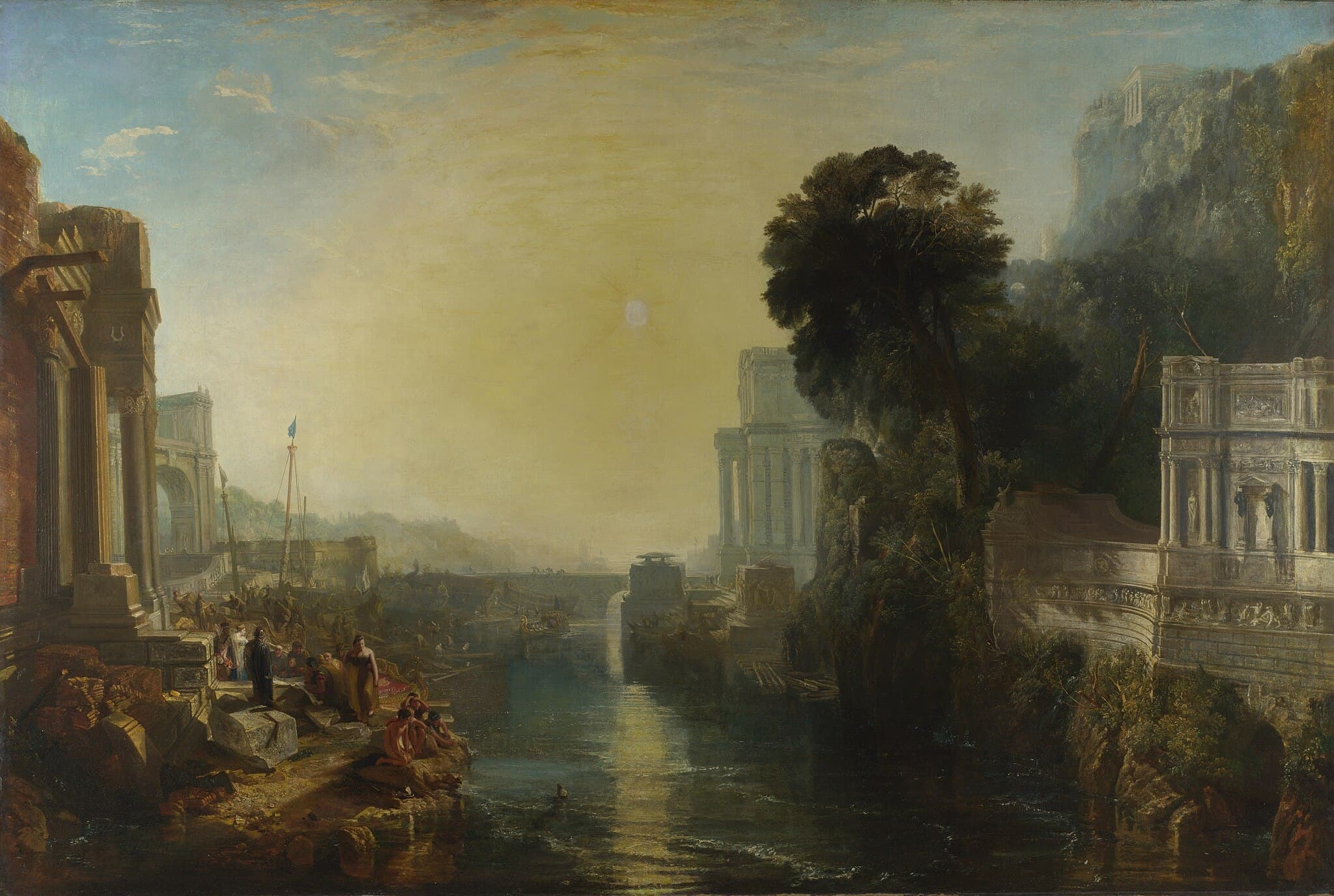
Dido building Carthage (The Rise of the Carthaginian Empire)
J. M. W. Turner, 1815 • Oil on canvas
Read full analysis of Dido building Carthage (The Rise of the Carthaginian Empire) →Valuation Analysis
Context and legal status: Dido building Carthage (1815) is catalogued in the National Gallery, London (NG498) and remains part of the Turner Bequest; as such it is functionally removed from the open market and not offered for sale under ordinary circumstances [1]. This valuation is therefore a hypothetical exercise that assumes the painting could be lawfully alienated, retained with a clear title and presented with a full conservation report and established provenance.
Comparable basis for the range: The USD 15–35M band is derived by calibrating relative artistic significance, scale and condition against realized prices for finished large Turners and adjusting down from the artist’s absolute high‑water marks. Major finished oils by Turner have reached the high tens of millions at auction (for example, Rome, From Mount Aventine realized c.£30.3M at Sotheby’s, 2014) [2]. Those sales set the ceiling for top‑tier masterpieces; Dido, while important as an ambitious 1815 history painting, is not generally cited as one of the handful of singularly iconic canvases and therefore is scored below those extremes.
Key value drivers: (1) Legal/provenance: long museum ownership and Turner’s bequest support provenance but simultaneously limit marketability; (2) condition: structural integrity, paint layer stability and any past interventions will materially move price—significant restoration or uncompensated losses could reduce value by multiples; (3) exhibition and publication history: sustained scholarly attention and high‑profile loans increase buyer confidence and can lift realized prices; (4) market context: scarcity of comparable finished oils in private hands concentrates demand, but the broader Old Masters/19th‑century auction environment has been episodic.
Buyer profile and sale dynamics: If offered, primary bidders would likely be major museums, foundation collectors and a very small set of blue‑chip private buyers. Institutional interest typically compresses downside risk, while private competition can push outcomes to the upper band. Presale marketing, timed exhibitions and an auction house positioning as a marquee lot would be required to realize the top of the range.
Practical next steps to firm the estimate: obtain written confirmation of legal/transfer status from the National Gallery; secure a full, dated condition/conservation report; gather comprehensive provenance, loan and publication records; and instruct a senior specialist at a major auction house to assemble a tailored comparable set and advise on sale strategy. With those inputs a formal presale estimate and reserve strategy can be produced.
Bottom line: academically and curatorially significant but effectively inalienable, Dido building Carthage should be treated as museum property. Under a strictly hypothetical, marketable scenario with clean legal status and excellent condition, USD 15–35M is a defensible, market-facing range; absent those conditions any dollar figure remains theoretical and contingent [1][2].
Key Valuation Factors
Art Historical Significance
High ImpactDido building Carthage is a substantial 1815 history painting that demonstrates Turner’s ambition in large‑scale narrative composition during his mature early period. It occupies an important place in scholarship on Turner’s development from classical and historical subjects toward increasingly atmospheric treatment of landscape and light. While not as publicly iconic as works such as The Fighting Temeraire, the canvas has strong academic value and curatorial importance, which elevates its market relevance relative to routine studies or works on paper. Scholarly interest and demonstrable art‑historical importance increase institutional demand and support the upper half of any hypothetical market range.
Provenance & Legal Status
High ImpactThe painting’s provenance is a decisive value driver. As part of the Turner Bequest and accessioned into the National Collection in the nineteenth century, NG498 carries impeccable museum provenance that reduces attribution risk and strengthens buyer confidence. That provenance also creates a practical barrier to sale: many Turners in national hands are treated as inalienable, and legal/ethical hurdles (including potential public interest objections and export controls) make commercial disposition exceptionally unlikely. If a sale ever became legally possible, the long museum history would be a major positive; in the present state, legal restrictions render any market valuation essentially hypothetical.
Condition & Conservation
High ImpactCondition is a primary determinant of value for a large oil such as this. Structural issues, old or invasive relinings, extensive overpaint, severe craquelure or compromised ground layers materially reduce marketability and can cut value by large percentages. Conversely, a documented history of careful conservation, stable canvas support and minimal non‑original intervention will support the upper end of the band. A formal, written condition report from the National Gallery conservation department is indispensable: it moves the valuation from theoretical to market‑actionable and will dictate whether institutional buyers would bid competitively.
Market Rarity & Comparables
Medium ImpactLarge finished oils by Turner rarely come to market because many are held in public collections. This scarcity is a structural price support; when comparable works appear they attract concentrated demand and can achieve high multiples. Auction records (e.g., major Sotheby’s offerings) show that the upper echelon of Turners has realized high tens of millions, but these represent a small subset of oeuvre. Dido’s market placement should therefore be judged against those rare high results while recognising that it likely sits below the very top canonical examples; the absence of private comparables of identical scale reduces precision but supports the mid‑range estimate.
Exhibition & Publication History
Medium ImpactA sustained exhibition and publication record materially enhances market value by increasing recognition and scholarly validation. As a National Gallery painting, Dido building Carthage is likely well catalogued and has an institutional exhibition history, both of which are positive. High‑profile loans or a leading role in a major Turner retrospective would further elevate market interest and could move a hypothetical auction result upward. Conversely, limited publication or absence from major shows would modestly reduce perceived prominence and buyer urgency.
Sale History
Dido building Carthage (The Rise of the Carthaginian Empire) has never been sold at public auction.
J. M. W. Turner's Market
J.M.W. Turner is one of the most collectible and academically prized British artists. The market is characterised by scarcity of major finished oils in private hands and by strong institutional demand; when significant Turners appear they can command high prices, with the artist’s auction high‑water marks in the high tens of millions. Works on paper typically trade in the six‑ to low‑seven‑figure band, while finished large oils occupy a much higher tier. Overall, Turner's market is specialist, episodic and supply‑constrained; quality and provenance drive outcomes decisively.
Comparable Sales
Rome, From Mount Aventine
J. M. W. Turner
Large, finished Turner oil of high museum quality and similar market standing (Italianate/landscape subject and major-sale provenance); serves as the artist's auction high-water mark and a direct precedent for top-tier finished oils.
$47.5M
2014, Sotheby's London
~$63.8M adjusted
Modern Rome – Campo Vaccino
J. M. W. Turner
Another large, important Turner oil (Italian/Rome subject) that sold in the same market tier as the 2014 record — a close stylistic and market analogue for a museum-quality history/landscape canvas.
$46.0M
2010, Sotheby's London
~$68.2M adjusted
The Rising Squall, Hot Wells, from St Vincent's Rock, Bristol
J. M. W. Turner
Recent rediscovered/small oil sale (2025) showing market appetite and volatility for Turners outside the museum circuit; useful as a mid-market data point though much smaller and less prestigious than a major history painting.
$2.6M
2025, Sotheby's London
Lake Brienz, with the Setting Moon
J. M. W. Turner
Worked-on-paper/watercolour sale (2025) representing typical mid-to-high six-figure realizations for Turner drawings/watercolours; provides a lower-anchor comparator for medium/scale differences versus large oils.
$1.0M
2025, Christie's London
Current Market Trends
The Old Masters/19th‑century segment softened through 2023–24, producing more selective buyer behaviour, but episodic rebounds tied to rediscoveries and anniversary programming (Turner 250 in 2025) produced pockets of heightened demand. Institutional purchasers remain the most reliable buyers for major Turners, and scarcity of high‑quality finished oils keeps upside potential for properly marketed lots, even as broader market volatility persists.