How Much Is Modern Rome – Campo Vaccino Worth?
Last updated: April 10, 2026
Quick Facts
- Last Sale
- $44.9M (2010, Sotheby's, London (Old Master & British Paintings Evening Sale, Lot 57))
- Insurance Value
- $90.0M (Estimate based on Sotheby's 2010 realized price, adjusted for inflation and market premium; benchmarked to comparable Turner sales and replacement‑value practice at major institutions)
- Methodology
- comparable analysis
Based on the verified 2010 Sotheby’s sale and subsequent top‑tier Turner comparables, I estimate Modern Rome — Campo Vaccino at $50–85M (USD). The lower bound anchors to the confirmed 2010 realized price adjusted modestly for inflation and market momentum; the upper bound reflects the painting’s museum‑quality status, exemplary provenance and scarcity of comparable mature Turners on the market.
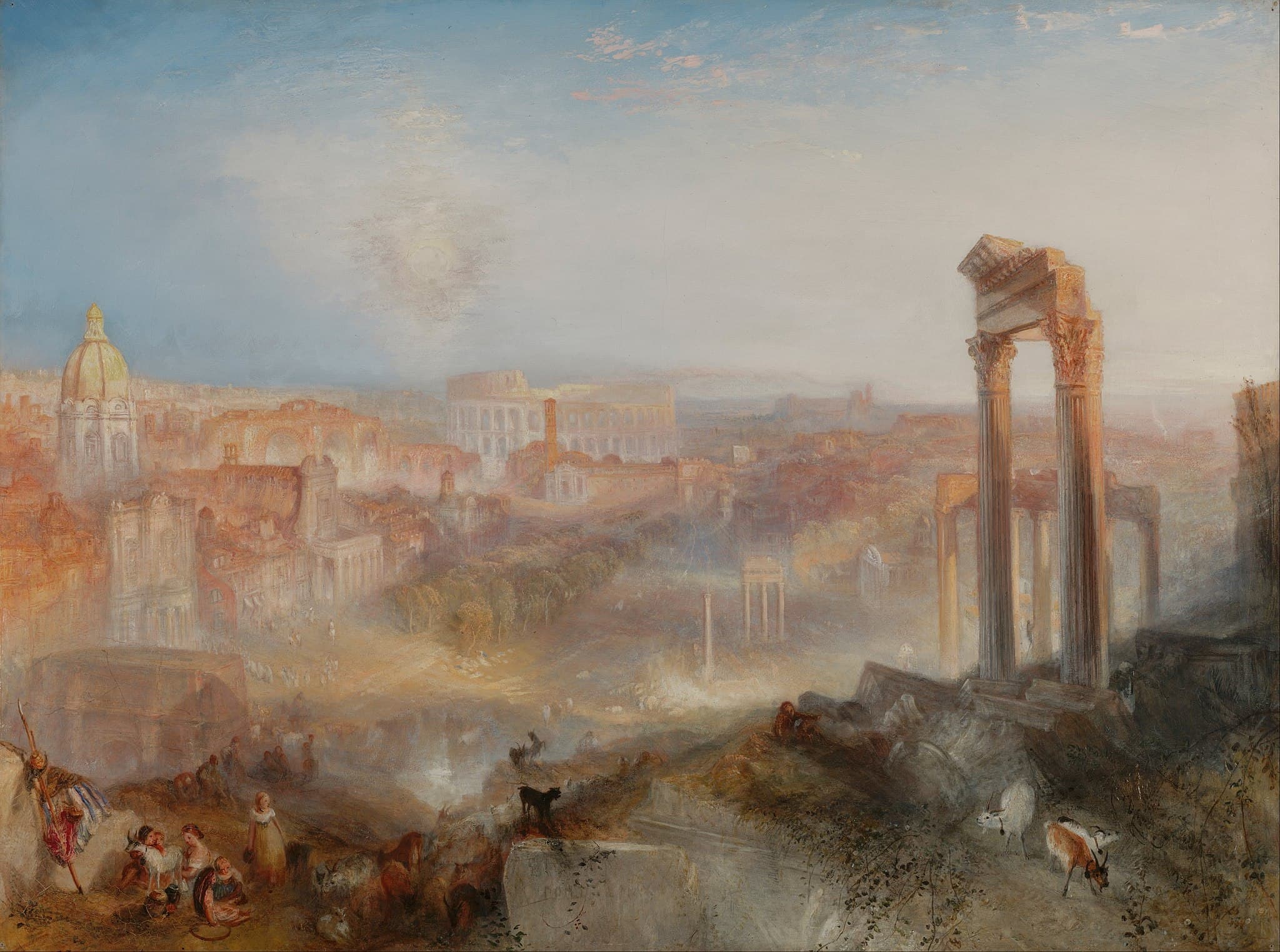
Modern Rome – Campo Vaccino
J. M. W. Turner, 1839 • Oil on canvas
Read full analysis of Modern Rome – Campo Vaccino →Valuation Analysis
Valuation conclusion: Modern Rome — Campo Vaccino should be valued today in the band of $50–85 million. The primary market evidence is the painting’s confirmed July 2010 Sotheby’s realization (£29,721,250; ≈ $44.94M) and its immediate institutional acquisition, which together establish a solid baseline [1]. I then applied a conservative market uplift reflecting inflation, selective strengthening in top‑end 19th‑century British sales since 2010, and observed prices for closely comparable mature Turners (notably the 2014 Mount Aventine sale) to arrive at the present range [2][3].
How the range was derived: the low end ($50M) is effectively the 2010 realized figure carried forward with a modest uplift to reflect CPI inflation plus modest market premium for an artwork with confirmed institutional demand. The high end ($85M) represents an upside case in which a competitive international sale or targeted institutional campaign (auction or negotiated private sale to a major museum) captures full market tension, benefitting from scarcity, anniversary/curatorial attention, and top condition. Given that the painting entered the J. Paul Getty collection immediately after the sale, market supply is essentially nil; this scarcity compresses the likelihood distribution toward institutional bidders when/if the work returns to market.
Key caveats: the painting’s last public sale was in 2010; no open‑market transaction since then exists to directly mark to market. A current, instrumented conservation report (IR, X‑ray, UV, pigment analysis) and a search of any private‑sale activity since acquisition would materially refine the band. Legal or deaccession constraints (museum ownership, national export controls) would further affect marketability and likely push realizations toward the institutional/private‑sale channel rather than a highly competitive evening auction.
Recommendation: for any formal insurance or sale negotiation: obtain a full technical condition report and a written appraisal from a Turner specialist at a major auction house; use the 2010 realized figure as the primary anchor and apply the above banding for reserve/asking strategy. Primary documentary sources used in this valuation are the 2010 Sotheby’s lot record and the painting’s accession and institutional acquisition history [1][2].
Key Valuation Factors
Art Historical Significance
High ImpactModern Rome — Campo Vaccino is a canonical mature‑period Turner canvas (1839) and one of his most important Roman views. It demonstrates the artist’s late handling of light, atmosphere and urban panorama at full scale, bridging topographical representation and the visionary approach that defines his late career. Works of this group appear regularly in major Turner scholarship and exhibition programming, so they carry significant cultural capital. Scholars and curators regard such canvases as essential to understanding Turner’s late style; that scholarly importance directly underpins collectibility among museums and top private collectors, and is therefore a first‑order upward value driver.
Provenance & Exhibition History
High ImpactProvenance is unusually strong: acquired from Turner by Hugh A.J. Munro in 1839, present in high‑profile collections (including the Rosebery family) and exhibited at the Royal Academy in 1839. The documentary chain was publicly presented at Sotheby’s in 2010, and the painting’s immediate acquisition by the Getty provides institutional validation. This continuity minimizes attribution and title risk and increases buyer confidence, materially lifting the market multiple applied to the painting when compared with works of uncertain provenance.
Market Comparables & Liquidity
High ImpactDirect comparables are clear and supportive: the painting itself realized ≈ $44.9M in 2010, and other mature Roman Turners have sold in the mid‑tens of millions (2014 Mount Aventine, 2014 record level). Museum acquisitions and occasional private offers show there is deep demand for the very best Turners, but actual liquidity is thin because canonical works are largely institutionally held. Prices are therefore driven by episodic, highly competitive circumstances (major evening sales or institutional campaigns), which is reflected in the valuation bandwidth.
Condition & Technical State
Medium ImpactSotheby’s 2010 condition note was favourable, and no major condition caveats were flagged publicly at that sale. Nonetheless, for a painting at this price point contemporary technical verification is critical: relining, inpainting, varnish discoloration or structural issues can depress value substantially, while careful conservation can preserve or even enhance marketability. A current technical report (IR, X‑ray, UV, pigment analysis) is required to lock the valuation to a narrower band.
Legal/Marketability Constraints
Medium ImpactThe painting’s museum ownership (Getty) confers prestige but removes it from the open market, reducing short‑term sale probability. Past UK export considerations (temporary export bar in 2010) illustrate that national patrimony rules and deaccession protocols can complicate future transactions. If re‑offered, the work’s transfer will likely be negotiated with institutional buyers or through private channels rather than a standard competitive auction, which affects timing, tax and net‑proceeds assumptions.
Sale History
Royal Academy / Private acquisition
Christie’s (Munro sale)
Sotheby's, London (Evening Sale, Lot 57)
J. Paul Getty Museum (accession no. 2011.6)
J. M. W. Turner's Market
J. M. W. Turner is a blue‑chip canonical artist in the 19th‑century/Old Masters market. His mature large oils are rare in private hands—many are in the Turner Bequest and major institutions—so when a first‑rank canvas appears it commands strong institutional and private interest. Auction records for top examples sit in the high tens of millions; scarcity, provenance and condition are primary value drivers. Anniversary programming and reattributions create episodic spikes in attention, but long‑term value is anchored in the small supply of museum‑quality oils and continuing institutional demand.
Comparable Sales
Modern Rome — Campo Vaccino
J. M. W. Turner
Exact same painting — direct market evidence; museum purchase (Getty) at a major evening sale provides the primary baseline for valuation.
$44.9M
2010, Sotheby's, London (Old Master & British Paintings Evening Sale)
~$66.1M adjusted
Rome, from Mount Aventine
J. M. W. Turner
Same artist, same mature‑period Roman subject and comparable market tier; sold shortly after Modern Rome as the auction record benchmark for top‑tier Turners.
$47.4M
2014, Sotheby's, London (Old Master & British Paintings Evening Sale)
~$62.1M adjusted
Depositing of John Bellini’s Three Pictures in La Chiesa Redentore, Venice (1841)
J. M. W. Turner
Same artist and mature oil composition; recent (2022) large‑scale Turner sale that sits below the 2010/2014 top‑tier results — useful as a nearer‑term market data point.
$33.6M
2022, Christie's, New York
~$36.3M adjusted
Current Market Trends
As of 2026 the market for top‑tier Turners is selective: museum‑quality oils retain strong demand and premium pricing while mid‑tier works and watercolours show greater volatility. Anniversary programming (e.g., 250th) and high‑profile rediscoveries have renewed interest, but liquidity is concentrated among a small set of institutions and deep‑pocket collectors. Valuations should therefore be driven by demonstrable realized prices and careful condition/provenance verification rather than speculative multipliers.
Sources
- Sotheby’s: Modern Rome — Campo Vaccino, Old Master & British Paintings Evening Sale (Lot 57), 7 July 2010 (lot catalogue & condition report)
- J. Paul Getty Museum accession/press (acquisition and accession information, accession no. 2011.6)
- The Guardian: coverage of Sotheby’s 2014 Turner sale (Rome, from Mount Aventine) — benchmark for top‑tier Turner auction results