How Much Is Rain, Steam and Speed Worth?
Last updated: February 20, 2026
Quick Facts
- Methodology
- extrapolation
Rain, Steam and Speed – The Great Western Railway (1844) is a canonical, late Turner masterpiece in the National Gallery, London, with no modern sale history. Extrapolating from the artist’s top auction benchmarks and the current trophy Old Master market, we estimate a hypothetical open-market value of $160–240 million.
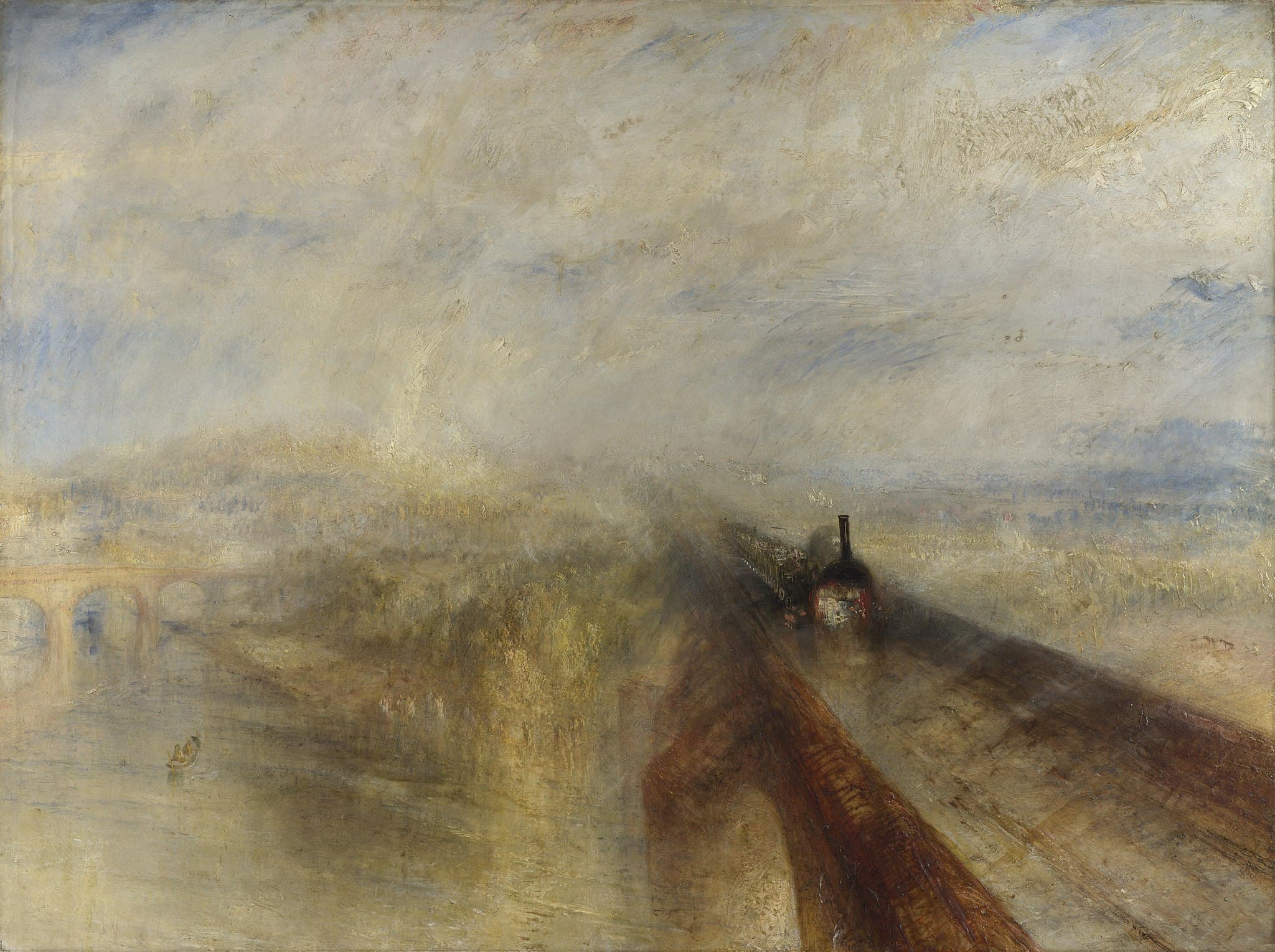
Rain, Steam and Speed
J. M. W. Turner, 1844 • Oil on canvas
Read full analysis of Rain, Steam and Speed →Valuation Analysis
Overview and status. J. M. W. Turner’s Rain, Steam and Speed – The Great Western Railway (1844) is among the most iconic paintings of the 19th century, central to narratives of modernity and Turner’s late style. It resides in the National Gallery, London, via the Turner Bequest (1856), and has no modern public sale history, making any pricing necessarily hypothetical and based on market comparables and category benchmarks [1].
Methodology and core comps. We extrapolate from the highest recent prices for Turner oils: Rome, from Mount Aventine (1835) set the artist’s auction record at £30.3m (≈$47.4m) in 2014, while other prime late oils have achieved $24m–$46m equivalents; notably, the Paul G. Allen Collection’s 1841 Venetian subject realized $33.595m in 2022 [2][4]. Adjusted for inflation and currency, top Turner oils cluster roughly in the $35m–$65m band. Rain, Steam and Speed, however, is qualitatively superior in renown and cultural weight, warranting a substantial “trophy premium” beyond these comps.
Cross-category context and trophy premium. The broader Old Master market demonstrates that super-iconic works can command nine-figure prices at auction: Botticelli’s Portrait of a Young Man Holding a Roundel sold for $92.2m in 2021, illustrating the headroom for universally recognized masterpieces [3]. In 2025, an Old Master category rebound included a record £31.9m (≈$43.9m) for a Canaletto, underscoring robust competition when exceptional quality appears [5]. Against this backdrop, a universally taught, image-defining Turner such as Rain, Steam and Speed could credibly clear $150m with global bidding.
Rarity, demand, and subject. Museum-caliber late Turner oils are extraordinarily scarce on the market; most apex works are held in UK national collections (National Gallery, Tate) or deep private hands. The painting’s subject—industry, velocity, and the sublime—has singular resonance within Turner’s oeuvre and art history at large. This combination of scarcity, art-historical centrality, and brand recognition creates the conditions for a multi-bidder, cross-category outcome well above the artist’s standing record.
Legal/marketability considerations. National Gallery works are effectively non-market and UK deaccession policies make a real sale highly unlikely. If a sale occurred under UK export controls with potential pre-emption at a matching price, realized proceeds could skew below a fully international, unconstrained auction. Our estimate assumes open, global competition without such constraints.
Conclusion. Balancing the artist’s existing price ceiling, the unique stature of this painting, cross-category trophy dynamics, and current Old Master market strength at the top, we synthesize a hypothetical open-market valuation of $160–240 million for Rain, Steam and Speed [2][3][4][5].
Key Valuation Factors
Art Historical Significance
High ImpactRain, Steam and Speed is a cornerstone of Turner’s late oeuvre and a touchstone for discussions of modernity, technology, and the sublime. It condenses Turner’s radical atmospheric handling and proto‑modern abstraction into a singular, widely reproduced image that anchors exhibitions, textbooks, and public consciousness of the artist. Among Turner’s most cited works (often grouped with The Fighting Temeraire and Snow Storm), it uniquely synthesizes landscape and industry, making it emblematic of the 19th century’s transformation. This degree of cultural penetration and scholarly consensus positions it at the very top of the artist’s canon—precisely the attribute set that commands the strongest trophy premiums at auction.
Rarity and Supply
High ImpactMuseum‑quality late Turner oils almost never come to market; the handful that have sold in recent decades set and reaffirmed the artist’s price ceiling. Many apex works are held in UK national collections (National Gallery, Tate) or in long‑term private hands, creating structural scarcity that sharply limits opportunities for collectors to acquire a truly canonical Turner. Compared with already rare late Venetian, Roman, or Rhine subjects, Rain, Steam and Speed is not merely excellent but singular within the oeuvre. The intersection of extreme rarity, universal recognition, and sustained global demand strongly supports a valuation that substantially exceeds the artist’s prior auction records.
Provenance and Collection Status
Medium ImpactThe painting’s placement in the National Gallery via the Turner Bequest ensures unimpeachable authenticity, continuous institutional care, and premier scholarly standing—all positives for value theory. However, UK national collection status makes practical marketability remote. Any hypothetical disposal would likely face significant legal, ethical, and export‑licensing hurdles, including potential pre‑emption at a matching price. While our estimate assumes an unconstrained, international sale to gauge economic value, these constraints could temper a real‑world price discovery process if the sale were restricted to the UK framework. Net effect: strong confidence in the work’s standing, with some practical frictions acknowledged.
Market Benchmarks and Trophy Demand
High ImpactTurner’s top auction results for prime oils cluster around $35–$65 million in today’s money, led by Rome, from Mount Aventine (2014). Yet cross‑category evidence shows that universally iconic Old Masters can break into nine figures (e.g., Botticelli at $92.2 million). Within this context, Rain, Steam and Speed’s unparalleled fame, narrative power, and scarcity justify a meaningful premium over the artist’s historic ceiling. Recent category momentum, including a 2025 Canaletto record, signals that deep collector and institutional demand remains ready to compete for the very best. Together these comparables and conditions support a $160–240 million extrapolated range.
Sale History
Rain, Steam and Speed has never been sold at public auction.
J. M. W. Turner's Market
J. M. W. Turner is a blue‑chip artist at the apex of British Romantic painting, with global demand from museums and top private collectors. His market is bifurcated: works on paper are relatively liquid from mid‑six to low‑seven figures depending on subject and quality, while prime oils are extremely scarce and command premium pricing. The artist’s current auction record is Rome, from Mount Aventine (1835) at £30.3m (≈$47.4m) in 2014. Subsequent major oils have traded in the $24m–$46m zone, with a notable $33.595m Turner oil in the Paul G. Allen Collection sale (2022). Supply, rather than demand, primarily limits price discovery for top‑tier oils.
Comparable Sales
Rome, from Mount Aventine
J. M. W. Turner
Same artist; mature 1830s prime oil; artist auction record; large, museum-quality city view with luminous atmosphere—closest market benchmark for a late, trophy Turner oil.
$47.4M
2014, Sotheby's London
~$63.5M adjusted
Modern Rome – Campo Vaccino
J. M. W. Turner
Same artist; monumental late 1830s oil and a canonical Turner subject; second-highest Turner price and a strong proxy for top-tier late oils.
$45.1M
2010, Sotheby's London
~$65.6M adjusted
Depositing of John Bellini’s Three Pictures in La Chiesa Redentore, Venice
J. M. W. Turner
Same artist; late-period (1841) Venetian oil with top provenance (Paul G. Allen Collection). Shows current appetite for prime late oils by Turner.
$33.6M
2022, Christie's New York
~$36.4M adjusted
Ehrenbreitstein
J. M. W. Turner
Same artist; major 1835 Rhine subject, mature style and museum-level quality; a strong but non-record benchmark for prime oils.
$24.0M
2017, Sotheby's London
~$31.0M adjusted
Giudecca, La Donna della Salute and San Giorgio
J. M. W. Turner
Same artist; late (1841) Venetian oil, long treated as a touchstone for Turner’s top-tier market; useful for long-run, inflation-adjusted benchmarking.
$35.9M
2006, Christie's New York
~$56.4M adjusted
Current Market Trends
Old Masters experienced a softer 2024 but rebounded in 2025 as top-quality consignments returned and sell-through rates strengthened. A new Canaletto record underscored robust appetite for blue‑chip, narrative‑rich works, while cross‑category trophy collectors remain active when masterpieces appear. Inflation and currency shifts aside, the principal driver at the high end is quality and story: canonical works with institutional‑grade provenance and broad cultural resonance continue to outperform. Against this backdrop, an apex Turner would likely attract deep, international bidding and price tension well beyond the artist’s historical record, with nine‑figure outcomes plausible for the most iconic examples.
Sources
- National Gallery, London: Rain, Steam and Speed – The Great Western Railway
- Guinness World Records: Most expensive painting by Turner sold at auction
- Sotheby’s: Botticelli’s Portrait of a Young Man Holding a Roundel achieves $92.2m
- Christie’s Press: Visionary – The Paul G. Allen Collection results (includes Turner at $33,595,000)
- The Art Newspaper: Canaletto painting of Venice sells for record £31.9m