How Much Is Snow Storm: Hannibal and his Army Crossing the Alps Worth?
Last updated: April 10, 2026
Quick Facts
- Methodology
- comparable analysis
Hypothetical market range for J. M. W. Turner’s Snow Storm: Hannibal and his Army Crossing the Alps (c.1812), if it were offered from its current museum holding, is USD 20–60 million. This is a reasoned comparable‑based band (moderate‑to‑low confidence) reflecting major Turner auction precedents, museum ownership, and unknowns around condition and sale mechanics.
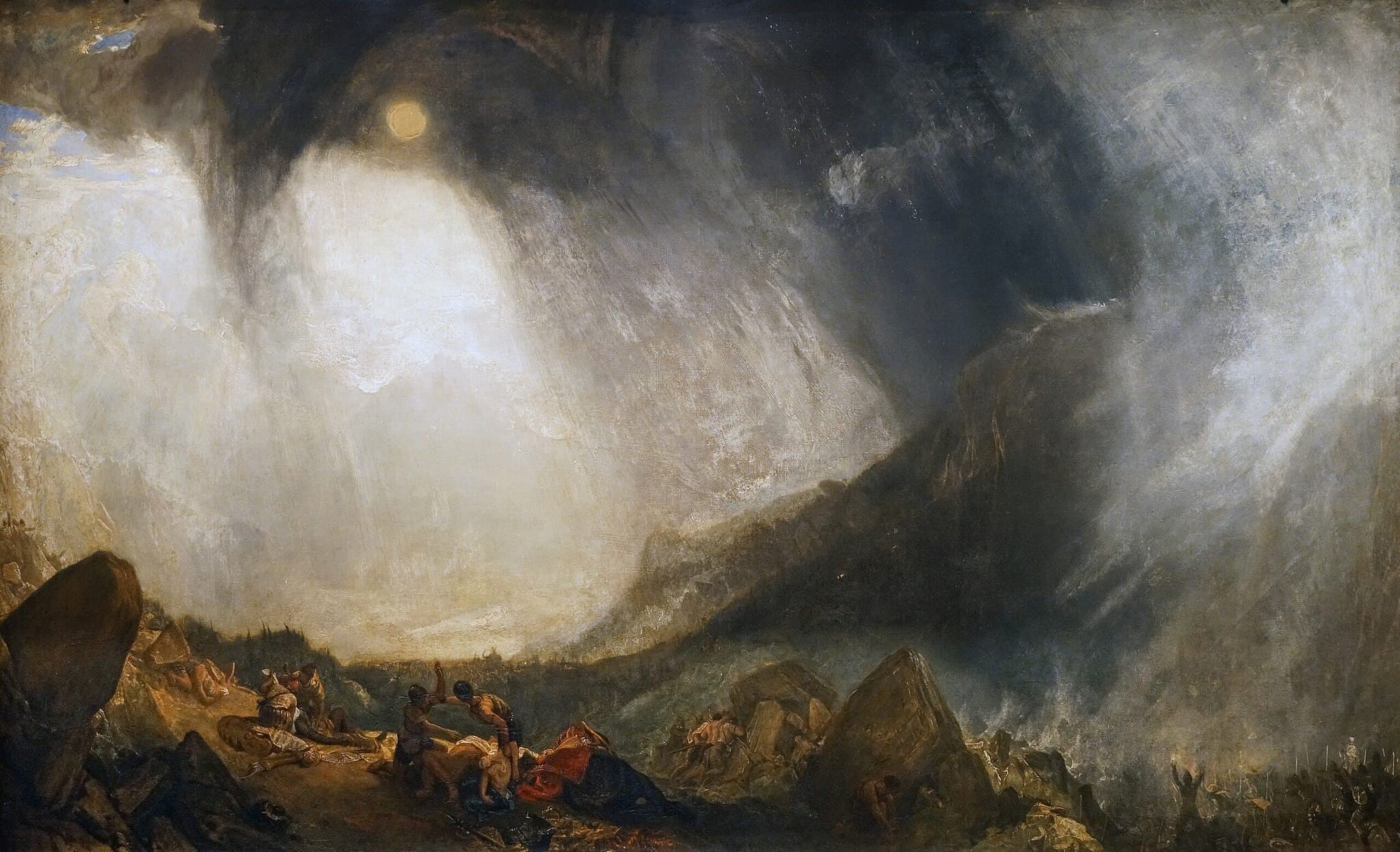
Snow Storm: Hannibal and his Army Crossing the Alps
J. M. W. Turner, 1812 • Oil on canvas
Read full analysis of Snow Storm: Hannibal and his Army Crossing the Alps →Valuation Analysis
Snow Storm: Hannibal and his Army Crossing the Alps (c.1812) is a museum‑held Turner oil that has not been price‑tested in the modern market; based on comparable modern sales of major Turners and current market conditions, my hypothetical liquidation range is USD 20,000,000–60,000,000. This estimate assumes the work is in stable, original condition and that provenance/exhibition history is consistent with public‑catalogue records; confidence is moderate‑to‑low because the painting is held by a national collection and has not been offered publicly in recent times.
The painting is recorded in public‑collection catalogues and is held as part of the Turner Bequest (Tate accession N00490), which explains the absence of recent auction testing and introduces legal and practical barriers to a sale [1]. Museum ownership confers curatorial prestige that would increase buyer interest, but it also removes normal market price discovery; any estimate is therefore extrapolative and contingent on extraordinary circumstances (deaccession, private sale, or a lender deciding to sell).
Price benchmarks come from a small set of high‑quality, modern sales: Sotheby’s sale of Rome, from Mount Aventine in 2014 (reported c. £30.3m) and Modern Rome — Campo Vaccino in 2010 (reported c. £29.7m), which together demonstrate that major Turner oils can achieve high‑multi‑million to low‑double‑tens‑of‑millions USD in the open market [2]. By contrast, recent rediscoveries and lesser oils have sold in the low millions, underscoring the steep value gradient across quality tiers.
Applying these comparables, the lower bound of USD 20M reflects a cautious market entry price for a canonical but not universally iconic Turner that may require conservation, has potential exhibition liabilities, or lacks the full cachet of the top‑tier Rome canvases. The upper bound of USD 60M reflects the credible upside if the work were in exceptional original condition, accompanied by pristine provenance, a recent conservation dossier and an exhibition history that prompts institutional bidding or a competitive private sale. Achieving the top end would also depend on timing and buyer appetite.
Key value drivers that could materially move the estimate include confirmed condition/conservation reports, complete provenance and exhibition history, and the selling vehicle (auction vs. private placement). Next steps to refine the valuation: obtain Tate’s conservation file and provenance notes, commission technical imaging and a condition report, and solicit confidential market opinions from senior Old Masters specialists at major houses. I can assist in commissioning that due diligence on request.
Key Valuation Factors
Art Historical Significance
High ImpactSnow Storm is regarded in Turner scholarship as a pivotal early‑career demonstration of the Romantic 'sublime', executed at scale and in oil during a formative period (c.1812). It is frequently cited in catalogues raisonnés and exhibition literature, which gives it strong academic weight. High scholarly significance increases institutional appetite and curatorial endorsement—both important drivers of value for canonical artists. However, scholarly status must be converted into market competition (bidding between institutions or deep‑pocket private buyers) to realize top prices; academic importance alone does not guarantee auction outcomes without favorable condition and sale circumstances.
Provenance & Ownership
High ImpactThe painting’s long institutional ownership—accepted under the Turner Bequest and held by Tate Britain (accession N00490)—provides unimpeachable provenance and curatorial validation. Those qualities typically support higher valuations because museums and lenders prize such works. Conversely, museum ownership also places legal, political and policy hurdles (deaccession rules, export controls, public scrutiny) in the pathway of sale, suppressing normal market availability. If offered, its museum provenance will attract institutional bidders and elite private collectors, amplifying potential competition but complicating or delaying a transaction.
Condition & Conservation
Medium ImpactCondition is decisive for a large, two‑century‑old Turner oil. Issues common to the artist—old varnish, relining, paint stability and historic retouching—can materially reduce realized value if not properly documented and treated. No publicly published contemporary conservation dossier appears readily available; therefore the estimate assumes an intermediate state. A documented original surface and recent professional conservation justify upward pricing, while evidence of heavy past interventions or unstable paint would lower marketability and could push the work toward the lower end of the band or below.
Comparable Sales & Price Benchmarks
High ImpactBenchmark sales for major Turner oils provide the primary market anchors: top modern auction results (notably Sotheby’s Rome canvases in 2010 and 2014) demonstrate that canonical Turners can achieve high‑multi‑million to low‑double‑ten‑million prices. These comparables justify positioning a museum‑quality Turner in a mid‑to‑upper tens‑of‑millions band when condition and provenance are exceptional. At the same time, rediscovery and lesser‑quality works have traded in the low millions, highlighting a sharp value gradient and reinforcing the need to treat this valuation as a comparable‑driven range rather than a fixed price.
Marketability & Buyer Pool
High ImpactDemand is concentrated among major museums, a small set of ultra‑high‑net‑worth collectors, and blue‑chip private dealers; this limited but deep buyer pool can drive strong prices when multiple parties compete. Institutional budgets, export licensing and national retention mechanisms (particularly relevant for UK national collections) affect the feasible buyer set and can constrain cross‑border sales. Marketing strategy, alignment with major exhibitions or scholarly campaigns, and confidentiality of the sale process are therefore critical to optimize realized value.
Sale History
J. M. W. Turner's Market
J. M. W. Turner occupies the top echelon of 19th‑century British art and remains highly sought after by institutions and informed private collectors. Liquidity for signature oils is limited because many major canvases are held in public collections, and as a result, when genuinely comparable works come to market they can command prices in the multi‑millions to tens of millions of dollars. The market rewards canonical quality, clean provenance and technical documentation; by contrast, studio works or poorly documented pieces trade at a markedly lower tier. Overall, Turner is a blue‑chip market name but realized prices concentrate in a small number of trophy works.
Comparable Sales
Rome, from Mount Aventine
J. M. W. Turner
Major, museum-quality Turner oil sold at auction (artist auction high in modern market); comparable in scale and institutional desirability to Snow Storm.
$47.5M
2014, Sotheby's, London
~$62.8M adjusted
Modern Rome — Campo Vaccino
J. M. W. Turner
Large canonical Turner canvas sold to a major museum (Getty); strong precedent for top-tier Turner oil prices and institutional demand.
$44.9M
2010, Sotheby's, London
~$64.5M adjusted
Rediscovered early Turner (Sotheby's Old Masters & 19th‑Century sale)
J. M. W. Turner
Recent rediscovery/attribution example from Summer 2025 showing market appetite for newly attributed Turners at lower price tiers; illustrates attribution/story effects on value.
$2.6M
2025, Sotheby's, London
Current Market Trends
Current market conditions for major Turners are cautiously positive: institutional programming (anniversaries/exhibitions) has renewed attention and selectively boosted demand, but the broader Old Masters/19th‑century segment remains narrower and more selective than the contemporary market. Buyers prize provenance, conservation dossiers and exhibition history; rediscoveries attract premium interest, yet macro headwinds and tighter liquidity keep the market disciplined. Successful high‑end sales depend on rigorous due diligence and targeted marketing to institutions and the small pool of qualified private collectors.