How Much Is The Burning of the Houses of Lords and Commons, 16 October 1834 Worth?
Last updated: April 10, 2026
Quick Facts
- Methodology
- comparable analysis
If this is the canonical, autograph 1834–35 oil by J. M. W. Turner now in public collections, it is effectively not available for normal sale; a hypothetical market or insurance/replacement valuation is $20–60M. If the object is a smaller autograph oil sketch, study, or a watercolour/workshop copy, values decline steeply to the mid‑six‑figures or low millions depending on attribution, condition and provenance.
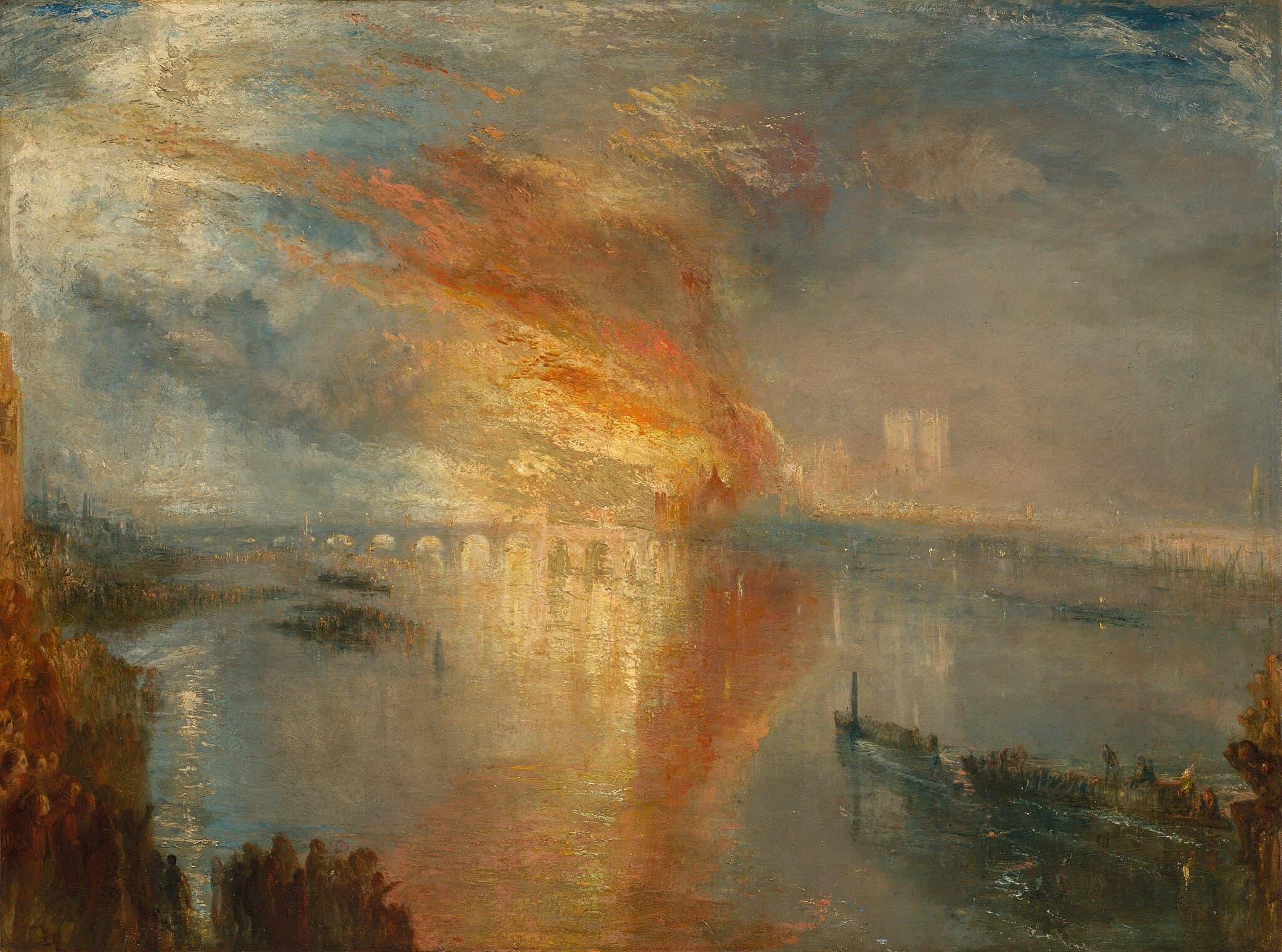
The Burning of the Houses of Lords and Commons, 16 October 1834
J. M. W. Turner, 1834 • Oil on canvas
Read full analysis of The Burning of the Houses of Lords and Commons, 16 October 1834 →Valuation Analysis
Conclusion and approach: This valuation uses a comparable analysis anchored to Turner's rare museum‑quality oils and the most recent market evidence for autograph works and rediscoveries. The two canonical large oils of The Burning of the Houses of Lords and Commons are held in major public collections (for example the Philadelphia example) and are therefore effectively removed from the commercial market; that institutional status is the principal reason this must be treated as a hypothetical insurance/replacement valuation rather than a conventional auction estimate [1].
Market anchors and comparables: The upper bound of the range is informed by the highest recent auction benchmark for a major Turner oil (Rome, from Mount Aventine, sold at Sotheby’s in 2014) which establishes the ceiling for museum‑quality late oils by Turner [2]. The mid‑market evidence is provided by recent rediscoveries and the active market for Turner works on paper and small oils: rediscovered autograph oils have recently realised in the low millions when marketed and authenticated, while high‑quality watercolours and drawings trade in the mid‑six‑figure to low‑seven‑figure band [4][5]. These outcomes combined support a multi‑tens‑of‑millions hypothetical replacement range for a canonical, large autograph oil, and much lower numbers for sketch/study variants.
Why $20–60M: The low end ($20M) reflects a conservative insurance/replacement estimate for a canonical autograph canvas that is highly significant but slightly below the absolute top Turner market ceiling in scale and public prominence. The high end ($60M) reflects the price a once‑in‑a‑generation museum‑quality Turner oil might realise if it were to appear in a competitive global sale and attract institutional as well as private bidders — an outcome driven by rarity, publicity and a favourable market window (the 2014 Rome sale demonstrates the market can reach this neighborhood for exceptional works) [2].
Conditional scenarios and next steps: If the object at hand is a smaller oil sketch by Turner the market expectation is roughly $1M–$8M; if it is a Turner watercolour or study the band typically ranges from $10k to several hundred thousand dollars, with the very best sheets reaching mid‑six figures. To refine any estimate further obtain high‑resolution images, exact dimensions, a full provenance chain, and a professional condition report including technical imaging and pigment analysis. If desired, approach a Turner specialist at a major auction house or a recognized Turner scholar for a formal attribution opinion and catalogue raisonné citation.
Final practical note: For the canonical 1834 painting the figure presented is an insured/replacement style valuation rather than a predicted hammer price; these works are rarely, if ever, offered and their value is driven as much by institutional importance and market scarcity as by recent sale comparables [1][2].
Key Valuation Factors
Art Historical Significance
High ImpactThe Burning of the Houses of Lords and Commons is an iconic subject in Turner's output: a dramatic depiction of a major national event that showcases his late interest in atmosphere, light and spectacle. Works that combine a high‑impact historical subject with Turner's mature palette and handling attract intense scholarly attention, frequent reproduction and institutional demand. The subject's narrative weight and visual drama materially increase cultural value and institutional desirability, which in turn elevates hypothetical market or insurance valuations. For a confirmed autograph, museum‑quality canvas this factor is one of the strongest positive drivers of price.
Provenance & Institutional Status
High ImpactProvenance is decisive. The best documented examples of this subject entered public collections early in the 20th century and form part of national holdings; works with direct Turner bequest or long museum ownership are effectively removed from the open market, which both limits supply and raises replacement/insurance valuations. Conversely, works with interrupted or dubious provenance suffer discounts. A canonical painting with continuous, museum‑quality provenance commands a premium because it will attract institutional interest and buyer confidence if it were ever to emerge.
Condition & Conservation
High ImpactCondition is a core quantitative variable. Turner oils often carry historical varnish, relining, and retouching which materially affect appearance and market reception. A stable, well‑documented conservation history and positive technical imaging (infrared, x‑ray, pigment analysis) support higher valuations and buyer confidence. Conversely, heavy overpainting, severe craquelure, or unresolved conservation issues can produce steep discounts. A professional condition report and technical attribution work are essential before any firm market positioning or insurance valuation.
Rarity & Market Supply
High ImpactLarge, museum‑quality Turner oils of iconic subjects are extremely scarce in private hands. This scarcity is a principal value driver: when such works appear they are treated as once‑in‑a‑generation opportunities and may attract global museum and private bids that lift price beyond ordinary comparables. The rarity premium is less pronounced for sketches, studies and works on paper, where supply is larger and auction frequency higher. Market supply dynamics therefore push canonical oils into the multi‑tens‑of‑millions bracket while placing studies in much lower bands.
Exhibition & Bibliography
Medium ImpactA documented exhibition history, catalogue raisonne entry, and sustained scholarly bibliography significantly increase market value. Publications and prominent loans build purchaser confidence and can convert a strong attribution into a market‑leading result. The presence of the work in major retrospectives or high‑profile research projects (for example Turner anniversary programming) elevates both cultural and commercial profiles and strengthens arguments for higher insurance/replacement sums.
Sale History
Sotheby's London (Evening sale)
Sotheby's London (Old Masters)
Christie's London (Works on Paper)
J. M. W. Turner's Market
J. M. W. Turner occupies the top tier of 19th‑century British art markets. His large autograph oils remain rare on the private market and set the ceiling for artist pricing when they do appear. Turner's works on paper are more liquid and have shown consistent demand in the mid‑six‑figure to low‑seven‑figure bands; notable rediscoveries and reattributions have produced headline sales in recent years. Institutional interest is strong and global, and benchmark sales (notably a major oil sold in 2014) continue to inform valuations for comparable masterpieces.
Comparable Sales
Rome, from Mount Aventine
J. M. W. Turner
Large, canonical late oil by Turner (c.1835) sold in a major evening sale—sets the market ceiling for museum‑quality Turner oils and is comparable by period, scale and significance to a canonical 'Burning' oil.
$47.4M
2014, Sotheby's London (Evening Sale)
~$58.8M adjusted
The Rising Squall, Hot Wells, from St Vincent’s Rock, Bristol
J. M. W. Turner
Autograph oil rediscovered and reattributed then sold in 2025—illustrates how small/medium autograph oils can reach low‑millions when properly authenticated and marketed (useful parallel if a smaller 'Burning' variant appeared).
$2.6M
2025, Sotheby's London (Old Masters)
Lake Brienz, with the Setting Moon
J. M. W. Turner
High‑quality Turner watercolour sold in the 2025 London sales—represents the active, more liquid market band for works on paper (mid‑six to low‑seven figures) versus oils.
$1.0M
2025, Christie's London (Works on Paper sale)
Lake of Geneva from Above Vevey
J. M. W. Turner
Another mid‑2025 Turner watercolour realisation—reinforces the mid‑six‑figure price band for well‑provenanced works on paper and helps bracket lower‑end market expectations for non‑oil variants.
$663K
2025, Sotheby's London (Master Works on Paper)
Current Market Trends
Through 2024–2026 the Turner market has been characterised by strong institutional interest (anniversary programming and exhibitions), active demand for works on paper, and selective premiums for authenticated rediscoveries. Major oils remain rare and command the highest prices when they appear; the mid‑market is driven by watercolours, studies and occasional reattributions that can significantly change individual lot outcomes.
Sources
- Philadelphia Museum of Art — object page for The Burning of the Houses of Lords and Commons
- Sotheby's coverage — Turner leads Old Masters evening sale (Rome, from Mount Aventine sale as benchmark)
- Cleveland Museum of Art — object page for The Burning of the Houses of Lords and Commons
- The Art Newspaper — coverage of the rediscovered Turner sold at Sotheby's (2025)
- Christie's — sale note for Turner watercolour (Lake Brienz)