How Much Is Harvesters Resting (Ruth and Boaz) Worth?
Last updated: April 1, 2026
Quick Facts
- Methodology
- comparable analysis
This canvas (Harvesters Resting / Ruth and Boaz, 1850–53) is museum‑held at the Museum of Fine Arts, Boston with direct early provenance, so it has no modern auction record. Assuming full attribution, good condition and standard sale preparation, a realistic public‑sale range is approximately $1,000,000 to $3,000,000, with movement within that band dependent on condition, technical findings and exhibition/publication history.
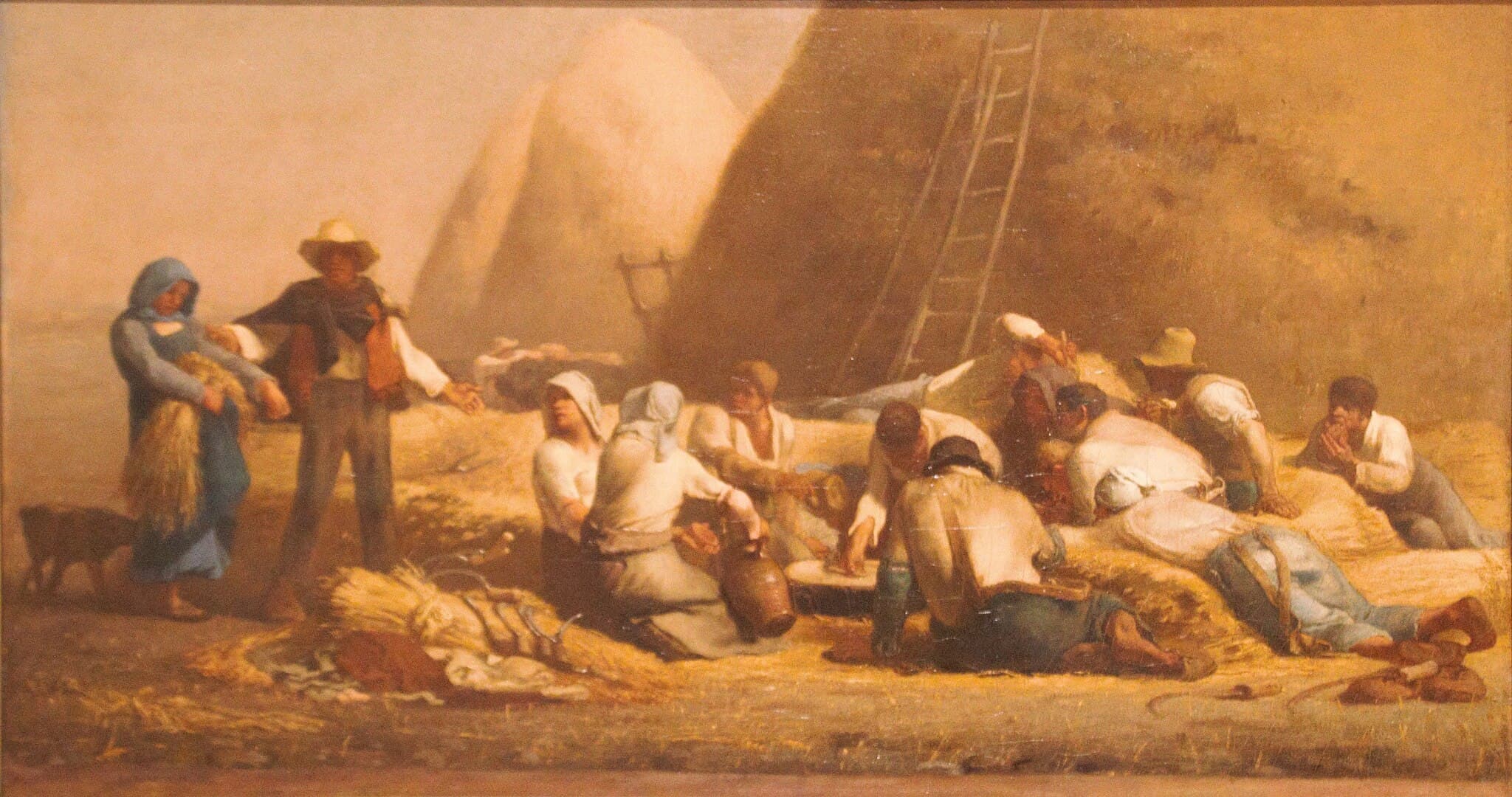
Harvesters Resting (Ruth and Boaz)
Jean-Francois Millet • Oil on canvas
Read full analysis of Harvesters Resting (Ruth and Boaz) →Valuation Analysis
Harvesters Resting (Ruth and Boaz) (Jean‑François Millet, 1850–53) is a museum‑owned oil in the Museum of Fine Arts, Boston (accession 06.2421). The MFA records early, direct provenance—sold by Millet to Martin Brimmer at the Salon of 1853 and later bequeathed to the Museum in 1906—so there is no modern auction sale record for this canvas [1]. If hypothetically offered with full attribution, sound condition and professional marketing by a major house, a reasonable public‑sale expectation would be approximately $1,000,000 to $3,000,000.
This range is anchored to public comparables and recent market patterns. Millet’s documented public ceilings include L’Horizon (La plaine), a work on paper realized at $1,985,000 in 2014, and a strong oil result reported for La fin de la journée at ~ $1,538,500 in 2011; these results set the objective public anchors for the artist and—when inflation‑adjusted—place fully marketable Millet pictures in the low‑to‑mid millions [2][3]. Works on paper sometimes eclipse oils publicly, but large, museum‑quality canvases with comparable pedigree are rare on the market.
Recent auction activity indicates a segmented market: many Millet lots (drawings, pastels and smaller oils) trade in the five‑figure band, while solid mid‑ to high‑six‑figure results are common for well‑provenanced oils. For example, late‑2024 sale coverage records works realizing in the low hundreds of thousands, illustrating steady but specialized demand and the premium that accrues to fresh, well‑documented examples offered at major houses [4].
Specific strengths for the MFA canvas are its secure early provenance, institutional custody and substantial format (67.3 × 119.7 cm). Principal uncertainties that could materially reduce value are condition issues (relining, heavy retouching, structural problems) or any unresolved attribution questions (workshop involvement or later repetition). Those variables can only be resolved by an in‑person conservator’s condition report and technical imaging (X‑ray, infrared reflectography, pigment analysis) which will largely determine whether the work sits at the bottom, midpoint, or top of the estimate [1].
Operationally, the low end of the range (~$1M) represents a conservative auction outcome for a marketable but non‑trophy Millet; the high end (~$3M) describes a best‑case auction or competitive private‑treaty sale where scholarship, condition, exhibition history and bidder interest converge. Private sales and institutional transfers can exceed public records, but the publicly documented evidence to date supports a prudent $1M–$3M band. For a firm insurance or sales valuation, obtain high‑resolution images, a conservator’s report, technical imaging and a formal specialist review; note that any sale of an MFA‑owned work would involve deaccession protocols [5].
Key Valuation Factors
Art Historical Significance
High ImpactJean‑François Millet is a central figure of mid‑19th‑century French Realism and the Barbizon school, and works that display his characteristic peasant themes carry meaningful scholarly and market weight. Harvesters Resting merges Millet’s rural labor focus with a biblical overlay (Ruth and Boaz), creating additional iconographic interest that enhances academic appeal. Although not in the same canonical tier as The Gleaners or The Angelus, this painting’s date (1850–53) situates it within an important period of Millet’s production. Institutional recognition (MFA custody) confirms the work’s cultural significance; this historical weight is a primary driver of premium versus anonymous school pieces.
Provenance & Legal Title
High ImpactThe documented chain—sold by Millet to Martin Brimmer at the Salon of 1853 and eventually bequeathed to the Museum of Fine Arts, Boston (accession 06.2421)—is a major positive on marketability and price confidence. Clear 19th‑century provenance reduces title risk, increases buyer trust, and simplifies underwriting for sale or insurance. Museum accession records and any associated archival documentation (bills, sale receipts or exhibition references) materially reduce transaction friction; that provenance is among the most important non‑technical value enhancers for 19th‑century French paintings and supports placement toward the upper part of a marketable range.
Condition & Technical Authentication
Medium ImpactCondition and technical authentication decisively affect price. Common issues with 19th‑century oils (varnish discoloration, localized retouching, relining or canvas weakness) can depress value or require costly restoration. Conversely, favorable conservation findings (original ground, period materials, minimal intrusive restoration) can add several hundred thousand dollars to an estimate. Technical imaging (X‑ray, IRR) and pigment analysis can confirm period materials and evidence of Millet’s hand (underdrawing/compositional alterations). Because condition is presently unknown to us, a conservator’s report is essential to refine the valuation and allocate the painting into the low, mid or high end of the estimate.
Market Comparables & Price Evidence
High ImpactPublic auction comparables give the clearest anchor: L’Horizon (La plaine) achieved $1,985,000 at Christie’s in 2014 and a well‑documented oil (La fin de la journée) realized ~ $1,538,500 in 2011; these results establish mid‑million public precedents for the artist [2][3]. More recent sales show many well‑provenanced Millet oils and works on paper achieving mid‑to‑high six‑figure results and occasional seven‑figure outcomes in exceptional cases [4]. Because Harvesters Resting is large, dated and institutionally provenanced, these comparables justify a low‑to‑mid‑millions public‑sale expectation, with private treaty outcomes potentially exceeding these anchors.
Rarity, Exhibition & Publication
Medium ImpactInstitutional custody increases scholarly visibility and can both elevate and limit market outcomes: a museum‑owned, well‑catalogued work gains credibility and is more desirable to major collectors, but it is also rarely offered on the open market. Inclusion in exhibition catalogues or a catalogue raisonné materially increases value by broadening provenance and buyer interest. Recent institutional attention to Millet (major museum acquisitions and focused exhibitions) heightens demand for museum‑quality examples; if this canvas has published exhibition history or catalogue citations, that would push a sale toward the top of the estimate band.
Sale History
Harvesters Resting (Ruth and Boaz) has never been sold at public auction.
Jean-Francois Millet's Market
Jean‑François Millet is firmly established in the 19th‑century French canon; his most important works are widely held by museums and attract steady collector interest. Public auction ceilings so far have been in the mid‑single millions (notably a near‑$2M work on paper in 2014 and a ~$1.5M oil in 2011), while the bulk of market activity sits in the five‑ and six‑figure bands for drawings, pastels and smaller oils. Institutional acquisitions and curated exhibitions have increased Millet’s visibility, but the market remains specialist and segmented—provenance, condition and exhibition history remain the primary value levers.
Comparable Sales
L’Horizon (La plaine)
Jean-François Millet
Top public auction result for Millet (pastel + crayon). Although a work on paper (different medium), it establishes the public-market ceiling for high-demand, rare Millet material and is therefore useful as an upper-bound benchmark.
$2.0M
2014, Christie's New York
~$2.7M adjusted
La fin de la journée (effet du soir)
Jean-François Millet
High public-auction result for an oil painting by Millet; similar medium and period to Harvesters Resting, making it a strong market comparable for large oils.
$1.5M
2011, Christie's New York
~$2.2M adjusted
Portrait of Madame Martin
Jean-François Millet
Recent mid-six-figure sale of a Millet oil at a major house; useful as a midpoint comparable for well-documented oils that are not canonical museum centerpieces.
$625K
2021, Christie's New York
~$736K adjusted
Paysanne veillant son enfant
Jean-François Millet
Very recent sale showing current demand levels for Millet works at auction; represents the lower/mid end of publicly realized prices for good-quality works.
$302K
2024, Christie's New York
~$307K adjusted
Current Market Trends
The current market for Barbizon and mid‑19th‑century French painting is steady and specialist. Institutional programming (notable museum acquisitions and major Millet exhibitions) has raised visibility and typically produces a modest uplift for top examples; however, no new sustained public‑auction record has displaced the 2014/2011 ceilings. Demand favors well‑documented, fresh‑to‑market canvases with clean title and solid condition; timing sales to follow major exhibitions and preparing full technical dossiers increases likelihood of top outcomes.
Sources
- Museum of Fine Arts, Boston — Harvesters Resting (Ruth and Boaz) (object page)
- Christie’s press results — 19th Century European Art (L’Horizon/La plaine sale, 2014)
- La fin de la journée (reported Christie’s result, 2011) — Wikimedia image / sale reference
- HENI / Christie’s coverage — Millet sales recap (example: Paysanne veillant son enfant, 2024)
- National Gallery — Millet: Life on the Land (exhibition press materials)
- Van Gogh Museum — 2023 Annual Report (acquisition reference)