How Much Is Le Printemps (Spring / Daphnis and Chloe) Worth?
Last updated: April 1, 2026
Quick Facts
- Methodology
- comparable analysis
Le Printemps (Daphnis and Chloë), 1865, by Jean‑François Millet is a documented, museum‑held, large autograph canvas (Matsukata Collection, National Museum of Western Art, Tokyo). If hypothetically offered on the open market under a clean deaccession or private‑treaty sale and assuming good condition, a reasoned market estimate is approximately US$2,000,000–$8,000,000, driven by size, provenance, exhibition history and Millet comparables.
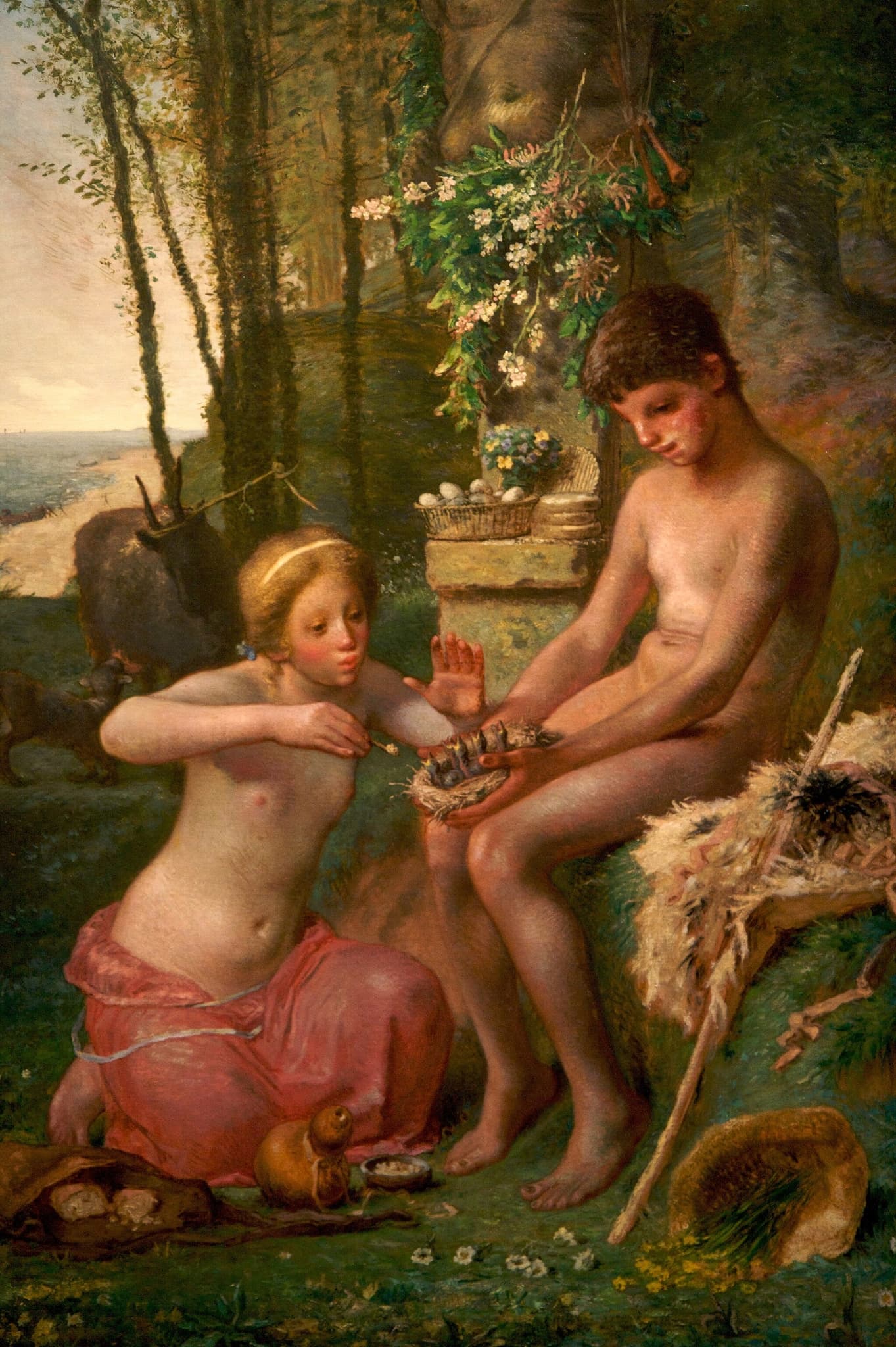
Le Printemps (Spring / Daphnis and Chloe)
Jean-Francois Millet • Oil on canvas
Read full analysis of Le Printemps (Spring / Daphnis and Chloe) →Valuation Analysis
Overview. Le Printemps (Daphnis and Chloë), dated 1865, is an autograph, large‑scale canvas by Jean‑François Millet in the Matsukata Collection now held at the National Museum of Western Art (NMWA) in Tokyo. The work’s physical scale (235.5 × 134.5 cm), nineteenth‑century provenance and museum‑level illustration/literature presence materially support a premium if it were legitimately offered for sale [1]. Because the painting has been in institutional custody for the better part of a century, no modern market hammer exists for this specific canvas; the numeric range below is therefore hypothetical and conditional on a lawful deaccession or private treaty sale.
Method and anchors. This valuation uses a comparable‑analysis approach anchored to Millet auction performance and to the painting’s attributes. Public comparables include a high reported pastel sale (L’Horizon, Christie’s New York, 2014, reported ≈ $1.985m) and a notable oil sold in 2011 (reported ≈ $1.538m) plus multiple mid‑six‑figure oil results in the 2010s–2020s that establish a routine trading band for market‑grade Millet oils [2][3]. Drawings and pastels have sometimes outperformed small oils, but museum‑quality large canvases are scarce and can command premiums for size, condition and provenance.
Numerical range and rationale. The suggested market range of US$2,000,000–$8,000,000 reflects two scenarios. The lower bound (≈ $2.0M) is a conservative, market‑tested figure for a well‑provenanced Millet oil that is not a universally recognised masterpiece but is materially rarer than routine studio works. The central evidence for this floor is the cluster of mid‑six‑figure oil sales and the occasional seven‑figure result for higher‑quality works. The upper bound (≈ $8.0M) models a low‑probability, best‑case outcome: a high‑profile sale or private treaty contested by institutions/blue‑chip collectors, favourable market conditions, and pristine conservation—which together could drive competitive bidding above previously recorded public highs for oils.
Downside and qualifiers. Value is very sensitive to attribution, condition, and legal/deaccession constraints. If technical study revealed significant restoration, later overpainting, or if attribution were reduced to workshop/circle, the painting’s market value could fall into the tens of thousands to low hundreds of thousands. Equally important: major museum holdings of Millet’s canonical works create scarcity and institutional interest, but public institutions rarely deaccession such pieces, so the probability of an open‑market sale is low and the hypothetical range assumes an exceptional and lawful sales pathway [1].
Next steps to refine value. Obtain a formal, written condition report and high‑resolution photography; commission technical analysis (IRR/X‑ray/pigment sampling) to confirm autograph status; compile a full provenance dossier and literature/exhibition citations from the NMWA entry; and obtain pre‑sale estimates from Christie’s/Sotheby’s/major specialist dealers. Those steps can tighten the estimate materially and identify the most appropriate sales channel.
Key Valuation Factors
Art Historical Significance
High ImpactLe Printemps is a large, late‑period Millet canvas executed in 1865 and forming part of a decorative 'Four Seasons' conception. While Millet is best known for peasant subjects (The Gleaners, The Angelus), this allegorical/seasonal canvas demonstrates his late‑career handling at scale and contributes to scholarship on his non‑canonical compositions. Because large, illustrated, and literature‑cited works by Millet are uncommon on the market, the painting’s intrinsic art‑historical interest elevates its desirability for institutions and private collectors seeking museum‑quality 19th‑century works. This factor therefore has a materially positive effect on market value, particularly when coupled with published provenance and exhibition history.
Provenance & Exhibition History
High ImpactThe painting’s documented chain (original ownership/commission, 19th‑century sales at Hôtel Drouot, passage through Durand‑Ruel and American collecting circles, acquisition by Kōjirō Matsukata and eventual transfer to NMWA) materially strengthens market confidence. Provenance items such as Durand‑Ruel and Havemeyer links, plus inclusion in the Matsukata Collection and museum cataloguing, reduce attribution risk and support institutional interest. Exhibition and literature citations that accompany the canvas increase transparency and buyer willingness to pay premium prices. In short, a strong provenance is one of the single most important positive drivers in the valuation.
Condition & Technical State
High ImpactLarge nineteenth‑century canvases are frequently relined or restored; the painting’s current physical condition (varnish, craquelure, retouching, structural stability) will have an outsized impact on market value. If the canvas is sound and retains original paint and handling, it will support the valuation range given; conversely, heavy restoration, unstable ground or significant later additions can depress marketability and price substantially. Because we have not reviewed a contemporary conservation report, technical verification (X‑ray, IRR, pigment analysis) is essential to confirm autograph status and to quantify condition‑driven valuation adjustments.
Comparables & Auction Record
High ImpactMarket anchors include notable Millet results: the reported Christie’s pastel (L’Horizon) at c. $1.985M (2014) and a significant oil at c. $1.538M (2011); more typical oils trade in the mid‑six‑figure band. Those public results establish both a ceiling for market‑tested Millet material and a routine trading band. Because Le Printemps is significantly larger and better‑provenanced than many comparables, it merits a premium above routine oils; the valuation range presented is calibrated to those documented auction outcomes and to how large, well‑provenanced canvases historically perform when they appear.
Rarity & Market Demand / Exhibition Exposure
High ImpactThe scarcity of large, museum‑quality Millet canvases on the market and renewed institutional focus (notably anniversary exhibitions and scholarship cycles) enhance demand. Publicity tied to major exhibitions or catalogue publications can materially lift buyer interest and realized prices. Regional demand (notably in Europe and Asia) and the propensity of institutions to acquire canonical or contextually important canvases add upward pressure. Deaccession constraints remain the primary limiting factor; if a clean sale pathway exists, rarity plus exposure can push a sale toward the top of the provided range.
Sale History
Le Printemps (Spring / Daphnis and Chloe) has never been sold at public auction.
Jean-Francois Millet's Market
Jean‑François Millet (1814–1875) is a central figure of the Barbizon/Realist movement. His most iconic paintings are concentrated in major museums, creating scarcity on the market. Historic and recent auction evidence shows that Millet works on paper and pastels often attract strong bidding, while oils typically trade in the mid‑five to mid‑six‑figure band; occasional high‑profile lots have reached the low seven figures. Institutional provenance, exhibition history and literature significantly enhance marketability; conversely, workshop attributions or poor condition reduce value sharply.
Comparable Sales
L'Horizon (La plaine)
Jean‑François Millet
Artist's modern auction high (pastel) — establishes a market ceiling for top-quality Millet material that comes to market; different medium (pastel) and typically smaller than Le Printemps.
$2.0M
2014, Christie's, New York
~$2.7M adjusted
La fin de la journée; effet du soir
Jean‑François Millet
Significant Millet oil sold at a strong price in 2011 — a useful anchor for high‑quality oils prior to the recent rise in interest.
$1.5M
2011, Christie's, New York
~$2.2M adjusted
Portrait of Madame Martin
Jean‑François Millet
A mid‑quality Millet oil sold in 2021 — representative of the mid‑six‑figure band for oil paintings by the artist in recent seasons.
$625K
2021, Christie's, New York
~$746K adjusted
Calling Home the Cattle
Jean‑François Millet
Another oil in the mid‑six‑figure range — supports the pattern that Millet oils commonly trade in the $300k–$800k band when offered.
$627K
2017, Sotheby's (reported)
~$828K adjusted
Paysanne veillant son enfant (charcoal & pastel)
Jean‑François Millet
Recent 2024 sale of a work on paper — illustrates current demand for Millet drawings/pastels and the upper end for works on paper in the 2023–2025 market.
$302K
2024, Christie's, New York
~$310K adjusted
Current Market Trends
The 19th‑century/Barbizon marketplace has been selective and somewhat subdued, with buyers focusing on provenance and scholarship. Institutional exhibitions (notably the 150th anniversary programming) and catalogue publications are currently boosting attention to Millet, but the sector remains price‑sensitive for mid‑quality works. Top, well‑provenanced examples can still attract competitive international bidding, especially when marketed through major houses or in private treaty.
Sources
- National Museum of Western Art (NMWA) — Collection entry: Spring (Daphnis and Chloë), P.1959-0146
- Christie's press — Results summary (includes L'Horizon (La plaine) 2014 reported result)
- Christie's lot entry — La fin de la journée; effet du soir (2011 sale reference)
- Christie's lot entry — Paysanne veillant son enfant (charcoal & pastel), Christie’s New York, Oct 2024