How Much Is Man with a Hoe Worth?
Last updated: April 1, 2026
Quick Facts
- Methodology
- comparable analysis
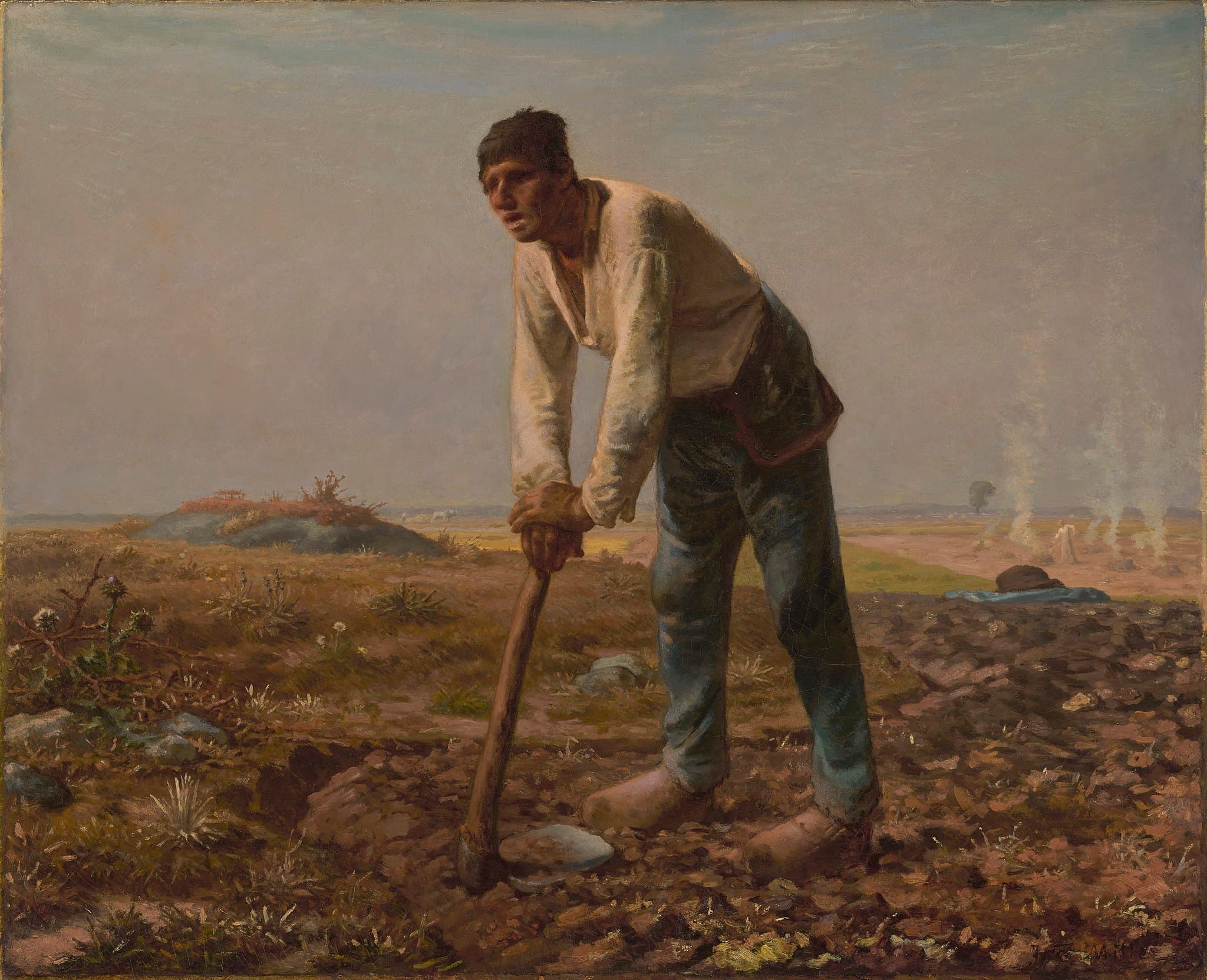
Assuming an autograph oil on canvas by Jean‑François Millet, a museum‑quality Man with a Hoe would be valued at approximately $3,000,000–$15,000,000 today. Lesser‑quality autograph examples, workshop variants, or pieces with weak provenance would fall into substantially lower bands ($750k–$3M and $100k–$750k respectively).
Valuation Analysis
Valuation conclusion: On the basis of comparable auction evidence, institutional holdings and scarcity of museum‑quality Millet oils, I estimate an autograph oil of Jean‑François Millet titled Man with a Hoe would realistically command between $3,000,000 and $15,000,000 on the open market if it matched Getty‑level provenance and condition. This valuation uses comparative sales and institutional precedent as the principal anchors and assumes the work is an autograph oil in good to excellent condition.
Millet’s best oils are seldom offered on the secondary market and many canonical canvases are held by major museums, which materially restricts available supply. The Getty’s secure holding and recent scholarship around this motif underscore the painting’s cultural importance and market scarcity; the Getty catalogue and exhibition documentation provide a strong provenance model that drives top‑end interest but also means the canonical canvas is not market‑available for direct comparison [1]. Public auction evidence for Millet shows the highest modern willingness to pay for top‑quality works on paper near $2M, illustrating collector appetite for well‑provenanced material even when not an oil; a museum‑quality autograph oil would command a substantive premium above typical day‑sale oils because of extreme scarcity and institutional buyer interest [2].
The range reflects scenario pricing: at the low end ($3M) for a confirmed autograph oil of important size but with some condition issues or a shorter exhibition/publication record; mid‑range ($3M–$7.5M) for a well‑provenanced, finely executed autograph canvas with good condition and published history; and upper range ($7.5M–$15M) only for an indisputable, historically pivotal version with pristine provenance, pristine condition, and major exhibition/catalogue documentation. By contrast, accepted workshop pieces, later studio variants or works with unresolved attribution would typically be valued between $100,000 and $750,000, while good but non‑canonical autograph oils usually trade in the $750,000–$3,000,000 band.
Primary drivers of movement within this range are attribution certainty, the completeness and directness of provenance, condition/conservation history, and demonstrable inclusion in major exhibitions or catalogue raisonnés. To firm this opinion into a transaction‑grade valuation you should secure high‑resolution recto/verso photography, a conservation condition report, dendro/technical testing where appropriate, and specialist sign‑off (catalogue raisonné / Millet specialist). Institutional interest, marketing strategy and timing relative to major exhibitions (which can lift visibility) will also affect the final hammer figure.
Recommendation: treat $3,000,000–$15,000,000 as a contingent market window tied directly to autograph status and provenance. If you wish, provide images and full provenance and I will refine the estimate to a narrower marketable reserve or suggested pre‑sale estimate.
Key Valuation Factors
Art Historical Significance
High ImpactJean‑François Millet’s peasant imagery is central to 19th‑century realism and social‑iconography; the Man with a Hoe motif is emblematic of his focus on rural labor. A canonical autograph example that is demonstrably early or associated with a key exhibition/publication carries outsized scholarly and curatorial importance, attracting institutional bidders and private collectors who prize narrative and rarity. Such art‑historical weight elevates market value materially compared with routine studio outputs or later copies, because museums and major collectors pay premiums for works that reshape or exemplify an artist’s oeuvre.
Attribution / Authenticity
High ImpactAttribution is the single largest value determinant. Millet’s oeuvre includes studies, repetitive motifs, studio works and known 20th‑century forgeries; clear technical and connoisseurial attribution (signature, paint handling, ground, underdrawing, pigment analysis) is required to realize the top market bands. A catalogue‑raisonné entry or specialist sign‑off converts speculative value into transaction value. Without secure attribution the work will be priced as a workshop or derivative piece and suffer a major discount relative to an accepted autograph.
Provenance & Exhibition History
High ImpactDirect, continuous provenance (early exhibition records, documented private collections, acquisition by respected institutions) significantly raises realized values. Works with published exhibition histories and catalogue citations attract institutional bidders and reduce buyer hesitation. The Getty’s documented acquisition history serves as a model for premium provenance: a clear chain to a major museum justifies higher estimates and invites loan/exhibition opportunities that further enhance marketability and price realization.
Condition & Conservation
High ImpactCondition affects buyer confidence and insurability; issues such as relining, overpainting, structural damage or heavy inpainting materially reduce competitive bidding. A well documented conservation history with minimal invasive treatment supports top valuations. Conversely, unpredictable restoration needs increase buyer risk and typically lower pre‑sale estimates and final hammer prices. Condition reports and high‑res technical imaging are mandatory pre‑sale documents for works aiming at the $3M+ bracket.
Market Supply & Demand (Rarity)
High ImpactSupply of museum‑quality Millet oils available to the market is extremely limited because many key canvases are institutional holdings. Scarcity combined with episodic institutional demand (retrospectives, high‑profile loans) concentrates competition among a small pool of deep collectors and museums, which can push prices above normal day‑sale outcomes. Conversely, if multiple high‑quality examples enter the market simultaneously, realized prices could be attenuated; historically, however, single‑canvas scarcity tends to support premiums.
Sale History
Paris Salon
Private acquisition by Crocker family
Private sale to Getty Museum
Jean-Francois Millet's Market
Jean‑François Millet is a principal figure of mid‑19th‑century French realism whose most famous canvases (The Angelus, The Gleaners) are museum anchors. On the secondary market Millet’s works on paper and pastels have produced the highest public results in recent decades, while typical oils that appear in day sales trade in the mid‑six‑figure band. Truly canonical, museum‑quality Millet oils rarely appear for sale; when they do they attract institutional attention and can move into the low‑to‑mid seven‑figure range depending on provenance and condition. Attribution certainty and exhibition history are critical to crack the upper bands.
Comparable Sales
L’Horizon (La plaine)
Jean‑François Millet
Highest recent public Millet result (work on paper, pastel/crayon). Shows peak willingness to pay for top‑quality Millet material and the ceiling for strong, well‑provenanced works even when not an oil.
$2.0M
2014, Christie's New York
~$2.7M adjusted
Paysanne veillant son enfant (1858)
Jean‑François Millet
Recent sale of a Millet peasant/figure painting — similar subject matter and medium to Man with a Hoe; useful as a mid‑market oil comparable showing current demand for oil figures by Millet.
$302K
2024, Christie's New York
~$311K adjusted
The Wanderers
Jean‑François Millet
Another recent Millet oil sold in a day sale — a practical lower‑end oil comparable that indicates many Millet paintings trade in the low‑to‑mid six‑figure band.
$199K
2024, Sotheby's London
~$205K adjusted
Current Market Trends
Current market conditions show stabilization in the $1M–$10M bracket and contraction at the very top; exhibition programming and institutional acquisitions (which raise visibility) are primary short‑term demand drivers for 19th‑century realists. For Millet this means selective, exhibition‑driven competition for high‑quality works and steady demand for authentic drawings and small oils in the mid‑six‑figure range.