How Much Is The Potato Harvest Worth?
Last updated: April 1, 2026
Quick Facts
- Methodology
- comparable analysis
The Walters Art Museum's The Potato Harvest (1855) by Jean‑François Millet is a museum‑held, mature‑period Millet of moderate size and secure provenance. Based on recent Millet comparables, museum ownership and typical market behaviour for mid‑19th‑century Barbizon oils, a reasonable fair‑market range for a hypothetical sale is US$1.0–3.5M, with the final outcome driven by condition, exhibition/publication history and technical confirmation of attribution.
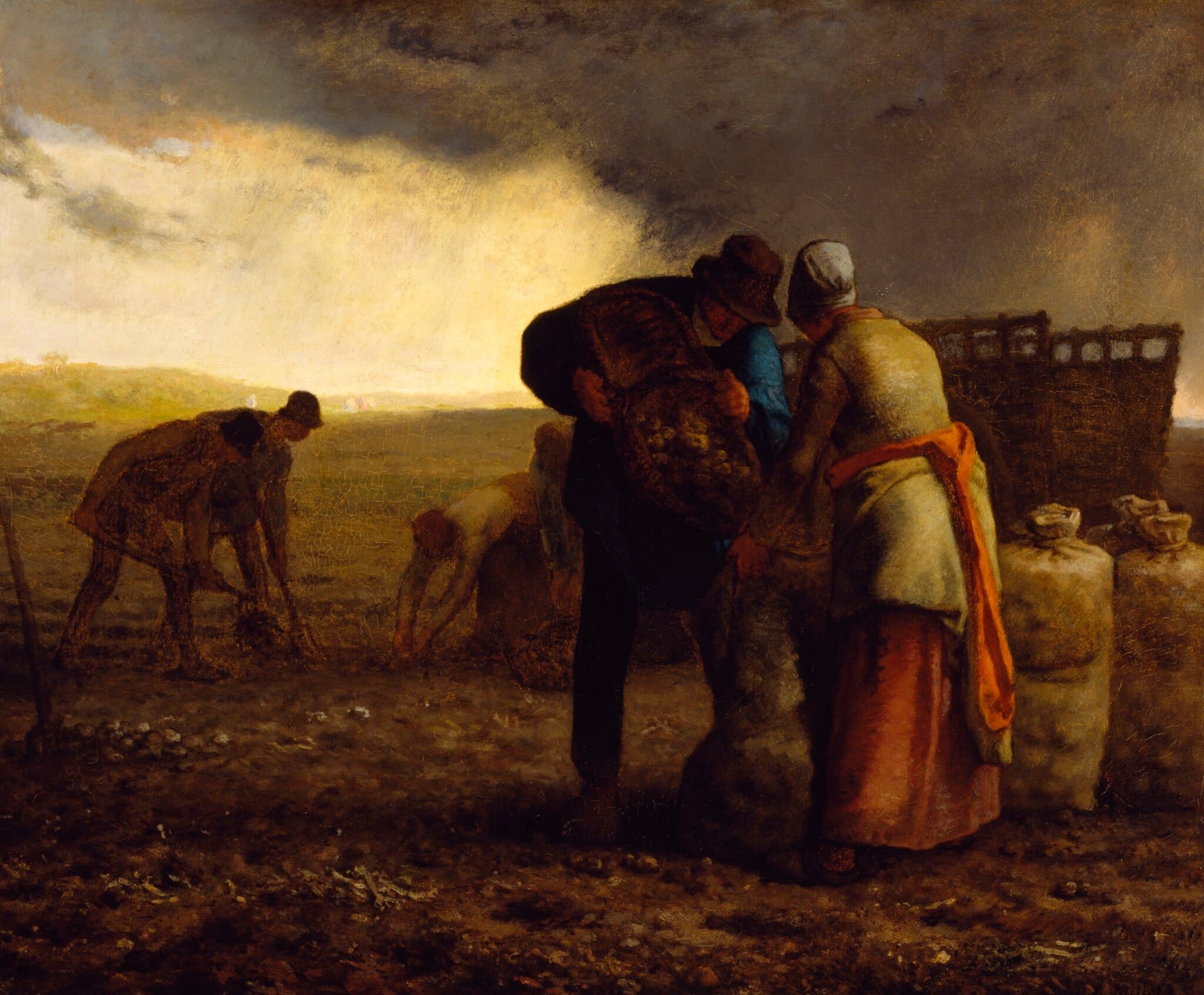
The Potato Harvest
Jean-Francois Millet, 1855 • Oil on canvas
Read full analysis of The Potato Harvest →Valuation Analysis
Work and provenance: The Potato Harvest (1855), oil on canvas (Walters Art Museum, acc. no. 37.115), is a securely provenanced Millet that entered William T. Walters's collection in the 19th century and was bequeathed to the Walters; the museum entry records dimensions c. 54 × 65.2 cm and an established conservation history [1]. That institutional ownership materially reduces attribution and provenance risk compared with an otherwise undocumented private canvas.
Comparable‑based valuation: Recent auction evidence for Millet shows finished oils commonly realize in the mid‑six‑figure band, while rare works on paper/pastels and the occasional standout oil have reached low seven‑figures or higher [2]. I therefore position The Potato Harvest, given its museum provenance and moderate scale (not among Millet's iconic large canvases), in a conservative market band of US$1,000,000–$3,500,000. The lower bound reflects realizations for solid, non‑canonical Millet oils; the upper bound reflects what a museum‑provenanced, well‑conserved Millet of this date might attract from both institutions and blue‑chip private collectors if surfaced with strong publication/exhibition support.
Key value drivers: The single largest positive is the Walters provenance: museum custody increases buyer confidence and can lift prices versus unattributed examples. Offsetting factors are the work's moderate size and the fact that Millet's highest multiples are reserved for iconic canvases (The Gleaners, The Angelus) or exceptionally rare pastels/drawings. Condition and any conservation history are decisive: an unaltered surface and full technical documentation will support the estimate; significant overpainting or structural interventions would reduce it.
Market context and route to sale: Millet remains collectible among museums and Barbizon specialists. If the Walters painting were ever to enter the market (deaccession or private sale), the optimal route for maximum value would be a major international saleroom with a pre‑sale loan or catalogue raisonné/exhibition tie‑in. Timing to coincide with Millet scholarship or a major Millet retrospective materially increases competitiveness among institutional and private bidders [2].
Recommendation: For any formal sale or insurance appraisal, obtain a current condition report, high‑resolution photography (front/back, details), IRR/X‑ray and a catalogue‑raisonné check. Those steps typically narrow the estimate band by eliminating attribution and condition uncertainty. Given current comparables and the Walters provenance, the stated band is a defensible market valuation for hypothetical sale scenarios.
Key Valuation Factors
Art Historical Significance
Medium ImpactJean‑François Millet is a central figure of the Barbizon School and 19th‑century rural realism. The Potato Harvest (1855) dates from Millet's mature period and is an academically and culturally relevant example of his harvest/peasant subject matter. However, it is not one of Millet’s universally iconic canvases (for example, The Gleaners or The Angelus), so its art‑historical weight is meaningful but not exceptional. Inclusion in a major catalogue raisonné entry, or selection for a high‑profile retrospective or scholarly publication, would elevate its significance and could push market value materially higher. As it stands, historical importance is a positive but not the primary value multiplier.
Provenance & Museum Ownership
High ImpactThe painting’s long‑standing provenance—acquired by William T. Walters in the 19th century and bequeathed to the Walters Art Museum (acc. 37.115)—is a major value enhancer. Museum custody reduces attribution and provenance risk, reassures buyers and insurers, and typically commands a premium versus comparable works without institutional provenance. Museum ownership also implies documented conservation and access to curatorial records, which aids sale or lending. Conversely, museum ownership makes an actual market sale unlikely (deaccession is rare), which limits liquidity. If a sale were to occur, the museum provenance would likely support competitively higher bids among institutions and knowledgeable private collectors.
Condition & Conservation History
High ImpactCondition is a decisive determinant of final price. A clean, original surface with minimal restoration and a clear conservation record—typical of museum‑held works—supports the mid‑to‑upper end of the estimate. Conversely, heavy retouching, extensive relining, or structural instability can depress value sharply. Technical imaging (X‑ray, IRR), pigment analysis and a written condition report will materially reduce valuation uncertainty. For The Potato Harvest, an up‑to‑date conservation assessment from the Walters would be the single most impactful piece of information to refine the estimate and to maximize buyer confidence in a hypothetical sale.
Size & Composition/Subject
Medium ImpactAt approximately 54 × 65.2 cm, The Potato Harvest is a moderate‑sized easel painting. Millet’s larger, more monumental compositions typically achieve higher ceilings than mid‑sized works; likewise, uniquely iconic subjects outperform recurring genre scenes. The harvest motif is marketable—collectors prize Millet's rural scenes—but this particular subject category is common across his oeuvre and therefore commands less of a rarity premium. Size and subject therefore place the work in the broad mid‑market for Millet oils rather than the small group of exceptional, market‑leading canvases.
Market Comparables & Demand
High ImpactRecent sales of Millet works (oils, pastels, drawings) show a wide spread: routine finished oils in the mid‑six‑figure range, with rare works on paper and the occasional canonical oil reaching low seven‑figures [2]. Comparable mid‑size oils at Bonhams and Christie’s in the last five years illustrate reliable market demand in the $200k–$700k range, while top examples have approached or exceeded $1M–$2M. Because supply of top‑quality Millet oils is limited (many are museum‑held), demand among institutions and specialist collectors can push strong examples toward the higher end of the band. Timing alongside exhibitions materially affects realized prices.
Sale History
The Potato Harvest has never been sold at public auction.
Jean-Francois Millet's Market
Jean‑François Millet is a cornerstone of the Barbizon School and remains collectible among museums and specialist private collectors. The market typically values his finished oils in the mid‑six‑figure band, while exceptional pastels and drawings have achieved realized highs near US$2M. Major canonical oils are scarce in the market—many are museum‑held—so supply constraints can elevate prices when top examples appear. Provenance, condition and exhibition/publication history are the primary price levers; scholarship and museum retrospectives (which have occurred in recent years) also lift demand and visibility for high‑quality works.
Comparable Sales
Paysannes au repos
Jean‑François Millet
Oil on canvas, rural/peasant subject and mid‑size format; recent mid‑six‑figure Millet oil — close match by medium and subject to The Potato Harvest.
$266K
2023, Bonhams Cornette de Saint Cyr, Paris
~$279K adjusted
A shepherdess knitting
Jean‑François Millet
Oil depicting a rural figure (shepherdess); strong mid‑six‑figure result for an oil with similar iconography and period — useful as a market peer for figure‑in‑landscape works.
$545K
2022, Christie's, London
~$598K adjusted
Portrait of Madame Martin
Jean‑François Millet
Oil by Millet sold in 2021 for a solid mid‑six‑figure sum; although a portrait (different subject), it represents recent market strength for finished Millet oils of good quality.
$625K
2021, Christie's, New York
~$741K adjusted
La fin de la journée; effet du soir
Jean‑François Millet
Oil landscape/rural composition achieving a seven‑figure result (reported GBP→USD in 2011); indicates ceiling for important Millet oils when quality/provenance/exhibition interest align.
$1.5M
2011, Christie's, New York
~$2.2M adjusted
L'Horizon (La plaine)
Jean‑François Millet
Pastel & crayon (work on paper) and Millet's auction record in major archives; different medium but demonstrates top‑end market demand for rare, museum‑quality Millet works.
$2.0M
2014, Christie's, New York
~$2.7M adjusted
Current Market Trends
As of the most recent market cycles, 19th‑century and Old Master segments have shown selective strength: mid‑market activity (sub‑$5M) is active while extreme top‑end volatility persists. Museum retrospectives and scholarly attention in 2024–2025 have increased interest in Millet, supporting stronger outcomes for well‑provenanced works. Timing a sale to coincide with institutional exhibition loans or catalogue publication remains an effective strategy to maximize realized price.