How Much Is The Winnower Worth?
Last updated: April 1, 2026
Quick Facts
- Methodology
- comparable analysis
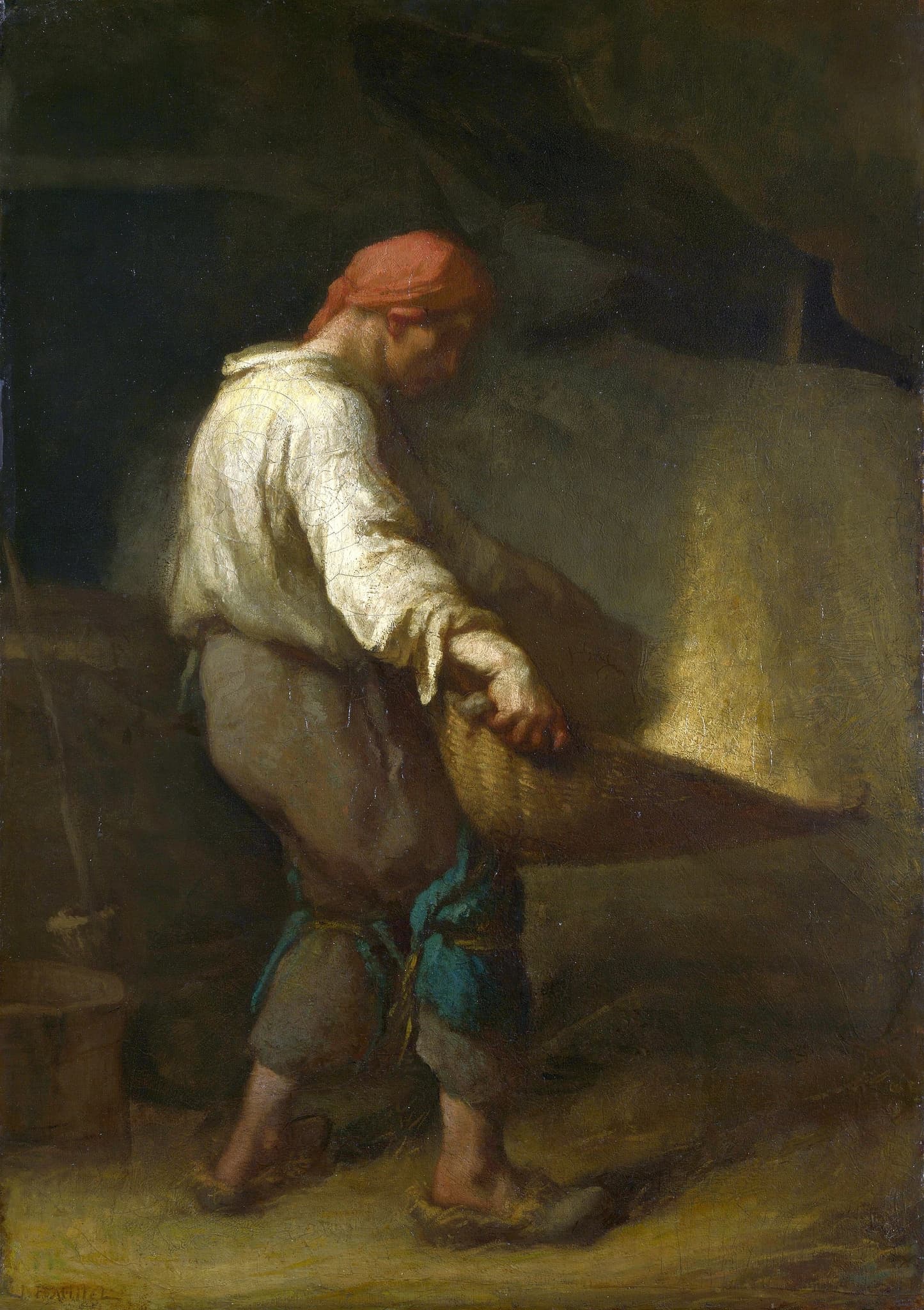
Assuming a museum‑quality, authenticated oil of Jean‑François Millet’s The Winnower (c.1847–48) with good condition and canonical provenance, the estimated auction range is USD 1,000,000–5,000,000. This range is driven by recent Millet comparables, the National Gallery provenance for the principal version, and the market pattern where works on paper have set the public ceiling while oils trade in the mid‑six‑figure to low‑seven‑figure band [1][2].
Valuation Analysis
Valuation conclusion: For a large, fully authenticated and well‑provenanced oil by Jean‑François Millet titled The Winnower (the principal c.1847–48 composition), I place the public auction estimate at USD 1,000,000–5,000,000. This is a defensible working range if the picture is by Millet in paint of museum quality and with continuous provenance or exhibition history; it falls to the lower bands if attribution, condition, or provenance are weaker.
Rationale (comparables and market context): The valuation is based on a comparative reading of Millet auction results and institutional practice. Millet’s highest publicly recorded sale results in recent decades have been for works on paper (a notable pastel/drawing sold at Christie’s in 2014 for c. USD 1.985M, which establishes a public ceiling for top‑tier material), while authenticated oils by Millet more commonly realize in the low‑to‑mid six figures or, for exceptional museum‑quality canvases, into the low millions [2]. Smaller signed oils and studies have sold in ranges from roughly USD 300k–750k at major houses, which supports the lower midpoint of this band. The National Gallery holds the principal Winnower, and that institutional provenance underlines the composition’s importance but also explains why similarly important versions rarely appear on the market [1].
Key sensitivities: The single most decisive determinants are (1) secure attribution to Millet (artist’s hand vs. workshop copy), (2) condition and extent of historic restorations, (3) demonstrable provenance and exhibition/publication history (the NG provenance — Ledru‑Rollin, Newman, 1978 sale — materially raises market confidence), and (4) size/finish (large, fully finished canvases command premiums over small sketches or studio repeats). Technical testing (infrared, X‑ray, pigment analysis) and catalogue‑raisonné confirmation would materially tighten this range upward if results are positive.
Disposition advice: If selling, seek a pre‑sale in‑hand appraisal from a major auction house specialist in 19th‑century French paintings and time a public offering to follow prominent Millet scholarship or exhibition visibility (the 150th anniversary / National Gallery programming increases demand). If buying or insuring, obtain technical and provenance documentation to justify placement in the higher portion of the stated range. For provenance gaps (notably the precise 1978 hammer amount), request Sotheby’s archival record and the National Gallery accession file to close valuation uncertainties [1].
Key Valuation Factors
Art Historical Significance
High ImpactThe Winnower is a clearly documented Millet composition dated c.1847–48 with multiple versions, one of which is held by the National Gallery (NG6447). While not as canonically famous as The Gleaners or The Angelus, the painting belongs to Millet’s central subject matter — peasant labour — that defines his market and scholarly importance. Institutional ownership and exhibition history elevate the composition’s profile and desirability among collectors of Barbizon and 19th‑century Realism. A version with direct museum provenance and exhibition/bibliographic citations will command a premium due to its demonstrated art‑historical relevance and curatorial recognition.
Attribution / Authenticity
High ImpactSecure attribution to Millet is the single most valuable determinant of price: an authenticated, signed Millet oil with technical support (IR reflectography showing characteristic underdrawing, period pigments, canvas weave consistent with 1840s practice) will be priced many multiples higher than a studio piece or later copy. Millet painted several repeats and studio variants; distinguishing a finished autograph work from a workshop variant often requires scientific testing and specialist connoisseurship. Proven and documented authentication allows consignors to seek major auction rooms and high estimates; uncertain attribution collapses the market into a much lower bracket.
Provenance & Exhibition History
High ImpactProvenance has a direct, measurable effect on sellability and price. Early ownership by figures such as Ledru‑Rollin and documented 19th‑century sales provide a continuous chain that reassures buyers; the National Gallery acquisition in 1978 underscores the composition’s acceptance by a top institution. Works with exhibition records and catalogue citations routinely fetch premium prices. Conversely, gaps in provenance or undocumented changes of ownership introduce buyer caution and can force conservative pre‑sale estimates or private‑sale negotiations rather than competitive public auctions.
Condition & Conservation
Medium ImpactCondition is a practical price driver: original, stable paint layers with minimal overpainting and sympathetic historic restoration will preserve value. Extensive relining, heavy retouching, or unstable ground layers materially depress buyer confidence and therefore price. A full condition report and photographic documentation (detail recto/verso, UV, X‑ray images) are required to place a single‑figure estimate precisely. Even well‑provenanced Millet paintings can underperform if their physical state suggests significant intervention or uncertain visual integrity.
Market Demand & Comparables
High ImpactMillet’s market shows persistent demand among collectors of Barbizon and 19th‑century Realism, particularly for works on paper and well‑provenanced oils. Public sale comparables indicate pastels/drawings have produced the highest headline figures, while oils generally settle in the mid‑six‑figure band with select examples reaching low‑seven figures. Recent sale activity and the timing of museum exhibitions (notably major Millet programming) can lift buyer interest and realized prices. Therefore, comparable sales and temporary exhibition visibility are immediate levers that can push a Millet oil toward the high end of the stated range.
Sale History
Private sale from artist
Private transaction
Sotheby Parke Bernet, New York
National Gallery, London
Jean-Francois Millet's Market
Jean‑François Millet (1814–1875) is an established master of mid‑19th‑century French Realism and a core figure of the Barbizon circle. Public auction records show the strongest outcomes for drawings and pastels (one notable work realized c. USD 1.98M), while oils typically trade in the mid‑six‑figure band and only occasionally reach into the low millions. Institutional holdings are widespread among major European and American museums, which supports scholarly visibility but also reduces the frequency of canonical works on the market. Collectors value Millet for authenticity, provenance, and rarity of top‑quality canvases.
Comparable Sales
L’Horizon (La plaine)
Jean‑François Millet
Highest public Millet result on record (pastel/drawing). Although a work on paper (not an oil), it sets the market ceiling for Millet and is therefore a key datapoint when valuing top-tier examples.
$2.0M
2014, Christie's New York
~$2.7M adjusted
Portrait of Madame Martin
Jean‑François Millet
Medium-format oil by Millet sold recently at a major house — provides a direct oil-on-canvas benchmark in the mid-six-figure band for authenticated works.
$625K
2021, Christie's New York
~$743K adjusted
A shepherdess knitting
Jean‑François Millet
Small signed oil with rural/peasant subject matter similar in theme to The Winnower; useful as a size/subject-area comparable for smaller oils.
$534K
2022, Christie's London
~$587K adjusted
Paysanne veillant son enfant
Jean‑François Millet
Recent sale (2024) of a Millet oil on a peasant theme; indicates current demand levels for museum‑quality rural subjects in the low‑to‑mid six‑figure band.
$302K
2024, Christie's New York
~$309K adjusted
Current Market Trends
As of the mid‑2020s the top end of the global art market has softened while the mid‑market (roughly USD 1M–10M) remains relatively stable. Renewed curatorial attention (notably major Millet exhibitions tied to anniversaries) temporarily elevates demand for comparable works. For Millet specifically, buyer interest concentrates on museum‑quality pieces and works on paper; timing a sale to coincide with major exhibition activity improves prospects for higher realized prices.