How Much Is Girl with a Pearl Earring Worth?
Last updated: March 13, 2026
Quick Facts
- Current Location
- Mauritshuis
- Methodology
- extrapolation
Hypothetical market valuation for Girl with a Pearl Earring (Mauritshuis) is USD 200 million to USD 600 million. This range is an extrapolation from extreme scarcity, trophy‑sale precedents and institutional willingness to pay, and is explicitly hypothetical because the work is museum‑held and has not been exposed to modern public auction price discovery.
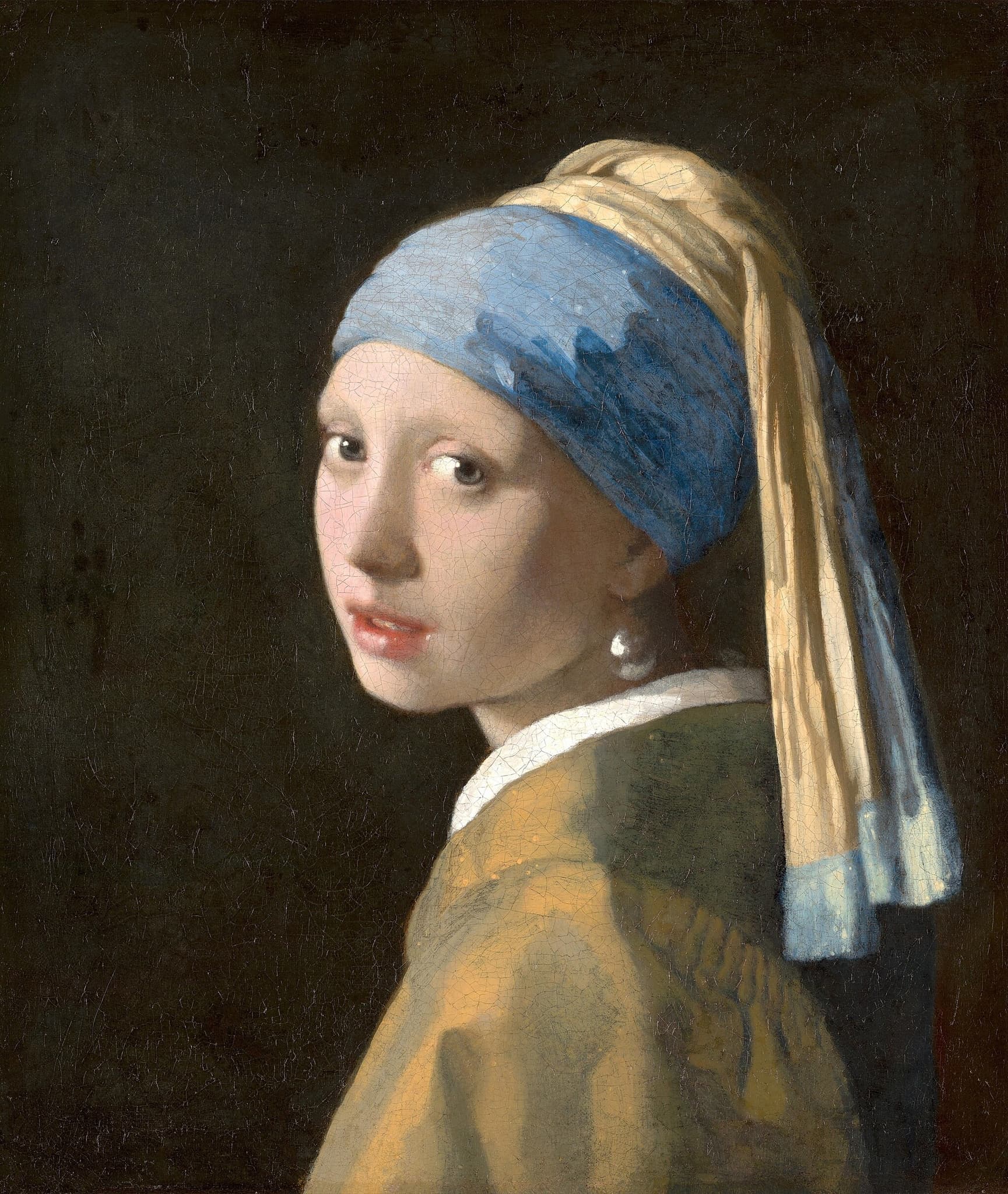
Girl with a Pearl Earring
Johannes Vermeer • Oil on canvas
Read full analysis of Girl with a Pearl Earring →Valuation Analysis
Girl with a Pearl Earring is a canonical Vermeer and a global cultural icon permanently held by the Mauritshuis in The Hague; it has been in public collection since the late 19th century and was last acquired via a minor 1881 transaction, so it has not been exposed to modern auction price discovery [1]. Because of that institutional history, any market valuation must be framed as a hypothetical replacement/insurance or private sale envelope rather than a predictable immediate sale price.
Direct auction comparables for an accepted, museum‑quality Vermeer are extremely limited. The only widely reported modern public sale of an accepted Vermeer is A Young Woman Seated at the Virginals (Sotheby’s, 2004), which realized about USD 30.1 million at the time (roughly USD 48.6 million in 2025 dollars) and illustrates both the scarcity of sales and the difficulty of relying on single transactions as reliable anchors [2]. That lot was less iconic and therefore cannot be treated as a ceiling for Girl with a Pearl Earring.
To estimate an upper bound we extrapolate from trophy masterpieces and headline institutional purchases. Record sales such as Leonardo da Vinci’s Salvator Mundi (Christie’s, USD 450.3 million) demonstrate that uniquely rare, universally recognized works can reach mid and high hundreds of millions under intense competition [3]. Likewise, state and joint museum purchases of Dutch Golden Age masterpieces set public price anchors and show institutional willingness to pay very large sums to retain national treasures [4]. These outcomes provide plausible scenarios in which a canonical Vermeer could achieve prices well above conventional Old Master auction results.
Balancing scarcity, cultural prominence and trophy precedents, this valuation uses an extrapolated, hypothetical market range of USD 200,000,000 to USD 600,000,000. The lower bound recognizes conservative trophy pricing and replacement‑value logic for a museum‑grade Vermeer; the upper bound reflects an exceptional competitive outcome involving sovereign or institutional bidders or a rare private buyer with singular interest. The width of the envelope reflects uncertainty driven by legal, ethical and liquidity constraints.
Critical caveats are decisive. The Mauritshuis is a national museum and deaccessioning this painting faces significant legal, ethical and reputational barriers, making an open market transaction highly improbable [1]. Any sale, if it occurred, would likely be private and contingent on export permissions, indemnities and political negotiation, which can materially affect headline pricing relative to public auction benchmarks.
For a formal, actionable appraisal obtain the museum’s confirmed insurance/indemnity valuation, full technical and conservation reports, and confidential broker estimates from major Old Master specialists. Those inputs would materially narrow the range and convert this hypothetical envelope into a defensible reserve for negotiation or insurance purposes.
Key Valuation Factors
Art Historical Significance
High ImpactGirl with a Pearl Earring occupies a singular position in art history and popular culture. It is widely reproduced, central to Vermeer scholarship, and repeatedly used as the primary visual shorthand for the artist. Its composition, technical mastery and enigmatic subject confer substantial intangible value beyond intrinsic material worth. That iconic status increases public and institutional reluctance to allow export, while simultaneously raising replacement value and competitive pressure among potential buyers or institutions seeking to secure a cultural emblem. In market terms, the painting’s symbolic capital magnifies its trophy appeal and supports a premium that would be reflected in any competitive acquisition or insurance valuation.
Rarity / Scarcity
High ImpactVermeer’s corpus is extremely small, with roughly 30 to 40 securely attributed paintings surviving. Very few of those works remain in private hands, so supply to the market is essentially fixed. Scarcity concentrates demand among a narrow set of deep‑pocketed buyers and institutions, amplifying price sensitivity to attribution certainty and condition. When an autograph, museum‑quality Vermeer becomes available, the near absence of substitutes means values can escalate rapidly. Conversely, scarcity also produces pricing volatility because there are too few transactions to create robust, repeatable market benchmarks.
Provenance & Ownership
High ImpactModern provenance for this painting is strong: purchased by collector A.A. des Tombe in 1881 and subsequently bequeathed to the Mauritshuis, it has enjoyed continuous museum care and public display. That institutional ownership enhances cultural value and simultaneously erects practical sale barriers: museums seldom deaccession signature works, and national patrimony statutes or export controls can prevent cross‑border sale. Provenance therefore both increases desirability and reduces marketability, pushing valuations toward indemnity or replacement scenarios rather than expectable auction outcomes.
Market Demand & Buyer Pool
High ImpactDemand for a canonical Vermeer would be concentrated among national museums, sovereign buyers and a tiny cohort of ultra‑wealthy private collectors. Institutional buyers factor in public access and cultural policy, often mobilizing government resources; private buyers pay premiums for exclusivity and prestige. This limited buyer pool can produce extreme bidding dynamics when institutional and private interests align, but it also creates illiquidity: if public institutions are unable or unwilling to bid for legal or policy reasons, private demand may be insufficient to reach the very highest theoretical valuations. Buyer composition thus both enables high ceilings and constrains consistent market formation.
Legal, Export and Condition Constraints
Medium ImpactLegal protections, export controls and museum deaccession policies are material determinants of marketability. As a named cultural asset in a national museum, the painting may be subject to restrictions that prevent or complicate a sale. Condition and conservation history also influence realizable value: a painting in pristine condition supports upper‑range pricing, whereas works requiring major restoration or of compromised integrity see reduced value. Reputational and ethical considerations further limit liquidity, introducing uncertainty to any hypothetical market valuation.
Sale History
Girl with a Pearl Earring has never been sold at public auction. It has been held by Mauritshuis.
Johannes Vermeer's Market
Johannes Vermeer occupies an elite and illiquid segment of the Old Masters market because so few autograph works survive and most are museum‑held. Auction evidence is sparse and irregular; where Vermeers have appeared they have sold for tens of millions, but those outcomes are poor proxies for the very top canonical examples. The market is dominated by institutional and sovereign demand, attribution certainty is critical, and pricing is more driven by scarcity and trophy dynamics than by frequent transactional evidence.
Comparable Sales
A Young Woman Seated at the Virginals
Johannes Vermeer
Only widely reported modern public auction sale of an accepted Vermeer—direct artist-to-artist comparable for market liquidity and realized pricing, though less iconic than Girl with a Pearl Earring.
$30.1M
2004, Sotheby's, London
~$48.6M adjusted
Saint Praxedis
Attributed to Johannes Vermeer (debated)
Sold under (or offered as) Vermeer attribution—useful for showing how attribution uncertainty materially depresses price versus firmly accepted autograph works.
$10.7M
2014, Christie's, London
~$13.8M adjusted
Salvator Mundi
Leonardo da Vinci
Record-breaking trophy sale for a single universally recognized masterpiece—demonstrates extreme upper-end pricing when a uniquely rare, high‑profile work comes to market.
$450.3M
2017, Christie's, New York
~$560.4M adjusted
Maerten Soolmans and Oopjen Coppit (pendants)
Rembrandt van Rijn
High‑value Dutch Golden Age purchase showing institutional willingness to pay very large sums to keep national masterpieces in public collections—directly relevant to expectations for a museum‑quality Vermeer.
$174.0M
2016, Private sale arranged with Christie's — joint acquisition by the Louvre and the Rijksmuseum
~$221.2M adjusted
The Standard Bearer
Rembrandt van Rijn
Recent headline state/museum acquisition that sets a modern public price anchor for top Dutch Golden Age works—useful for valuing an iconic Dutch portrait held by a national collection.
$200.0M
2023, Dutch state / Rijksmuseum purchase (reported)
~$202.6M adjusted
Current Market Trends
The Old Masters market is smaller and more conservative than Modern and Contemporary segments, but remains capable of producing headline trophy transactions when supply of museum‑grade works emerges. Recent years have seen notable institutional purchases that anchor high public valuations and further reduce market supply. Macro liquidity and provenance/technical clarity drive short‑term appetite, but for uniquely famous masterpieces demand from states and super‑collectors sustains very high theoretical values despite low transaction frequency.
Sources
- Mauritshuis — Girl with a Pearl Earring (collection entry)
- Sotheby’s — Old Master Paintings, A Young Woman Seated at the Virginals (2004 lot / press coverage)
- Christie’s — Leonardo Salvator Mundi coverage (2017 sale)
- The Art Newspaper — coverage of major Dutch Golden Age acquisitions and public price anchors