How Much Is The Concert Worth?
Last updated: March 13, 2026
Quick Facts
- Methodology
- extrapolation
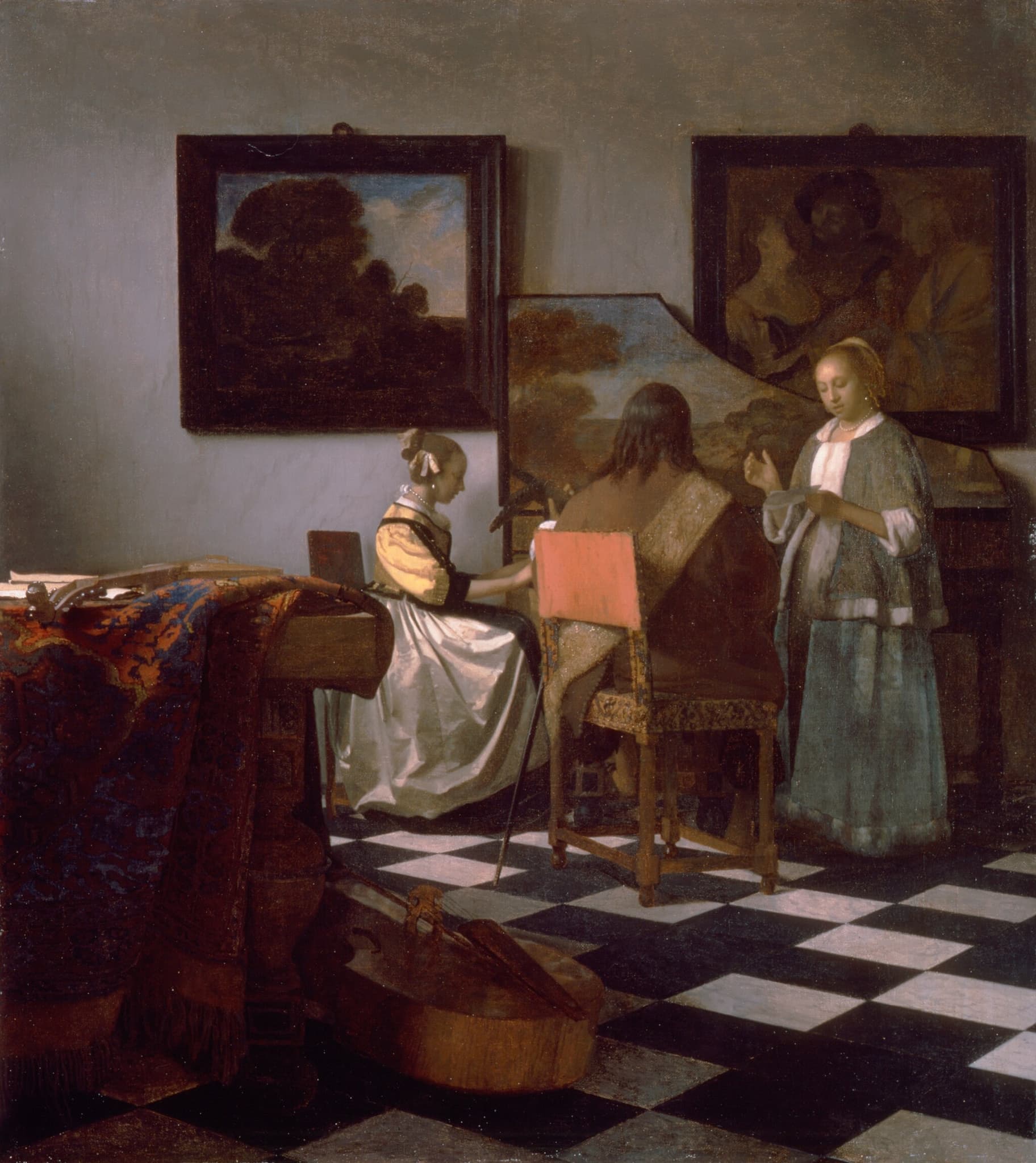
Conditional on recovery, clear title, authentication and good condition, The Concert by Johannes Vermeer is estimated at $150–350 million (USD). Its extreme rarity and high institutional/trophy demand drive the upside; its stolen, unrecovered status makes any present valuation hypothetical and contingent on legal and condition outcomes.
Valuation Analysis
Overview: This valuation is conditional: if recovered, authenticated, in marketable condition and free of encumbrances, I estimate a market range of $150–350 million for Johannes Vermeer’s The Concert. The band reflects the extreme scarcity of accepted Vermeers, the work’s high public profile as a Gardner masterpiece, and the trophy‑collector environment for canonical Old Master paintings. Because it remains stolen and unrecovered, this is a hypothetical, market‑conditional valuation — not a realizable price today.
Drivers: Vermeer’s accepted oeuvre is extremely small (roughly mid‑30s of paintings), so any secure, museum‑quality Vermeer commands exceptional attention and a concentrated buyer pool. The Concert is widely regarded as a major work within that corpus: compositionally iconic, well documented in institutional literature, and historically visible to the public before the 1990 Gardner theft. These factors create a high intrinsic value premium relative to more common Old Masters and to problematic attributions.
Comparable evidence: Market evidence is limited because accepted Vermeers rarely appear at auction. The most directly comparable public sale is A Young Woman Seated at the Virginals (Sotheby’s, 2004, reported ≈$30.1M) — a useful lower‑anchor for public auction realizations in the early twenty‑first century [2]. Trophy private and contested Old Master sales (e.g., Klimt’s Adele Bloch‑Bauer I in private acquisition; Leonardo’s Salvator Mundi at Christie’s) demonstrate that singular, culturally iconic works can reach hundreds of millions in private or public venues, and they set a practical ceiling for a recovered Concert offered under ideal circumstances.
Legal and marketability constraints: The Concert was stolen from the Isabella Stewart Gardner Museum in 1990 and remains unrecovered; the museum and law‑enforcement resources list it as missing and claim title to the picture [1]. That status eliminates any legitimate near‑term market pathway and injects severe legal, reputational and operational discounts into any hypothetical price. Title disputes, insurer subrogation and museum recovery preferences will typically exclude sale to third parties until rights are resolved.
Valuation methodology and adjustments: This appraisal uses extrapolation from sparse public Vermeer sales, trophy Old Master private purchases, and an assessment of demand elasticity for canonical works. Starting from conservative public anchors, I apply premiums for rarity, exhibition potential and cultural fame, and apply discounts for legal encumbrance, condition uncertainty and constrained buyer pool. The resulting band ($150–350M) reflects a material upside if the work is recovered, authenticated, and free of claims, with a practical expectation in the $200–300M bracket under current market dynamics.
Next steps: To refine this valuation meaningfully, obtain recovery/condition reports, formal technical authentication, museum/insurer title documentation, and up‑to‑date comparable private sale records. Until recovery and clear title are achieved, any advertised price is hypothetical and contingent; if recovered, expect intense institutional interest and a targeted, competitive bidding environment among museums and ultra‑high‑net‑worth collectors.
Key Valuation Factors
Art Historical Significance
High ImpactBecause Vermeer’s accepted output is extremely limited, each authenticated work has outsized historical and cultural value. The Concert was documented, exhibited and widely reproduced prior to the 1990 theft, establishing it as one of the artist’s public 'icons' and a core reference point in Vermeer scholarship. Museum recognition and the painting’s demonstrable role in exhibition histories raise its institutional utility—loans, retrospectives and scholarship—which increases buyer willingness to pay at the trophy level. Scholarly consensus and public familiarity therefore translate directly into a premium over lesser-known or disputed works, materially widening the top end of the valuation band.
Scarcity & Attribution Certainty
High ImpactVermeer’s market value is dominated by extreme scarcity and the clarity of attribution. With roughly mid‑30s accepted autographs, any secure Vermeer draws a narrow set of well‑capitalized institutional and private buyers, producing auction outcomes that are event‑driven rather than market‑driven. Attribution debates (as in other Vermeer‑adjacent cases) can reduce prices dramatically; conversely, incontrovertible technical authentication and unanimous scholarly backing can add substantial upside. For The Concert, a confirmed attribution to Vermeer with supporting technical reports would be a primary value multiplier, while unresolved attribution risk could reduce realizable value by an order of magnitude relative to an accepted autograph.
Provenance & Title Risk
High ImpactTitle clarity and provenance are decisive for The Concert. The Isabella Stewart Gardner Museum claims ownership and the painting was stolen in 1990; until recovery and legal resolution occur the work is not marketable through legitimate channels. Legal encumbrances, insurer subrogation, and potential restitution or settlement terms will either prevent sale or require complex agreements that dilute proceeds (for example, insurer recoupment or museum retention). Practical market pricing must therefore include a substantial discount for unresolved title risk; only clear title and formal museum/insurer waivers would restore full market value potential.
Market Demand & Comparable Sales
High ImpactComparable sales are sparse but instructive. Public auction anchors (the 2004 Sotheby’s Vermeer) set conservative public‑floor expectations, while high‑profile private transactions and record Old Master sales demonstrate that iconic works can reach hundreds of millions. The trophy market is sensitive to exhibition potential, bidder competition, and geopolitical wealth centers. For The Concert, if recovered and uncontested, expect concentrated bidding from museums, sovereign or private collectors prepared to pay premiums to secure unique cultural capital. Market appetite exists, but timing and sale architecture (private sale vs. curated auction) will materially influence final price realization.
Sale History
The Concert has never been sold at public auction.
Johannes Vermeer's Market
Johannes Vermeer occupies a top‑tier position among Dutch Golden Age artists. His oeuvre is tiny and intensely studied; accepted autographs are rare and primarily museum‑held. Public sales are infrequent, so price discovery is limited and driven by exceptional events. Collectors and institutions prize Vermeer for scholarly prestige and public appeal; this combination makes any authenticated Vermeer a near‑unique acquisition opportunity. Attribution certainty, exhibition potential, and provenance determine whether a work trades at a museum‑grade trophy level or at a materially lower price as a studio or 'in the manner of' piece.
Comparable Sales
A Young Woman Seated at the Virginals
Johannes Vermeer
Only widely reported undisputed Vermeer offered at a major auction (2004). Directly comparable by artist/period and shows public‑auction realization for an accepted Vermeer.
$30.1M
2004, Sotheby's, London
~$50.4M adjusted
Saint Praxedis
Johannes Vermeer (attributed / disputed)
Disputed‑attribution Vermeer sold at major auction (2014). Useful as a lower‑bound comparable demonstrating the gap between accepted and contested Vermeer material.
$10.7M
2014, Christie's, London
~$14.3M adjusted
Portrait of Adele Bloch-Bauer I
Gustav Klimt
High‑profile, trophy private sale of a canonical masterpiece; relevant as a market ceiling for museum‑quality, culturally iconic works and for cases involving restitution/ownership complications.
$135.0M
2006, Private sale / Neue Galerie acquisition (2006)
~$212.0M adjusted
Salvator Mundi
Leonardo da Vinci
Record auction price for an Old Master (2017). Although attribution/marketability controversies apply, it sets an upper bound for headline Old Master sales and helps calibrate the ceiling for an exceptional recovered Vermeer.
$450.3M
2017, Christie's, New York
~$581.0M adjusted
Venice, the Return of the Bucintoro on Ascension Day
Canaletto
Recent 2025 trophy Old Masters result showing renewed demand at the top of the category and providing a mid‑market comparable in 2025 dollars.
$43.9M
2025, Christie's, London
Current Market Trends
In 2025 the Old Masters market showed selective strength driven by a handful of trophy consignments and major exhibitions. Demand concentrated at the top end where scarcity and institutional interest are strongest; lower tiers of the market remained softer. For canonical names like Vermeer, this dynamic supports elevated pricing under ideal sale conditions, but overall liquidity is limited and buyer competition is concentrated. Timing, exhibition plans and clear title/authentication will be decisive for realizing top valuations for recovered masterpieces.