How Much Is The Embroiderer Worth?
Last updated: February 24, 2026
Quick Facts
- Methodology
- comparable analysis
Johannes Vermeer’s The Lacemaker (often misrendered as “The Embroiderer”) is an undisputed late masterpiece in the Louvre and has no modern market sale. Based on scarcity, canonical status, and nine‑figure Old Master benchmarks, its hypothetical fair‑market value today is $200–450 million. This range reflects Vermeer’s near‑unique rarity and the work’s iconic stature, offset by small scale and Old Master market depth.
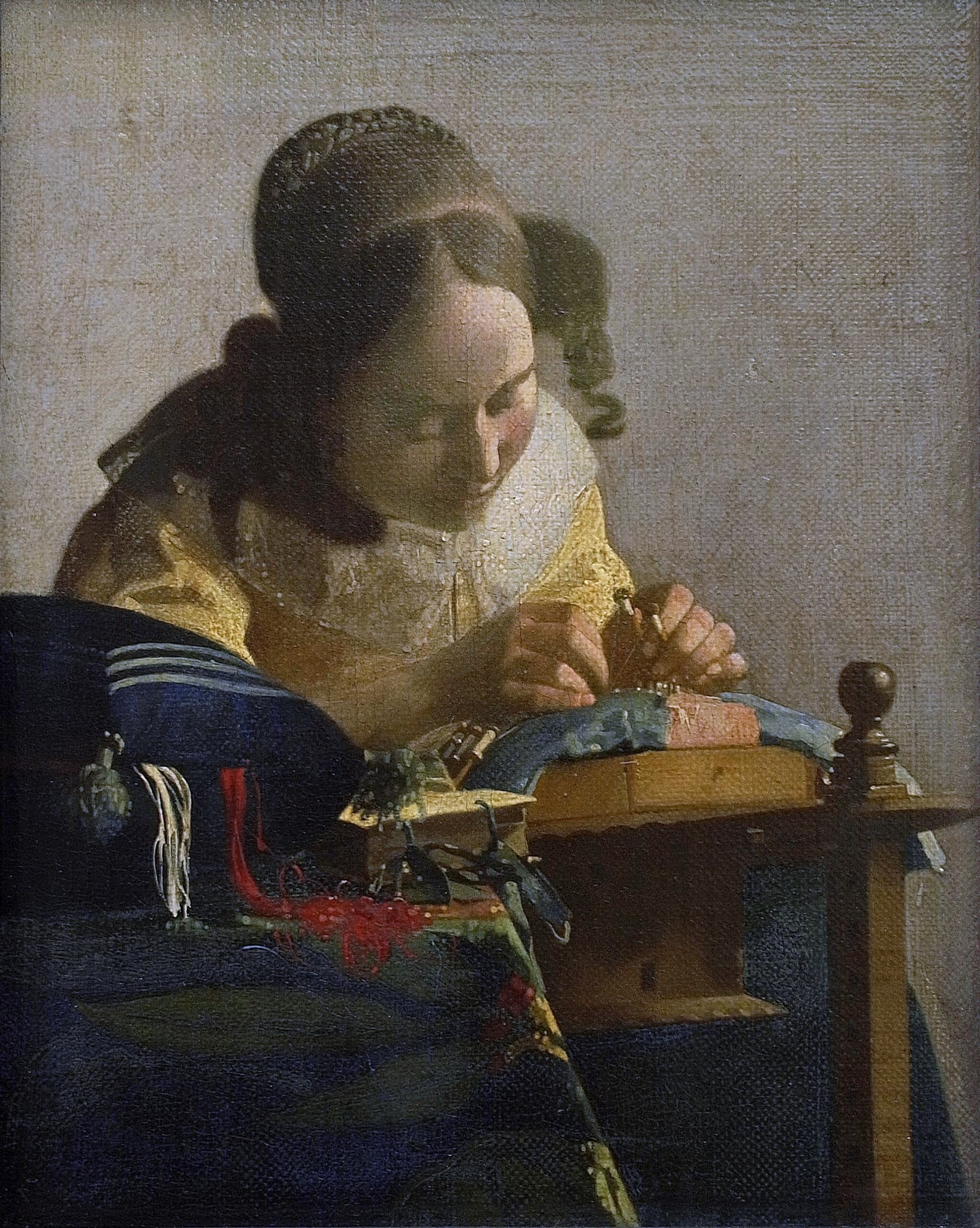
The Embroiderer
Johannes Vermeer, 1669–1670 • Oil on canvas, later laid down on panel
Read full analysis of The Embroiderer →Valuation Analysis
Work and status. The painting in question is Vermeer’s The Lacemaker (La Dentellière), c. 1669–70, in the Musée du Louvre (inv. MI 1448), a universally accepted late masterpiece and one of the artist’s most reproduced images [1]. As part of a French national museum collection, it is inalienable under the Code du patrimoine, so any figure is necessarily a hypothetical fair‑market or insurance proxy rather than a realizable sale price [2].
Method and benchmarks. Because no uncontested, mature Vermeer has traded publicly in the modern era, we derive value by triangulating across: (i) the artist’s limited market prints; (ii) adjacent Old Master price ceilings; and (iii) art‑historical significance and supply scarcity. The most recent Vermeer auction record—A Young Woman Seated at a Virginal (2004)—made roughly $30.1 million despite long‑running attribution debate, a level far below what a canonical, undisputed late work would command today [3]. Cross‑category Old Master benchmarks now validate sustained nine‑figure appetite for museum‑caliber rarities: Leonardo’s Salvator Mundi at $450.3 million set the market ceiling [4], while Botticelli’s Portrait of a Young Man Holding a Roundel achieved $92.2 million at auction [5]. The private, sovereign‑backed purchase of Rembrandt’s Maerten Soolmans and Oopjen Coppit portraits around $180 million further demonstrates institutional capacity at the top end [6].
Why this range. The Lacemaker is one of Vermeer’s most admired late works—small in size but monumental in refinement and focus—and sits alongside The Milkmaid and Girl with a Pearl Earring as an icon of the oeuvre [1]. Vermeer’s supply is vanishingly scarce (roughly mid‑30s accepted works, with almost all in museums) and only a single mature work is widely accepted to remain in private hands, so demand for any incontestable, major example would be extraordinary [7]. Against that backdrop, a $200–450 million band captures a realistic competitive outcome under modern auction dynamics: the low end is supported by the Botticelli and Rembrandt precedents, while the high end reflects the global ceiling set by Leonardo and the brand power of Vermeer at the apex of Dutch Golden Age painting [4][5][6].
Offsets and nuances. The painting’s tiny format and the Old Master buyer pool’s relative narrowness temper the upper bound; additionally, the work was transferred from canvas to panel historically, a noted though stable conservation factor. These are outweighed by its uncontested authorship, canonical status, and extreme scarcity. Because the Louvre cannot deaccession, the estimate is most applicable for insurance/indemnity, loan planning, and academic benchmarking rather than a practical sale scenario [1][2].
Key Valuation Factors
Art Historical Significance
High ImpactThe Lacemaker is a late, undisputed masterpiece and one of Vermeer’s most iconic images, epitomizing his microscopic attention to domestic labor, optical acuity, and abstracted focus. It stands alongside The Milkmaid and Girl with a Pearl Earring as a capstone of his career, frequently reproduced and central to scholarship. Its concentrated composition—hands, bobbins, and thread—condenses Vermeer’s magic of light and stillness into a jewel‑like format. Within Dutch Golden Age genre painting, it represents the summit of refinement and moralized domesticity. This canonical status amplifies global brand recognition and institutional demand, ensuring that, in any hypothetical market test, it would function as a trophy of the first order with correspondingly strong pricing power.
Rarity and Market Scarcity
High ImpactVermeer’s oeuvre numbers only in the mid‑30s and is overwhelmingly held by museums and royal collections. In the modern era, no uncontested, mature Vermeer has traded publicly, and only a single mature painting is broadly accepted to remain in private hands. This creates a structurally supply‑starved market with pent‑up demand from institutions, sovereign buyers, and top private collectors. When comparable Old Master trophies appear, nine‑figure outcomes are now validated. The Lacemaker’s unimpeachable authorship, late date, and fame position it at the apex of this constrained supply, justifying a valuation far above the artist’s dated auction record and squarely in the realm of the very few pre‑1800 works capable of commanding $200m+ today.
Condition and Conservation
Medium ImpactThe work was executed on canvas and later laid on a wooden panel—an historical intervention documented by the Louvre. Transfers can introduce risks, but the painting’s current presentation and long museum stewardship suggest stability and high legibility. Its tiny dimensions (approximately 24 × 21 cm) mean the paint surface is intensely worked yet protected by limited handling in a modern context. While the transfer prevents it from being pristine in terms of original support, the impact on its art‑historical standing is minimal given the consensus on authorship, the clarity of the image, and the painting’s enduring critical reception. Any final pricing would still be contingent on a fresh, detailed condition report.
Legal and Transactional Constraints
Medium ImpactAs part of the French national collections, The Lacemaker is inalienable and subject to strict export and deaccession controls. Practically, it cannot be sold; any value therefore functions as a fair‑market proxy for insurance, indemnity, or academic benchmarking. Such constraints can deter hypothetical private competition, but paradoxically they underscore the work’s absolute scarcity and enhance perceived “untouchable” status. In valuation exercises, these factors shape context rather than intrinsic worth: they limit realizability but do not diminish the painting’s economic potential were it to be freely tradeable. For lenders and borrowing institutions, the inalienable status tends to push indemnity valuations toward conservative high‑end ranges in recognition of irreplaceability.
Sale History
Amsterdam, Dissius sale
Catalogue entry widely identified with The Lacemaker (‘a young woman doing needlework’). Early posthumous disposal of Vermeer works.
Paris, D. Vis Blokhuyzen sale
Public auction appearance shortly before purchase for the French State/Louvre later in 1870.
Johannes Vermeer's Market
Johannes Vermeer is among the rarest blue‑chip Old Masters, with roughly 34–36 accepted paintings and nearly all in public collections. The modern auction record—about $30.1 million for A Young Woman Seated at a Virginal (2004)—is an outlier shaped by attribution debate rather than a benchmark for an uncontested late work. No mature, undisputed Vermeer has appeared at auction in recent decades, and only one such painting is widely acknowledged in private hands, leaving the market effectively untested yet intensely coveted. Blockbuster exhibitions (notably the Rijksmuseum’s 2023 show) have amplified global demand and awareness. In any credible offering scenario, Vermeer would attract sovereign, institutional, and UHNW competition and would be expected to achieve a nine‑figure price.
Comparable Sales
A Young Woman Seated at a Virginal
Johannes Vermeer
Same artist; late, small-format interior of a young woman; closest market print for a mature Vermeer. Notably, its canvas weave matches The Lacemaker, underscoring proximity in date/workshop. Shows price level for a small, domestic Vermeer in modern auction.
$30.1M
2004, Sotheby's London
~$50.2M adjusted
Saint Praxedis
Johannes Vermeer (attributed)
Same artist attribution circle; rare modern sale touching the Vermeer market. Earlier, religious subject and continued attribution debate make it a conservative (low) anchor for Vermeer pricing.
$10.7M
2014, Christie's London
~$14.3M adjusted
Portraits of Maerten Soolmans and Oopjen Coppit (pair)
Rembrandt van Rijn
Top-tier Dutch Golden Age master; museum-caliber rarity purchased by sovereign institutions. Demonstrates nine-figure willingness to pay for canonical 17th‑century Dutch masterpieces—relevant to The Lacemaker’s expected buyer base and scarcity premium.
$180.0M
2016, Private sale (joint acquisition by Rijksmuseum and Louvre)
~$236.3M adjusted
Portrait of a Young Man Holding a Roundel
Sandro Botticelli
Blue‑chip Old Master portrait with museum‑level provenance and fame. Establishes the modern auction appetite for pre‑1800 icons in the $90m+ range; useful as a cross‑category Old Masters benchmark for a canonical Vermeer.
$92.2M
2021, Sotheby's New York
~$107.1M adjusted
Salvator Mundi
Leonardo da Vinci
Record Old Master sale; market ceiling for a globally recognized, extremely scarce Renaissance masterpiece. While a different artist and with attribution controversy, it frames the upper bound for museum‑caliber rarities—relevant for a top‑tier Vermeer like The Lacemaker.
$450.3M
2017, Christie's New York
~$578.6M adjusted
Current Market Trends
Old Masters pricing has bifurcated: supply is thin and mid‑market liquidity uneven, but museum‑caliber rarities continue to achieve strong, sometimes record, results. The category’s top end has validated nine‑figure prices for icons with impeccable attribution, provenance, and condition. Cross‑border regulatory friction persists, but sovereign and institutional participation remains a stabilizing force for masterpieces. After a softer 2024 for the high end across categories, selective strength returned in 2025–2026, with guarantees and irrevocable bids helping to underwrite trophy outcomes. In this climate, extreme scarcity and canonical status are decisive—precisely the profile that positions a Vermeer of The Lacemaker’s caliber to command a $200m+ result in a hypothetical open market.
Sources
- Musée du Louvre collections: Vermeer, The Lacemaker (MI 1448)
- Code du patrimoine (France), inalienability of national collections
- LA Times: Vermeer painting fetches $30.1 million (2004)
- Christie’s: Leonardo da Vinci’s Salvator Mundi sells for $450.3m
- Sotheby’s: Botticelli portrait achieves $92.2m (2021)
- New York Times: Rembrandt portraits to be shared by Rijksmuseum and the Louvre (c. $180m private sale)
- The Art Newspaper: How to see every painting by Johannes Vermeer