How Much Is The Milkmaid Worth?
Last updated: February 22, 2026
Quick Facts
- Current Location
- Rijksmuseum
- Methodology
- comparable analysis
Open‑market estimate for Vermeer’s The Milkmaid: $250–400 million. The range reflects the painting’s iconic status, Vermeer’s extreme scarcity, pristine condition, and recent trophy benchmarks for top Old Masters.
Valuation Analysis
Conclusion: On a hypothetical, unrestricted open‑market basis today, Johannes Vermeer’s The Milkmaid would command approximately $250–400 million. This range reflects the picture’s canonical status within Vermeer’s tiny oeuvre, its superb condition, and a trophy‑market environment in which blue‑chip Old Masters with global name recognition have achieved nine‑figure prices.
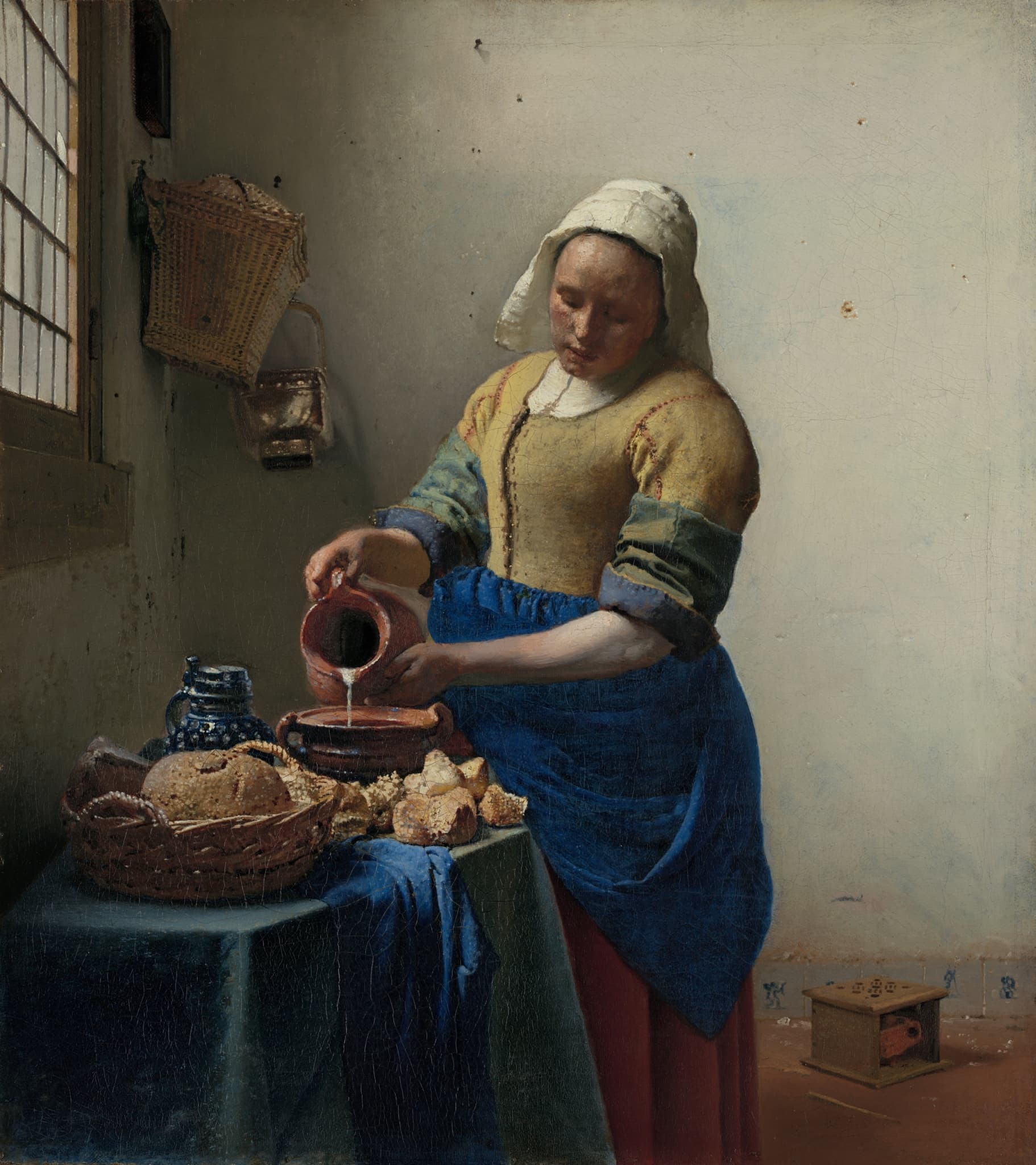
Rationale and significance: The Milkmaid is one of Vermeer’s most famous works and a signature image of the Rijksmuseum’s collection, prized for its concentrated depiction of domestic labor, extraordinary handling of light, and uncommonly well‑preserved surface [1]. Within an oeuvre of roughly three dozen accepted paintings, widely dispersed and overwhelmingly in public institutions, The Milkmaid sits in the top tier with Girl with a Pearl Earring and View of Delft—works that define the artist in the public imagination. Its art‑historical stature, image recognition, and state of conservation position it as a “must‑have” masterpiece for any buyer capable of competing at the very top end.
Comparables and price formation: Direct Vermeer market data are scarce: the last broadly accepted Vermeer to sell at auction (a small panel) brought about $30 million in 2004, far below today’s trophy levels. Pricing therefore relies on cross‑artist Old Master benchmarks and the extraordinary scarcity premium. Botticelli’s Young Man Holding a Roundel realized $92.2 million in 2021, demonstrating contemporary willingness to pay nine figures for iconic Renaissance pictures [5]. In 2016, the Louvre and the Rijksmuseum jointly acquired Rembrandt’s full‑length portraits of Maerten Soolmans and Oopjen Coppit for about €160 million (≈$174m at the time), evidencing sovereign‑level pricing for Dutch Golden Age masterpieces [3]. At the outer edge, Leonardo’s Salvator Mundi sold for $450.3 million in 2017, setting the modern ceiling for an Old Master trophy [4]. Against these comparables, a universally accepted, instantly recognizable Vermeer of The Milkmaid’s quality would be expected to clear the Botticelli and Rembrandt benchmarks by a wide margin, while remaining below Leonardo’s unique, category‑defining premium. Recent sovereign acquisition of Rembrandt’s The Standard Bearer for €175 million further underscores current pricing for national‑icon Dutch works [6].
Provenance and institutional status: The Milkmaid is widely identified with the 1696 Dissius sale in Amsterdam (175 guilders), a strong price in that landmark dispersal of Vermeers [2]. It entered the Rijksmuseum in 1908 via the Six–Van Winter collection and is now Dutch State property in the museum’s care [1]. While cultural‑heritage protections and museum policy make an actual sale exceedingly unlikely, those same factors reinforce scarcity and the work’s intangible premium in any hypothetical pricing scenario.
Market context and demand: Vermeer’s public profile and demand were recently amplified by the Rijksmuseum’s record‑breaking 2023 Vermeer exhibition, which drew unprecedented attendance and global media attention [7]. In a supply‑constrained Old Masters market, buyers compete intensely when works of this caliber appear. Taking all factors together—rarity, icon status, condition, and cross‑category trophy benchmarks—the $250–400 million band best reflects likely competitive outcomes today.
Key Valuation Factors
Art Historical Significance
High ImpactThe Milkmaid is a touchstone of Vermeer’s mature style—light‑suffused, hushed, and psychologically resonant—and among the three or four images most synonymous with the artist. Its subject, a humble kitchen maid pouring milk, attains monumentality through composition, light, and color, making it a cornerstone of Dutch Golden Age painting. This centrality in the canon dramatically expands the qualified buyer pool (institutions, sovereign collections, marquee private foundations) and commands a substantial “icon” premium over lesser works. As a signature image of the Rijksmuseum and a fixture in art‑historical curricula and reproductions, it benefits from global name recognition, an especially powerful value driver in the trophy segment.
Extreme Rarity and Market Scarcity
High ImpactVermeer’s accepted oeuvre numbers roughly 34–36 paintings, with the overwhelming majority in museums. Only one broadly accepted painting has appeared at auction in the past two decades (2004), and it was a small‑format work. The near‑absence of supply, combined with deep and international demand for a universally accepted Vermeer, creates outsized competitive dynamics should a picture of The Milkmaid’s stature ever be offered. Scarcity also compounds over time, as museum accessions withdraw works from trade permanently, pushing potential buyers to pay a significant premium when rare opportunities arise.
Condition and Quality
High ImpactThe Milkmaid is celebrated for its excellent preservation and the exceptional quality of its paint surface. The crystalline rendering of light, meticulous textures (bread, jug, basket, tile), and saturated blues and yellows preserve Vermeer’s intent at a level unusually high for a 17th‑century canvas. In the ultra‑high end, condition can swing outcomes by tens of millions; here, the combination of top‑tier quality and state of conservation supports valuation at the upper end of Old Master comparables and substantially above the artist’s dated auction record.
Market Benchmarks and Buyer Pool
High ImpactRecent Old Master trophies have achieved nine‑figure prices: Botticelli’s portrait sold for $92.2m (2021) and the Louvre/Rijksmuseum jointly acquired Rembrandt’s pendant portraits for c. €160m (2016); Leonardo’s Salvator Mundi set a $450.3m record. The Milkmaid’s recognition, art‑historical weight, and rarity position it to clear the Botticelli and Rembrandt benchmarks and approach a mid‑nine‑figure result in a competitive setting. The likely buyer pool includes sovereign entities, leading museums (via joint purchases), and mega‑collectors, each capable of paying premiums for singular, nation‑defining works, thereby supporting the $250–400m estimate.
Sale History
Dissius sale (Amsterdam)
Sold for 175 guilders; early‑modern currency. USD conversion not applicable. Widely identified with Vermeer’s The Milkmaid.
Private treaty (Dutch State/Rijksmuseum via Six–Van Winter acquisition)
Approximate USD equivalent of a 750,000‑guilder package of 39 paintings at near‑gold‑parity exchange; not a stand‑alone price for The Milkmaid. Date approximate.
Johannes Vermeer's Market
Johannes Vermeer sits at the absolute apex of Old Masters, with an oeuvre of roughly three dozen accepted works and almost no market turnover. The last broadly accepted Vermeer at auction, A Young Woman Seated at the Virginals, sold for about $30 million in 2004; a historically debated attribution, Saint Praxedis, brought roughly $10.7 million in 2014. These dated, small‑format comparables understate contemporary trophy pricing but highlight near‑total supply scarcity. Because most Vermeers are in museums, any fully accepted, high‑quality example would trigger intense competition from institutions, sovereign buyers, and marquee private collectors. In practice, this means Vermeer’s market is defined less by frequent trades than by extrapolation from cross‑category trophy results and by the artist’s unparalleled scarcity premium.
Comparable Sales
A Young Woman Seated at the Virginals
Johannes Vermeer
Same artist; accepted Vermeer; small, late domestic interior; last universally accepted Vermeer sold at auction, thus the best direct market anchor.
$30.1M
2004, Sotheby's London
~$51.2M adjusted
Saint Praxedis
Johannes Vermeer (attribution debated)
Market transaction linked to Vermeer attribution; shows pricing for a work with contested status versus canonical Vermeers.
$10.7M
2014, Christie's London
~$13.9M adjusted
Portrait of a Young Man Holding a Roundel
Sandro Botticelli
Top-tier Old Master trophy result in recent years; benchmarks the modern appetite for blue-chip, instantly recognizable works by a scarce master.
$92.2M
2021, Sotheby's New York
~$106.0M adjusted
Portraits of Maerten Soolmans and Oopjen Coppit (pair)
Rembrandt van Rijn
Record-level private acquisition for Dutch Golden Age masterpieces; indicates institutional and sovereign-level pricing for national icons.
$174.0M
2016, Private treaty (joint purchase by the Louvre and the Rijksmuseum)
~$217.5M adjusted
The Standard Bearer
Rembrandt van Rijn
Recent national-icon purchase in the same Dutch Golden Age sphere; evidences current sovereign willingness to pay near-$200m for a canonical work.
$198.0M
2022, Private sale to the Dutch State
~$219.8M adjusted
Salvator Mundi
Leonardo da Vinci
The modern ceiling for Old Masters; a benchmark for how scarcity, attribution, and global trophy demand can drive extreme outcomes.
$450.3M
2017, Christie's New York
~$576.4M adjusted
Current Market Trends
Old Masters remain a supply‑constrained but resilient segment. After a softer 2024 at the top end, 2025–2026 saw renewed strength when exceptional property appeared, with records for category leaders reaffirming deep connoisseur demand. Nine‑figure purchases by institutions and sovereigns underscore willingness to fund national‑icon works, while global collectors continue to pursue the very best examples with clean provenance, strong condition, and secure attribution. Blockbuster exhibitions have broadened public engagement with 17th‑century Dutch art, supporting long‑term demand. Against this backdrop, an iconic, museum‑caliber Vermeer would likely achieve a mid‑nine‑figure price, outpacing most Old Master comparables apart from the unique Leonardo ceiling.
Sources
- Rijksmuseum collection page: The Milkmaid (SK-A-2344)
- Essential Vermeer: The Dissius Auction (1696)
- BBC News: Netherlands and France to buy Rembrandt portraits for €160m
- The New York Times: Leonardo da Vinci Painting Sells for $450.3 Million
- The Guardian: Rare Botticelli portrait sells for record $92m at auction
- DutchNews.nl: Dutch state to buy Rembrandt’s The Standard Bearer for €175m
- The Art Newspaper: Vermeer blockbuster breaks records at Rijksmuseum