How Much Is The Music Lesson (A Lady at the Virginals with a Gentleman) Worth?
Last updated: March 13, 2026
Quick Facts
- Methodology
- comparable analysis
The Music Lesson (A Lady at the Virginals with a Gentleman) by Johannes Vermeer is held in the Royal Collection and is effectively off‑market; if offered in a fully competitive international sale I estimate a hypothetical market value of US$120–250 million, with the realistic possibility of exceeding US$300 million in an exceptional strategic/private transaction. This range assumes undisputed attribution, sound condition, and no restitution or export impediments.
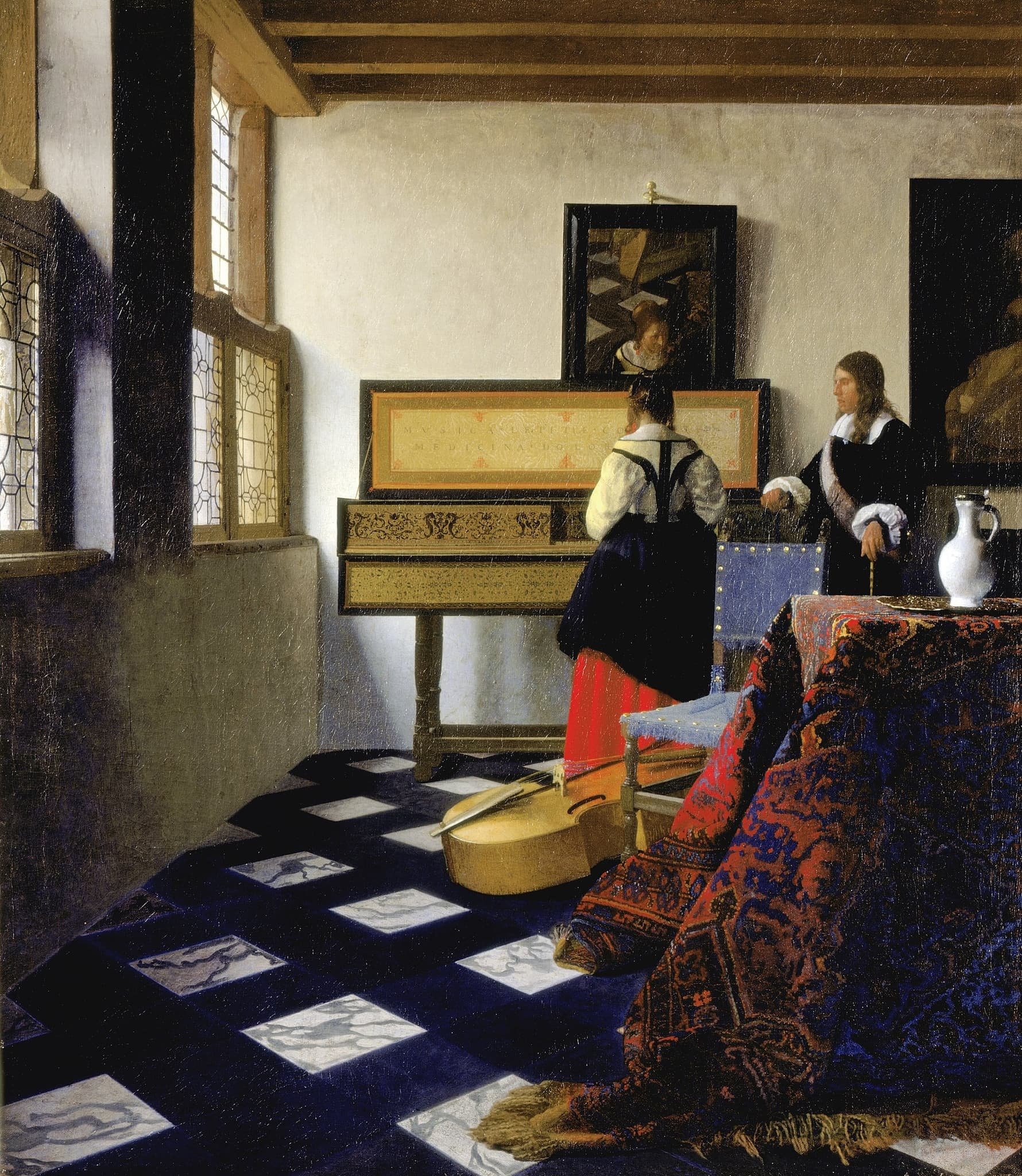
The Music Lesson (A Lady at the Virginals with a Gentleman)
Johannes Vermeer • Oil on canvas
Read full analysis of The Music Lesson (A Lady at the Virginals with a Gentleman) →Valuation Analysis
Valuation conclusion: The Music Lesson (A Lady at the Virginals with a Gentleman) is part of the British Royal Collection and, for practical purposes, is effectively priceless to public institutions. Treating the work hypothetically as an open, internationally competitive sale item, I place a reasoned market band at US$120,000,000–US$250,000,000, with the caveat that a highly strategic private or sovereign purchase could push the outcome above US$300,000,000 under exceptional competitive conditions [1][2].
The valuation is derived by comparative analysis and reasoned extrapolation. No modern, undisputed Vermeer of this calibre has been sold on the open market recently, so I used three datum types: (1) realized prices for Vermeer‑attributed pieces (which tend to sit in the low tens of millions where attribution or scale is in question), (2) strategic institutional acquisitions of canonical Old Masters that demonstrate museums’ willingness to pay mid‑to‑high nine figures, and (3) extreme outlier public auctions that establish a market ceiling for unique masterpieces [2][3][4]. The lower bound reflects conservative competition and attribution/condition risk; the upper bound reflects a scenario with aggressive institutional/sovereign bidding.
Primary value drivers are extreme scarcity (Vermeer’s securely attributed corpus is small and nearly all works are museum‑held), the painting’s standing as a mature, multi‑figure interior of high technical and compositional quality, and the long Royal Collection provenance that reduces provenance risk but makes market access unlikely [2][1]. Recent major exhibitions and scholarship have increased visibility and technical vetting for Vermeer works, which supports valuation confidence when attribution and condition are clear [5].
Material negatives that would lower value include unresolved restitution claims, export restrictions, condition or structural issues revealed by conservation, or any accepted doubt over attribution—each of which can materially depress prices (as seen in other attributed Vermeer sales where doubts reduced realized values). By contrast, clean conservation/technical reports and active institutional competition materially increase potential outcomes. Finally, private treaty or joint institutional purchases can produce outcomes outside auction precedent, explaining the possibility of >US$300M results in bespoke transactions [3][4][5].
Next steps to refine: obtain the Royal Collection’s accession and conservation records and any loan/insurance figures; commission a targeted technical and attribution briefing; and consult Old Masters specialists at leading auction houses to model sale channels (public vs private treaty) and reserve/insurance strategy. With those inputs the band can be narrowed and a firm pre‑sale estimate prepared.
Key Valuation Factors
Art Historical Significance
High ImpactThe Music Lesson is widely regarded as a mature, multi‑figure interior by Vermeer and is a high‑quality example of his refined control of light, spatial composition and genre narrative. It sits among his important interior scenes and is frequently cited in scholarship as a core work of his mature output. That scholarly weight elevates the painting beyond a typical commercial Old Master lot; museums and major collectors prize such canonical works both for display and for their role in national and institutional narratives. The artwork’s academic importance directly supports a trophy‑level valuation.
Rarity & Supply
High ImpactVermeer’s securely attributed corpus numbers only around 35–40 paintings, nearly all in public collections; as a result supply is effectively fixed and extremely scarce. When an undisputed museum‑quality Vermeer becomes available the buyer set is small but intensely competitive—major national museums, sovereign buyers and ultra‑wealthy private collectors. This scarcity is the single most powerful upward pressure on value and is why hypothetical estimates quickly move into the low‑to‑mid hundreds of millions for prime examples.
Provenance & Legal Status
High ImpactThe painting’s long, well‑documented provenance culminating in its acquisition by King George III and continuous Royal Collection ownership since 1762 materially increases confidence in title and attribution, reducing discount for provenance risk. At the same time, Royal Collection ownership and potential national patrimony considerations make an open market sale unlikely and subject to political and export constraints. Good provenance raises theoretical market value but often reduces practical liquidity because public institutions rarely dispose of such works.
Condition & Attribution Certainty
High ImpactA clean conservation history and unambiguous attribution are essential. Technical analysis and condition reports that confirm original paint, stable support and no serious overpainting increase buyer confidence and price. Conversely, evidence of significant restoration, structural instability, or unresolved attribution questions (as has affected other Vermeer‑attributed sales) would lower realizable value substantially. For canonical works the market places premium weight on conservation and technical scholarship.
Market Comparables & Institutional Demand
High ImpactDirect auction comparables for undisputed Vermeers are scarce; smaller/attributed Vermeer sales (2004, 2014) sit in low tens of millions and are depressed by attribution/scale issues. Strategic institutional purchases of canonical Old Masters (e.g., the Rembrandt pendants) and the extraordinary Leonardo Salvator Mundi auction outcome show that institutions and private buyers will mobilize mid‑to‑high nine‑figure sums for unique, museum‑quality masterpieces. These precedents anchor the mid‑to‑upper bounds of the estimate and demonstrate how sale channel and buyer composition govern ultimate price.
Sale History
Johannes Vermeer's Market
Johannes Vermeer occupies the top tier of the Old Master market: his securely attributed corpus is unusually small (≈35–40 works) and the majority of pieces are in major public collections. That extreme scarcity, combined with worldwide recognition, means that any authentic Vermeer of major quality is treated as a trophy work. Modern public auction evidence is thin and often involves attribution debate; price discovery therefore occurs rarely and is largely driven by institutional demand, private treaty transactions, and strategic acquisitions by museums and sovereign entities.
Comparable Sales
A Young Woman Seated at a Virginals (attributed to Johannes Vermeer)
Johannes Vermeer
One of the few modern public auctions of a work attributed to Vermeer; provides a lower‑bound market anchor for an attributed Vermeer in open sale (but smaller and attribution was debated).
$30.0M
2004, Sotheby's London (July 2004)
~$50.0M adjusted
Saint Praxedis (attributed to Johannes Vermeer)
Johannes Vermeer
Attributed Vermeer sold at auction where attribution questions materially reduced realized value — useful as a cautionary lower comparable for attribution‑sensitive lots.
$10.7M
2014, Christie's London (July 2014)
~$14.2M adjusted
Maerten Soolmans and Oopjen Coppit (pendants)
Rembrandt van Rijn
Nine‑figure, strategic museum purchase of canonical Old Masters; directly relevant as a precedent showing institutions will mobilize mid‑to‑high nine‑figure funds for museum‑quality masterpieces.
$174.4M
2016, Private treaty / joint acquisition by the Louvre and the Rijksmuseum (facilitated by Christie’s, Feb 2016)
~$228.2M adjusted
Salvator Mundi
Leonardo da Vinci
Extreme outlier / market ceiling for an Old Master rediscovery sold at public auction — demonstrates how competition and uniqueness can push prices into the mid‑hundreds of millions and above.
$450.3M
2017, Christie's New York (Nov 15, 2017)
~$576.9M adjusted
Portrait of Adele Bloch-Bauer I
Gustav Klimt
Iconic, museum‑quality single‑artist masterpiece sold privately for nine figures — useful cross‑category benchmark for the price a leading institution/private collector will pay for an irreplaceable masterpiece.
$135.0M
2006, Private sale (2006; buyer: Ronald Lauder / Neue Galerie)
~$210.3M adjusted
Current Market Trends
The Old Masters market is currently selective: institutional and research‑backed buying has strengthened while speculative depth at the ultra‑top remains constrained by macroeconomic headwinds. Major exhibitions and new technical scholarship (e.g., large Vermeer shows) have increased appetite for high‑quality Dutch interiors, but practical liquidity for museum‑grade masterpieces remains limited and outcomes depend heavily on buyer composition and sale channel.
Sources
- Royal Collection Trust – A Lady at the Virginals with a Gentleman (The Music Lesson), RCIN 405346
- Essential Vermeer – provenance and cataloguing notes (including Dissius sale references and modern comparables)
- Christie’s press release – Sale of Leonardo da Vinci’s Salvator Mundi (2017) – market ceiling example
- Christie’s / press coverage – Joint acquisition of Rembrandt pendants by the Louvre and the Rijksmuseum (2016) – institutional precedent
- Rijksmuseum – Vermeer exhibition and scholarly context (2023)