How Much Is Woman Holding a Balance Worth?
Last updated: March 13, 2026
Quick Facts
- Current Location
- National Gallery of Art
- Methodology
- comparable analysis
Hypothetical open‑market value for Johannes Vermeer’s Woman Holding a Balance is estimated at USD 150–400 million (central planning bracket USD 200–300 million). The work is held by the National Gallery of Art and is not for sale; this valuation is therefore theoretical and contingent on provenance, condition, legal/deaccession permissions and private‑sale dynamics.
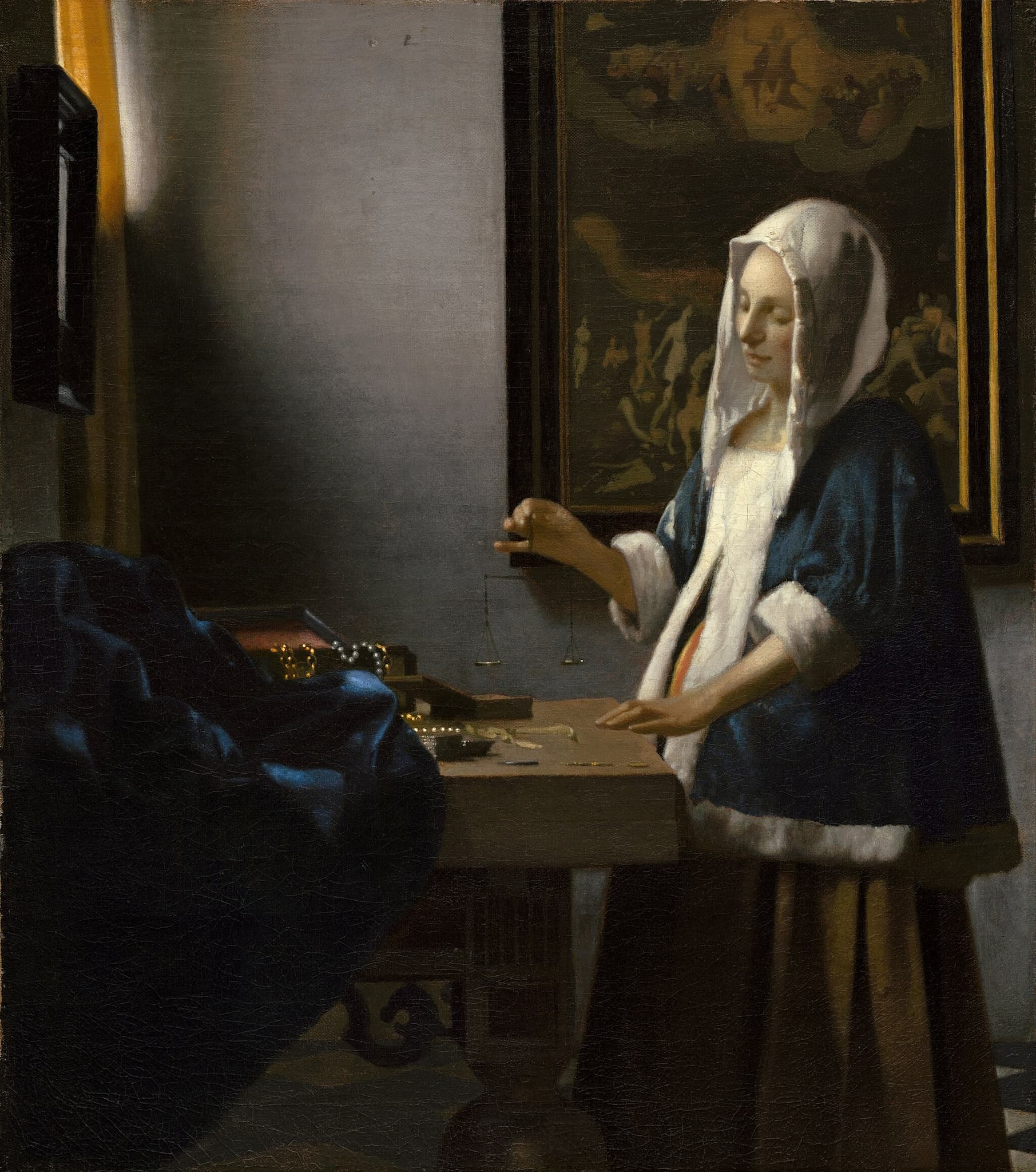
Woman Holding a Balance
Johannes Vermeer • Oil on canvas
Read full analysis of Woman Holding a Balance →Valuation Analysis
Estimate and context: Based on comparative market anchors, institutional trophy purchases, and replacement/insurance practice, I estimate a hypothetical open‑market value for Vermeer’s Woman Holding a Balance in the range USD 150–400 million (central planning USD 200–300 million). The painting is in the National Gallery of Art (Widener Collection) and is effectively off‑market, so this figure is a theoretical replacement/market valuation rather than a transaction price [1].
Method and comparables: Because the painting has no modern auction sale record, the assessment uses a blended comparable approach: (a) the last undisputed Vermeer public‑auction anchor (Sotheby’s, "A Young Woman Seated at the Virginals", 2004) as a baseline for artist‑level pricing behavior [2]; (b) high‑end private/institutional Dutch Golden Age purchases (for example the 2016 joint Louvre/Rijksmuseum Rembrandt acquisition) to demonstrate institutional willingness to pay nine‑figure sums for national icons [3]; and (c) extreme trophy‑sale ceilings (e.g., the Salvator Mundi result) to set upper bounds on scarcity premiums [4]. Adjustments reflect scarcity, icon status, condition/technical risk and the practical unavailability of the work to ordinary market bidders.
Key drivers: Three forces push the estimate upward: Vermeer’s extreme scarcity (c. mid‑30s securely attributed paintings), the painting’s canonical art‑historical status and its public visibility (textbook/icon work), and institutional/sovereign buyer appetite for national‑icon masterpieces as demonstrated in recent trophy purchases. These drivers justify a high eight‑figure to low nine‑figure valuation if the work were legitimately offered to the market. Major exhibitions and ongoing technical scholarship (e.g., recent Vermeer retrospectives) have strengthened the cultural premium for top works [5].
Caveats and brakes: The principal restraints on realizing this value are legal/institutional: donor restrictions, museum deaccession policy and public‑trust considerations make an actual commercial sale highly unlikely. Additionally, absence of public insurance/replacement valuations, confidential private‑sale comparables, and the need for up‑to‑date condition and technical reports mean this estimate carries wide uncertainty. Attribution or condition issues, if discovered, could materially lower the price; conversely, a coordinated sovereign/institutional purchase would be likelier to achieve the top of the range [2][3][4].
Scenario framing: The low end (≈USD 150M) reflects a market in which strong but cautious institutional and private bidders compete, and where condition or other minor risks moderate top pricing. The high end (≈USD 400M) represents a trophy‑purchase scenario with multiple institutions or a consortium of sovereign/state actors willing to pay a premium for a cultural icon. All figures are hypothetical; they should be refined with provenance files, full conservation/technical reports, insurance valuations and any records of prior private offers.
Next steps: To refine this valuation I recommend obtaining the NGA’s provenance/condition/technical files, any insurer/replacement valuation, and confidential private‑sale comparables for top Dutch Golden Age works. I can prepare a one‑page memorandum that lays out the comparables, inflation/adjustment math and scenario sensitivities if you’d like a working model.
Key Valuation Factors
Art Historical Significance
High ImpactWoman Holding a Balance is a mature, canonical Vermeer and a widely recognized icon of Dutch Golden Age domestic interior painting. Its sophisticated composition, subtle light handling and layered iconography (the balance, the celestial/Judgment motif in the background) make it central to Vermeer scholarship and public recognition. This cultural prominence translates into a ‘museum‑icon’ premium: museum curators, national collections and foundations prize such works for their interpretive and audience value. In market terms, art‑historical significance raises both replacement/insurance valuations and the competitive intensity among deep‑pocketed institutional or sovereign buyers if the work were ever legitimately offered.
Rarity / Scarcity of the Oeuvre
High ImpactVermeer’s securely attributed oeuvre is extremely small (roughly mid‑30s), and very few works ever re‑enter the market. Scarcity drives a structural trophy premium: when a canonical work becomes available, the pool of potential buyers (major museums, sovereign buyers, a handful of ultra‑high‑net‑worth collectors or consortia) competes intensely. The lack of repeat transactional evidence means market formation relies on cross‑category trophy comparables and institutional precedent, which amplifies price volatility but supports high valuation multiples relative to more liquid artist markets.
Institutional Ownership & Provenance
High ImpactThe painting is part of the National Gallery of Art (Widener Collection, accession 1942.9.97), which imposes significant legal, donor and ethical constraints on commercial disposal. Public ownership reduces liquidity—making sale improbable—but simultaneously increases the painting’s insured/replacement value and symbolic importance. Provenance tied to major collections enhances market trust and desirability for potential buyers, yet deaccession rules, export controls and national cultural policies are practical brakes. Institutional ownership thus raises theoretical value while making realization of that value extremely difficult.
Comparable Transactions & Trophy Market
High ImpactWith no modern sale for this painting, valuation leans on comparables: the last undisputed Vermeer auction anchor (2004 Sotheby’s virginals), high‑value private/institutional purchases (e.g., the Rembrandt pair acquired jointly by the Louvre and Rijksmuseum), and extreme trophy auction ceilings (e.g., Salvator Mundi). These transactions show institutions will pay eight‑ to nine‑figure sums for national icons and that a canonical Vermeer could plausibly enter that bracket under the right circumstances. Comparative analysis therefore supports a broad but credible USD 150–400M range.
Condition / Technical / Attribution Risk
Medium ImpactCondition and technical findings materially affect price; even canonical works can be reappraised following conservation imaging or technical study. Attribution risk (or downgraded authorship) substantially reduces values, as seen in contested Vermeer attributions sold at lower prices. For Woman Holding a Balance the current scholarly consensus supports autograph status, but final market value would require the NGA’s detailed conservation and technical reports. The absence of those public reports imposes uncertainty and justifies the wide valuation band.
Sale History
Woman Holding a Balance has never been sold at public auction. It has been held by National Gallery of Art.
Johannes Vermeer's Market
Johannes Vermeer occupies a unique position in the Old Masters market: extreme scarcity (c. mid‑30s accepted works), very high public recognition, and a majority of his paintings held by museums or public institutions. Transactional liquidity is minimal—few works surface, and the last widely reported undisputed Vermeer auction sale was in 2004—so market pricing depends heavily on trophy‑sale dynamics, institutional demand and replacement/insurance practice. When a major Vermeer is legitimately available, expect aggressive institutional bidding and prices that leap far above typical Old Masters market medians.
Comparable Sales
A Young Woman Seated at the Virginals
Johannes Vermeer
Best modern public-auction anchor for a securely attributed Vermeer; same artist, similar small domestic interior genre; direct auction comparable.
$30.1M
2004, Sotheby's, London
~$49.9M adjusted
Saint Praxedis (attributed)
Attributed to Johannes Vermeer
Attributed/contested Vermeer sold at auction—useful as a lower-bound reference for works where attribution or condition reduces market confidence.
$10.7M
2014, Christie's, London
~$14.1M adjusted
Maerten Soolmans and Oopjen Coppit (pair)
Rembrandt van Rijn
Sovereign/institutional purchase of top Dutch Golden Age masterpieces; demonstrates institutions will pay high eight‑ to nine‑figure sums for national-icon works—useful cross-artist trophy comparable.
$177.6M
2016, Private sale arranged via Christie's (joint acquisition by the Louvre and the Rijksmuseum)
~$231.6M adjusted
Portrait of a Young Man Holding a Roundel
Sandro Botticelli
High-profile modern Old Master auction trophy (post-2020); cross-period benchmark for ceilings on rare pre-20th-century masterpieces.
$92.2M
2021, Sotheby's, New York
~$106.5M adjusted
Salvator Mundi (attributed to Leonardo da Vinci)
Attributed to Leonardo da Vinci
Upper-ceiling trophy Old Master sale illustrating extreme scarcity + attribution premium; not a direct Vermeer comparable but useful as an upper bound for rare canonical works.
$450.3M
2017, Christie's, New York
~$575.0M adjusted
Current Market Trends
The top tier of the Old Masters market has shown renewed strength driven by blockbuster exhibitions, rare rediscoveries and institutional buying. Attribution and technical research are increasingly price‑moving factors. However, the category remains specialist and illiquid: record results can occur, but only for exceptional, museum‑quality works that attract sovereign or consortium buyers.
Sources
- National Gallery of Art — Woman Holding a Balance (object page)
- Sotheby's — A Young Woman Seated at the Virginals, Old Master Paintings (2004 sale page)
- The Art Newspaper — France and Netherlands finalise €160m Rembrandt treaty (Rembrandt pair institutional purchase)
- The Art Newspaper — Leonardo’s Salvator Mundi sells for $450m at Christie’s (2017)
- Rijksmuseum — Vermeer exhibition press release (2023)