How Much Is Black Square Worth?
Last updated: March 19, 2026
Quick Facts
- Methodology
- extrapolation
Kazimir Malevich’s Black Square (1915) has never been sold and is held by the State Tretyakov Gallery, making it effectively non‑marketable. In a hypothetical, unrestricted international sale, its unique, canonical status would command approximately $200–400 million, well above the artist’s auction record. This would likely set an all-time record for Russian art.
Valuation Analysis
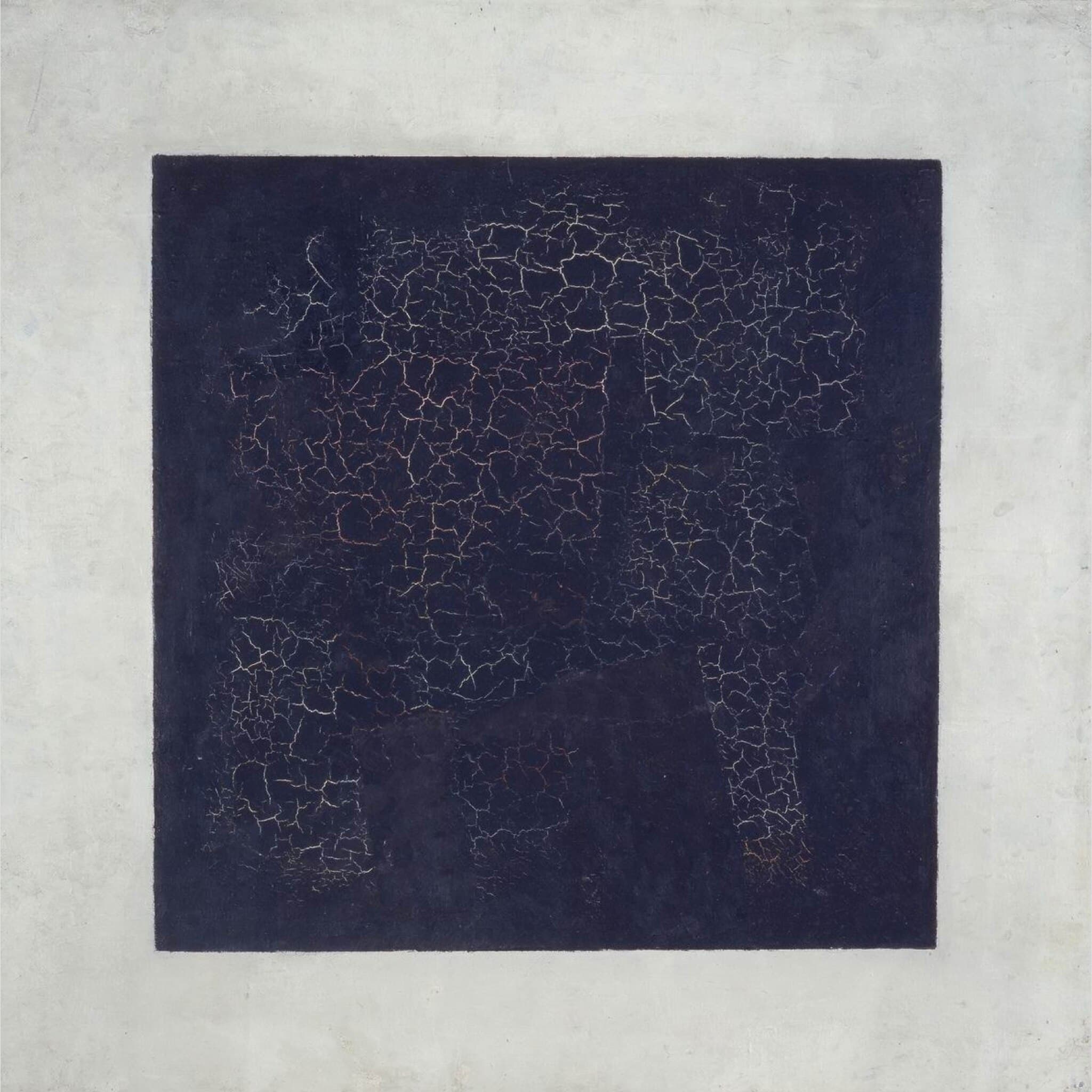
Estimate and premise. This valuation treats Malevich’s 1915 Black Square as if it could be legally and cleanly offered in the global market. The work has never been sold publicly and is in the State Tretyakov Gallery, Moscow, where it is protected as a cultural treasure and effectively non‑deaccessionable [1][4]. In a fully competitive, unrestricted sale at a top-tier venue, the painting would reasonably achieve $200–400 million.
Methodology: anchor and extrapolation. We extrapolate upward from the artist’s standing auction record—Malevich’s Suprematist Composition (1916) at $85.81 million (Christie’s New York, 2018) [2]—applying an ‘icon multiplier’ for Black Square’s singular art-historical primacy. Cross-artist trophy benchmarks confirm depth of demand for canonical, era-defining images: Andy Warhol’s Shot Sage Blue Marilyn realized $195.04 million (2022) [5], Pablo Picasso’s Les femmes d’Alger (Version O) achieved $179.37 million (2015) [6], and the modern apex remains Leonardo’s Salvator Mundi at $450.31 million (2017) [7]. These comparables frame a realistic ceiling for unparalleled cultural icons.
Why Black Square sits at the top of the curve. Created in 1915, Black Square is the keystone of Suprematism—the artist’s declared “zero point of painting”—and the single most reproduced, debated, and institutionally canonized work in Malevich’s oeuvre. Its image power transcends the rest of his market, including the high-value Suprematist Compositions that have tested auction records. Multiple later versions exist, but the 1915 canvas is broadly regarded as primus inter pares; its scarcity is absolute (all canonical versions are in Russian state museums) and its cultural resonance is unmatched [1].
Offsets: condition and structure. The 1915 picture is notoriously fragile, with severe craquelure and complex stratigraphy; 2015 technical studies revealed underlayers and a handwritten inscription, underlining both significance and conservation sensitivity [3]. Condition risk would temper the very top of bidding, yet, given its icon status, market history shows that connoisseur buyers and institutions will prioritize cultural weight over condition when an object is uniquely important—hence our broad but robust $200–400 million range.
Marketability caveat. The Tretyakov’s ownership and Russia’s cultural‑property/export regime make a real sale implausible [1][4]. Since 2022, major houses have also curtailed dedicated Russian art auctions, further reducing price discovery in this category [8]. Accordingly, this is a hypothetical, unrestricted-market estimate—best interpreted as an “agreed value”/insurance-type benchmark for a canonical masterpiece, not a fair‑market value derived from active trade.
Key Valuation Factors
Art Historical Significance
High ImpactBlack Square (1915) is the foundational image of Suprematism and one of the most consequential statements in 20th‑century art. It is widely described as the “zero point of painting,” a decisive rupture with representation that redefined the possibilities of abstraction. Within Malevich’s oeuvre it is the keystone; within the broader avant‑garde, it is a touchstone on par with the most discussed icons of Modernism. Its influence extends beyond painting into design, architecture, graphic systems, and conceptual frameworks, making it far more than a stylistic experiment. This unique, irreplaceable art‑historical weight justifies a substantial premium over any other Malevich work.
Market Comparables and Trophy Pricing
High ImpactThe artist’s standing auction record—Suprematist Composition (1916) at $85.81m (2018)—anchors Malevich at the top tier of early Modernism. Cross‑artist trophies show sustained demand for singular cultural icons: Warhol’s Shot Sage Blue Marilyn at $195.04m (2022), Picasso’s Les femmes d’Alger at $179.37m (2015), and Leonardo’s Salvator Mundi at $450.31m (2017). While not stylistic peers, these results establish the price envelope for works whose fame and art‑historical centrality transcend their categories. Black Square’s image power and canonical status credibly place it in this cohort, supporting a $200–400m estimate in a fully global, unencumbered sale.
Scarcity and Institutionalization
High ImpactSupply of first‑tier Malevich paintings is extraordinarily thin; most prime works reside in museums. All canonical Black Squares are in Russian state collections, and the 1915 canvas has never been on the market. Extreme scarcity underpins price: collectors can vie for works on paper or secondary motifs, but not for the seminal icon. In trophy markets, this kind of absolute scarcity amplifies willingness‑to‑pay when a hypothetical opportunity appears, particularly among a small set of global buyers competing for museum‑caliber, era‑defining objects. This structural supply constraint is a key driver of the high estimate range.
Condition and Conservation Risk
Medium ImpactTechnical studies have documented severe craquelure and layered complexities in the 1915 Black Square, and the work seldom travels due to fragility. Such condition issues introduce uncertainty about long‑term stability and may limit exhibition/loan potential, traditionally softening the absolute price ceiling. However, for singular icons, market precedent shows that condition is often discounted relative to cultural primacy—collectors pay for the idea and the historical position as much as the material state. Our $200–400m range reflects this balance: condition tempers the upside but does not dislodge Black Square from the trophy tier.
Legal/Geopolitical Constraints
High ImpactAs a state‑held cultural treasure in the Tretyakov Gallery, the 1915 Black Square is effectively non‑deaccessionable and non‑exportable under Russian cultural‑property law. Since 2022, dedicated Russian art sales at major houses have also been curtailed, constraining price discovery and participation. These realities make an actual transaction highly unlikely and any value necessarily hypothetical. Nevertheless, for purposes of insurance planning or academic benchmarking, a rigorous market‑equivalent range is essential. Our estimate explicitly assumes an unrestricted legal pathway and normal competitive bidding; in real‑world conditions, such constraints would preclude or materially depress any transaction.
Sale History
Black Square has never been sold at public auction.
Kazimir Malevich's Market
Kazimir Malevich is a blue‑chip pillar of early Modernism whose best works are tightly held by institutions. His auction record stands at $85.81 million for Suprematist Composition (Christie’s, 2018), one of the highest prices for a European avant‑garde painting. Public supply since then has been sparse at the top end, with market activity concentrated in authenticated works on paper at mid‑five to low‑six figures, while museum‑caliber paintings rarely surface. Demand is global and highly selective: provenance, scholarship, and period significance are decisive. In this context, Black Square, as the defining image of Suprematism, would command a substantial multiple of the artist’s record in any hypothetical sale.
Current Market Trends
The post‑2020 market favors singular, museum‑quality trophies with impeccable provenance, even as overall liquidity at $10m+ has become more selective. Since 2022, dedicated Russian art sales have contracted amid sanctions and compliance headwinds, reducing category‑specific price signals. Nevertheless, top‑tier Modern icons continue to attract deep competition, as evidenced by recent marquee results for emblematic 20th‑century works. For early abstraction, standout, fully vetted pieces perform strongly, while middling or uncertain material struggles. Against this backdrop, a uniquely canonical object like Black Square would trade in the upper stratum of the global trophy market if legally and practically available.
Sources
- State Tretyakov Gallery — Collection entry for Black Square (1915)
- Christie’s — May 2018 Impressionist & Modern Evening Sale report (Malevich record $85.81m)
- The Guardian — ‘Kazimir Malevich’s Black Square hides paintings underneath’ (2015)
- Law of the Russian Federation No. 4804-1 — On Export and Import of Cultural Valuables (overview)
- Christie’s — Warhol’s Shot Sage Blue Marilyn sells for $195,040,000 (2022)
- Christie’s — Picasso’s Les femmes d’Alger (Version O) realizes $179,365,000 (2015)
- Christie’s — Leonardo da Vinci’s Salvator Mundi sells for $450,312,500 (2017)
- The Art Newspaper — Sotheby’s and Christie’s call off Russian art auctions (2022)