How Much Is Birthday (L'Anniversaire) Worth?
Last updated: March 20, 2026
Quick Facts
- Methodology
- comparable analysis
MoMA’s 'Birthday (L'Anniversaire)' (1915; oil on cardboard; 80.6 × 99.7 cm) is a well‑documented early Chagall with strong provenance and exhibition history. If hypothetically offered, a defensible conditional market range is $3,000,000–$12,000,000, driven upward by institutional provenance and exhibition history and moderated by the cardboard support and condition risk.
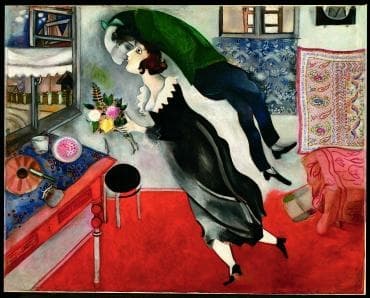
Birthday (L'Anniversaire)
Marc Chagall, 1915 • Oil on cardboard
Read full analysis of Birthday (L'Anniversaire) →Valuation Analysis
Valuation conclusion: For the work titled 'Birthday (L'Anniversaire)' (1915; oil on cardboard; 80.6 × 99.7 cm), a defensible conditional market range if offered is $3,000,000–$12,000,000. This is a hypothetical sale estimate — the specific MoMA object is museum‑held and not on the market, but its documented provenance and exhibition history inform the premium end of the range [1].
The methodology used is a focused comparable‑analysis of recent and historic Chagall sales and institutional practice. Top‑tier Chagall canvases have set a high ceiling (e.g., 'Les Amoureux,' c.1928, which realized c. $28.45M at Sotheby’s) while high‑quality 1920s works have realized mid‑teens millions; important early oils have sold in the $5–8M band [2][3][4]. These comparables establish market appetite and ceiling; the oil‑on‑cardboard support, however, typically discounts realized prices relative to canvas works, which underpins the lower bound and the conservative mid‑range.
Condition and support are decisive. Cardboard as a support is inherently vulnerable to deformation, acidity and past relining/repair; buyers and institutional buyers routinely apply significant discounts to works on ephemeral supports unless a rigorous conservation history and stabilizing treatment is documented. If the MoMA painting is in excellent, well‑documented conservation condition and has been stabilized by a major conservation laboratory, it would be positioned toward the upper third of the estimate; if untreated or with structural compromises, it would fall toward the lower third.
Provenance and exhibition history materially enhance marketability. The MoMA accession record traces an ownership chain through reputable dealers and collectors and records early 20th‑century exhibitions in European institutions; such continuity and public exhibition (including loans to major retrospectives) reduce buyer risk and support a premium. Conversely, any provenance gaps or possible wartime‑era problems would sharply reduce competitive bidding and price realization [1].
Authentication and catalogue‑raisonné inclusion are also essential. Institutional ownership by MoMA and repeated scholarly reproduction make the attribution to Chagall robust for market purposes, but formal catalogue confirmation (Comité/raisonné entry) and written provenance documentation remove residual uncertainties that can depress hammer prices. Technical examination (IRR, pigment, and support analysis) further de‑risk the offering and is standard practice ahead of a high‑value sale.
Recommendation: to maximize value, prepare a full written provenance packet, recent conservation report, technical examination, and propose either a curated auction placement in a major evening sale or a high‑level private‑treaty placement with marketing emphasizing the work’s exhibition history. Given the support and documented institutional status, the $3,000,000–$12,000,000 range reflects realistic market positioning based on the cited comparables and present market dynamics [2][4].
Key Valuation Factors
Art Historical Significance
High ImpactThe painting dates to 1915, an important formative moment in Chagall’s oeuvre when familiar motifs of lovers, floating figures, and dream imagery crystallized. As an early work that exemplifies themes Chagall returned to throughout his career, it carries substantial art‑historical weight. Institutional recognition — most notably MoMA’s acquisition and repeated exhibition inclusion — further elevates the composition’s cultural importance and desirability for collectors and museums. That significance translates directly into market value: canonical early works or those widely reproduced in scholarship attract competitive bidding and premium prices, provided attribution, condition and provenance are secure.
Condition & Support
High ImpactSupport and condition are among the single most important price drivers for this object. Oil on cardboard is inherently less stable than oil on canvas: cardboard is prone to warping, edge loss, acidity and patching. Major buyers will demand a recent, thorough conservation report and proof of long‑term stabilization; absent that, they apply steep discounts. A pristine conservation history and professional stabilization (with documentation from a recognized conservation laboratory) materially increase saleability and lift price expectations toward the top of the estimate, whereas untreated structural issues will push value toward the low end.
Provenance & Exhibition History
High ImpactThe painting’s provenance chain — acquisition from the artist through reputable dealers and past ownership by known collectors, culminating in MoMA via the Lillie P. Bliss bequest — substantially reduces buyer risk and supports premium pricing. Early 20th‑century exhibition appearances in European institutions and subsequent loans to major retrospectives amplify market confidence and demand. Clear, continuous provenance combined with public exhibition record is a powerful value enhancer; conversely, any gaps or unresolved wartime‑era ownership questions would materially depress the achievable price and lengthen the sale timeline.
Authentication & Catalogue‑Raisonné Status
Medium ImpactInstitutional ownership and inclusion in museum catalogues make attribution credible for the market, but formal catalogue‑raisonné listing or written confirmation from recognized Chagall authorities further de‑risk a transaction. Technical analysis (IRR, X‑ray, pigment testing) that aligns with a circa‑1915 dating and Chagall’s hand is expected before a high‑value sale. Full authentication increases buyer confidence and narrows the discount applied by risk‑averse bidders; absence of a raisonné entry or unresolved attribution questions can reduce interest from major houses and collectors.
Market Comparables & Demand
Medium ImpactRecent auction results for Chagall show a broad range: top canvases have achieved multi‑million to tens‑of‑millions results, while early works and mid‑quality pieces regularly realize mid‑single‑ to low‑double‑million figures. Comparables such as early oils sold in the $5–8M range demonstrate strong appetite for canonical early works, but those were often on canvas and/or had different condition/provenance profiles. Geographic demand (Europe, North America, Russia) and the timing of sale (major evening sale vs. private treaty) will determine whether the work approaches the top, middle, or lower part of the proposed range.
Sale History
Birthday (L'Anniversaire) has never been sold at public auction.
Marc Chagall's Market
Marc Chagall is an established blue‑chip modernist with steady global demand. His auction record (notably a late 20th/early 21st century high in the tens of millions) demonstrates a strong ceiling for canonical masterpieces; at the same time the artist’s prolific output means a wide spread of results across supports, sizes and qualities. Canvases with impeccable provenance and exhibition histories command the highest prices, while works on paper or fragile supports (drawings, cardboard) typically realize materially less. Collectors and institutions remain active, and museum provenance substantially increases marketability.
Comparable Sales
Les Amoureux
Marc Chagall
Top-tier, museum-quality Chagall masterpiece that establishes the market ceiling for canonical works by the artist; useful as an upper-end benchmark though later in date (1928) and on canvas.
$28.5M
2017, Sotheby's New York
~$36.4M adjusted
Au‑dessus de la ville
Marc Chagall
1924 work with the ‘flying lovers/figures over town’ motif related in subject to Birthday; strong canvas sale in the mid‑teens million range—useful as a high, subject‑related comparable.
$15.6M
2023, Sotheby's New York
~$16.6M adjusted
Le Père
Marc Chagall
Early‑period Chagall (1911) sold strongly at major auction—closer in chronology to the 1915 Birthday and therefore a relevant period comparable; provenance/restoration issues affected this lot, so it illustrates demand for early works despite condition/provenance caveats.
$7.4M
2022, Phillips New York
~$8.1M adjusted
Le Violoniste
Marc Chagall
Mid‑1920s figurative oil in a lower‑mid price bracket; useful as a benchmark for market interest in Chagall’s figurative works that are less than top‑tier masterpieces—helps define the middle market relative to the MoMA 1915 Birthday (noting support/condition differences).
$5.9M
2023, Christie's New York
~$6.3M adjusted
Current Market Trends
The market for blue‑chip modernists like Marc Chagall remains resilient, with sustained demand for museum‑quality works and strong interest from collectors in Europe, North America and Russia. Auction sales of canonical canvases have recently produced multi‑million results, supporting high price ceilings, while works on paper and fragile supports have underperformed relative to canvas. Economic cycles and geopolitical shifts periodically compress bidder pools, but institutional loans, blockbuster retrospectives and scholarly attention reliably boost prices. For a museum‑quality Chagall with impeccable provenance the market is robust; for a cardboard support or condition issues, expect discounting and longer sale timelines and reduced liquidity.
Sources
- The Museum of Modern Art – Collection: Marc Chagall, Birthday (L'Anniversaire), 1915
- Sotheby's – Coverage: Chagall's 'Les Amoureux' and major auction highlights (2017)
- Sotheby's – Preview and highlights including 'Au‑dessus de la ville' (2023 coverage)
- Phillips – Sale entry and result for Marc Chagall, 'Le Père' (1911)
- Christie's – Comparable mid‑period sale listings (example: 'Le Violoniste')
- Official Marc Chagall Site – Work summary for 'L'Anniversaire' (1915)