How Much Is I and the Village Worth?
Last updated: March 14, 2026
Quick Facts
- Methodology
- extrapolation
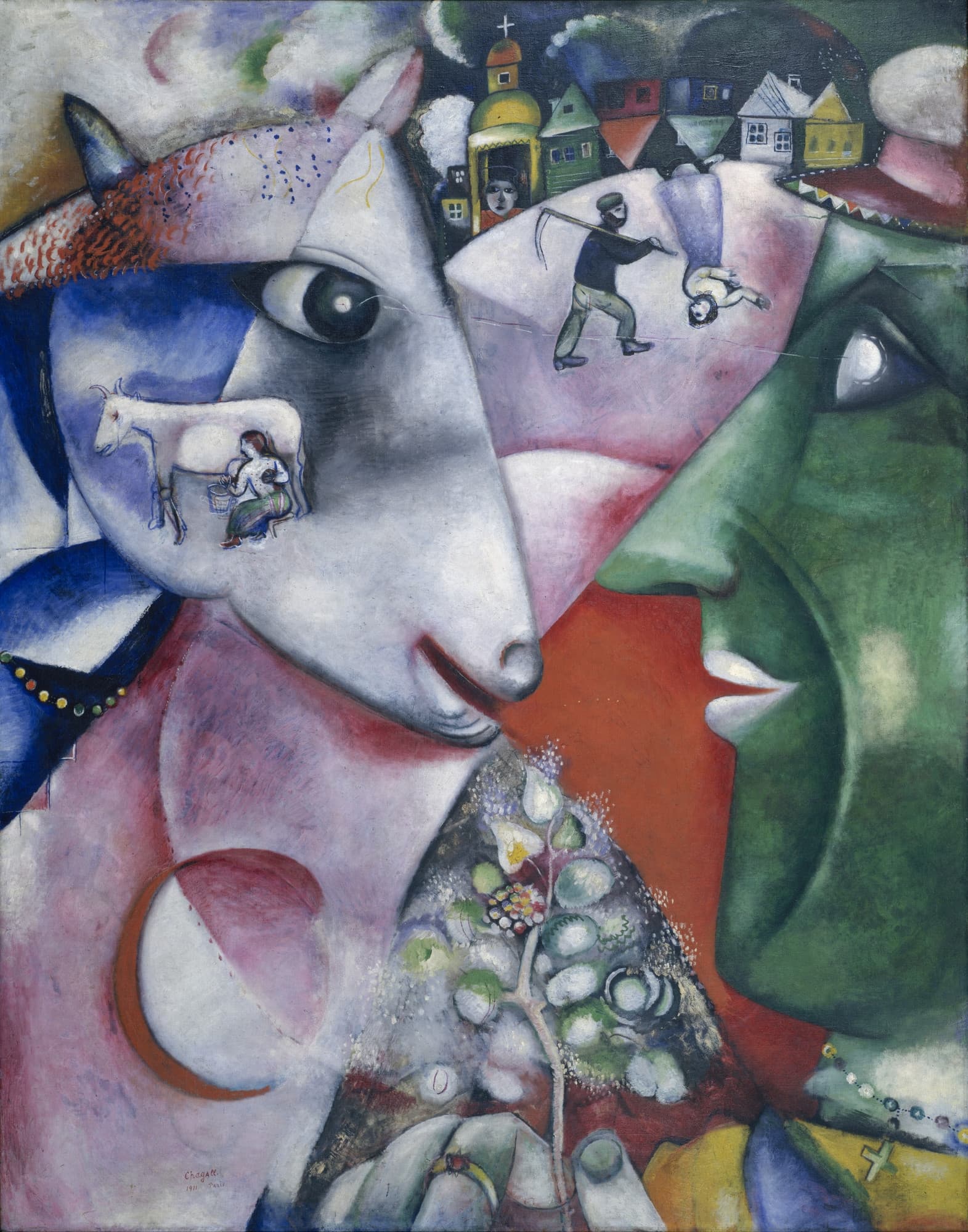
I and the Village (1911) is a canonical early‑modern masterpiece by Marc Chagall and a cornerstone of MoMA’s collection. Given the work’s singular art‑historical status, extreme scarcity of true peers, and current trophy‑market dynamics, a hypothetical sale would likely achieve $100–200 million under optimal conditions.
Valuation Analysis
Conclusion: I and the Village (1911) is one of Marc Chagall’s most important paintings and a pillar of MoMA’s permanent collection. Were it ever to be deaccessioned and sold in a prime marquee setting with a robust global marketing campaign and appropriate financial backing (e.g., a third‑party guarantee), a fair‑market value in the range of $100–200 million is supportable.
Why this sits far above the artist’s public auction record: Chagall’s auction ceiling stands at $28.45 million for Les Amoureux (1928) at Sotheby’s in 2017 [2]. In late 2025, a major late‑period canvas, Le songe du Roi David, realized $26.51 million at Christie’s, underscoring depth for top‑tier but non‑canonical works [3]. An early 1911 painting, The Father, brought $7.4 million in 2022—significant for the period but not comparable in icon status [5]. None of these sales approaches the art‑historical centrality or brand‑defining power of I and the Village, which fuses Cubist structure with Chagall’s Russian‑Jewish folklore and is among the most reproduced images in 20th‑century art [1].
Trophy-market context: When singular, canon‑defining early‑modern masterworks surface, the buyer pool expands well beyond category specialists and national borders. Recent headline results—such as Gustav Klimt’s $236.4 million portrait in 2025—demonstrate the capacity of today’s market to fund nine‑figure outcomes for museum‑caliber icons with indisputable cultural cachet [4]. While not a direct one‑to‑one comparable, such benchmarks illustrate the premium paid for unique, brand‑defining works—precisely the segment in which I and the Village resides.
Specific value drivers for this painting: The date (1911), scale, and synthesis of avant‑garde form with personal symbolism place the work at the heart of Chagall’s early Paris breakthrough. Its long, transparent provenance—including ownership by René Gaffé and MoMA’s 1945 acquisition via the Mrs. Simon Guggenheim Fund—confers exceptional market confidence [1]. The work’s ubiquity in textbooks and exhibitions amplifies cultural recognition, an intangible yet potent force at the high end of the market. True substitutes are essentially off the market: most comparable early‑period icons reside in museums, so any pricing must be extrapolated from cross‑artist trophies and the artist’s upper‑tier results.
Execution considerations: Outcomes at this level hinge on sale strategy (public evening sale vs. discreet private placement), competitive tension, timing, and macro risk. Institutional deaccessioning constraints and public scrutiny can also affect format and buyer perception. Even so, given the confluence of canonical status, scarcity, pristine provenance, and demonstrated trophy liquidity, a $100–200 million range reflects where informed bidders could rationally transact today under favorable conditions [1][2][3][4][5].
Key Valuation Factors
Art Historical Significance
High ImpactI and the Village (1911) is widely regarded as one of Chagall’s defining early Paris works, crystallizing his merger of Cubist structure with autobiographical and folkloric imagery. It is among the most reproduced, taught, and exhibited pictures in 20th‑century art, used to explain Chagall’s unique contribution to modernism and cultural memory. Works with this level of critical consensus command a substantial premium because they attract a broader, trophy‑oriented buyer base that values cultural resonance as much as connoisseurship. In effect, the painting is not just a masterpiece by Chagall; it is a canonical image of early modern art, which justifies pricing far above the artist’s auction record.
Scarcity and Supply Constraints
High ImpactTrue peers—large‑scale, early‑period Chagall icons with similar art‑historical weight—are effectively unavailable. Most are held by major museums; private examples seldom, if ever, surface. This structural scarcity creates a discontinuous pricing curve: conventional within‑artist comparables (which top out around $26–29m) systematically understate the value of a singular, brand‑defining work. In practice, collectors seeking a museum‑caliber Chagall must bid across categories, and the lack of substitutes compresses decision time and pushes prices upward. Scarcity also enhances long‑term price resilience because the likelihood of another equivalent example entering the market is minimal.
Provenance and Institutional Exposure
High ImpactThe painting’s chain of ownership—Nell Walden, Marc Chagall, René Gaffé—and MoMA’s acquisition in 1945 via the Mrs. Simon Guggenheim Fund provide impeccable provenance and title clarity. Decades of high‑profile display and scholarship at MoMA further validate quality and importance while maximizing global recognition. Such institutional pedigree is a powerful de‑risking mechanism at the top end: buyers prize works with transparent histories and sustained exhibition records because they reduce legal, scholarly, and reputational uncertainty. Provenance of this caliber typically adds a meaningful premium over otherwise comparable works lacking similar museum association.
Trophy-Market Dynamics
High ImpactIn the current ‘winner‑take‑most’ market, capital concentrates on a small subset of universally recognized masterpieces. Recent nine‑figure results for early‑modern icons confirm deep, global demand when works of unquestioned stature appear. At this level, collectors evaluate cross‑artist substitutions—e.g., choosing between a Klimt, a Picasso, or a Chagall of defining importance—so pricing is set by the broader trophy pool rather than the artist’s legacy record. With appropriate sale engineering (global outreach, competitive consignor terms, and a strategic guarantee), I and the Village could catalyze that cross‑category demand, supporting a nine‑figure outcome despite Chagall’s sub‑$30m auction ceiling.
Sale History
I and the Village has never been sold at public auction.
Marc Chagall's Market
Marc Chagall’s market is deep and global, supported by strong liquidity in prints and works on paper and steady demand for color‑rich oils from the 1950s–60s Vence period. The public auction record is $28.45 million for Les Amoureux (1928) at Sotheby’s in 2017, with a near‑record $26.51 million achieved for Le songe du Roi David in 2025, signaling renewed strength at the top end. Early Paris‑period masterpieces are exceptionally scarce on the market; when early works do appear, they can perform well relative to scale and subject, but few approach the status of the canonical icons held by museums. Asian demand has grown, and institutional provenance meaningfully enhances price potential.
Comparable Sales
Les Amoureux
Marc Chagall
Same artist; blue‑chip oil with celebrated Lovers motif; still the public auction record for Chagall—useful for anchoring the artist’s known auction ceiling.
$28.5M
2017, Sotheby's New York
~$36.5M adjusted
Le songe du Roi David
Marc Chagall
Same artist; major late Vence‑period oil with institutional provenance; near‑record 2025 result showing depth for top‑tier (but non‑canonical) Chagall paintings.
$26.5M
2025, Christie's New York
The Father
Marc Chagall
Same artist; same pivotal early Paris year (1911) as 'I and the Village'; smaller, sober composition; restitution provenance. Indicates pricing for early‑period works absent 'trophy' status.
$7.4M
2022, Phillips New York
~$8.0M adjusted
Le soleil rouge ou Le soleil des amoureux
Marc Chagall
Same artist; strong mid‑century lovers/sun theme and vibrant palette; useful for gauging demand for signature Chagall iconography in sizeable oils.
$10.5M
2025, Christie's New York
Portrait of Dr. Gachet
Vincent van Gogh
Cross‑artist benchmark; universally recognized Post‑Impressionist icon with a long‑standing auction record; inflation‑adjusted near $200m—frames the high‑end appetite for canonical masterpieces.
$82.5M
1990, Christie's New York
~$199.0M adjusted
Portrait of Elisabeth Lederer (title per sale record)
Gustav Klimt
Cross‑artist 'trophy' benchmark; museum‑caliber, canon‑defining early‑modern portrait sold for $236.4m in 2025, illustrating nine‑figure demand when singular masterpieces surface.
$236.4M
2025, Sotheby's New York
Current Market Trends
Modern category auction turnover contracted in 2023–2024, but late‑2025 marquee sales showed a clear rebound at the top, with nine‑figure trophies resetting confidence and cross‑border participation (notably from Asia) increasing. The market remains highly selective: best‑in‑class, museum‑exhibited works with impeccable provenance command aggressive bidding, while mid‑tier material is price‑disciplined. Against this bifurcated backdrop, brand‑defining early‑modern masterpieces can transcend artist‑specific ceilings and trade on cross‑category trophy demand. In short, masterpieces outperform and carry meaningful scarcity premia, a dynamic directly relevant to a hypothetical sale of I and the Village.
Sources
- MoMA collection record: Marc Chagall, I and the Village (1911)
- Sotheby’s New York (Nov 14, 2017): Chagall record, Les Amoureux
- Christie’s New York (Nov 17, 2025): Le songe du Roi David price realized
- AP News: Klimt portrait sets modern-art auction record at $236.4m (Nov 18, 2025)
- Times of Israel/AFP: Chagall’s The Father fetches $7.4m at Phillips (Nov 15, 2022)