How Much Is Les Amoureux (The Lovers) Worth?
Last updated: March 20, 2026
Quick Facts
- Last Sale
- $28.5M (2017, Sotheby's New York (Impressionist & Modern Evening Sale))
- Methodology
- recent sale
If the work is the documented 1928 oil with the Bernheim Jeune acquisition, Basel exhibition history and the dimensions/condition recorded in Sotheby’s 2017 lot, current market value (Mar 2026) is estimated at $28–40M. This range is anchored to the Sotheby’s Nov 14, 2017 sale that realized $28,453,000 and adjusted for inflation, recent comparable results and condition/provenance variables.
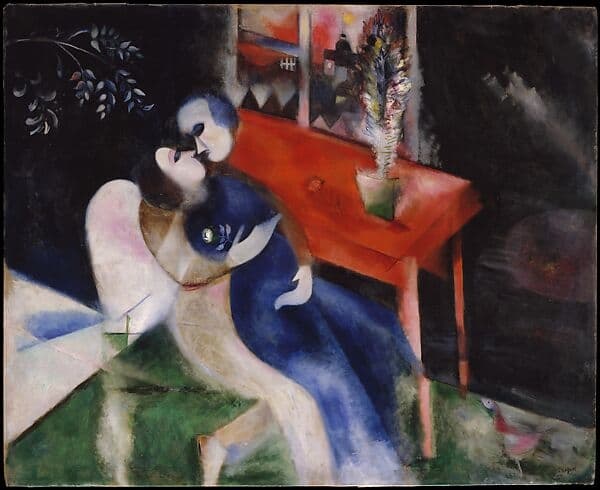
Les Amoureux (The Lovers)
Marc Chagall, 1928 • Oil on canvas
Read full analysis of Les Amoureux (The Lovers) →Valuation Analysis
Valuation conclusion: Based on the documented 1928 oil titled "Les Amoureux" that sold at Sotheby's New York on 14 November 2017 for $28,453,000 (buyer’s premium inclusive), my market valuation for an identical work in equivalent condition, provenance and documentation as of March 2026 is US$28,000,000–US$40,000,000. The methodology anchors to that recent sale, adjusts for inflation and market movement, and factors in comparable results for Paris‑period Chagall canvases [1].
The 2017 sale that establishes the anchor was supported by exceptionally strong credentials — an acquisition from Bernheim Jeune directly from the artist in 1928, continuous family ownership until the offering, exhibition (Kunsthalle Basel, 1933) and literature citations — all catalogued in the Sotheby’s lot note [1]. Those provenance and exhibition details materially reduce attribution risk and mobilize institutional and high‑net‑worth buyers, creating the competitive conditions that produced the $28.45M result. Post‑sale press and house materials framed the work as the artist's auction record, which also amplifies its market visibility and collector desirability [2]. If your object matches that pedigree, it sits at the top tier of Chagall marketability; if not, the market will price it below the anchor, sometimes by a large margin.
To translate the 2017 anchor into a current estimate I applied a two‑step approach: (1) adjust the 2017 result for inflation and general market appreciation experienced in the Impressionist & Modern segment (a conservative CPI+ marketplace adjustment yields a baseline in the low‑to‑mid‑$30M range), and (2) calibrate up or down for condition, exact dimensions, committee/canonical inclusion and recent comparable auctions (for example, a high‑quality 1924 Paris‑period canvas realized ≈$15.6M in 2023 and earlier important canvases have realized single‑ to mid‑digit millions) [3]. Under this logic a midpoint around $34–36M is defensible for a fully verified, pristine example; the $28M lower bound reflects a sale with less ideal attributes, while $40M represents a ceiling available in a very strong market and exceptional buyer competition.
Caveats and next steps: Final valuation is highly sensitive to concrete facts: exact dimensions, high‑resolution imagery (front/back/signature), condition and treatment records, full provenance documents, and committee/catalogue raisonné confirmation. I recommend obtaining a formal condition report, technical imaging (X‑ray/IR) if concerned about authorship, and a written estimate from a major house (Sotheby’s/Christie’s/Phillips) and/or a certified appraiser; if authenticity is uncertain, securing opinion from the relevant Chagall authority is essential. If you supply photos and provenance I can produce a tightened estimate and tailored sale strategy. All monetary anchors cited above derive from public auction records and Sotheby’s catalogue documentation [1][2].
Key Valuation Factors
Art Historical Significance
High ImpactThe lovers motif is among Chagall’s most recognizable themes and the late 1920s Paris period represents a mature moment in his practice. A 1928 oil that demonstrates signature chromatic intensity, compositional clarity and painterly sophistication commands collector and institutional interest. The work’s scholarly footprint—whether it is reproduced in monographs, cited in catalogues and discussed in exhibition essays—transforms it from an appealing decorative canvas into a work of lasting art‑historical importance. When the picture is both exemplary of the artist’s style and well documented in literature, that factor strongly elevates market value and institutional demand.
Provenance & Exhibition History
High ImpactClear, early gallery provenance (Bernheim Jeune) and continuous ownership until a high‑profile consignment materially reduce attribution risk and elevate buyer confidence. Public exhibition history—especially inclusion in respected museum shows (e.g., Kunsthalle Basel, 1933 for the Sotheby’s example) and literature citations—substantially improves salability and price realization. Gaps in provenance, unclear title, or ownership entanglements can drive steep discounts. For top‑tier Chagall works the presence of direct artist‑to‑gallery documentation and early exhibition records often accounts for the difference between a mid‑market sale and a multi‑tens‑of‑millions result.
Condition & Conservation
Medium ImpactSurface condition, structural stability of the canvas, past restorations and the visibility of any inpainting are critical to value. A well‑preserved original varnish and stable paint layer allow bidders to focus on attribution and significance; conversely, visible overpainting, major relining, or aesthetic compromises reduce buyer confidence and price. Conservation history that documents careful, professional treatments mitigates concerns; undocumented or extensive restoration will often necessitate discounts and limit institutional interest. A formal condition report and technical imaging are essential for precise valuation.
Market Comparables & Auction Record
High ImpactThe direct public sale of this exact 1928 Les Amoureux at Sotheby’s (Nov 2017) for $28.45M establishes the strongest available anchor. Other Paris‑period comparables (e.g., a 1924 canvas at ≈$15.6M in 2023) demonstrate robust demand for high‑quality Chagalls but also the wide price dispersion by scale, provenance and condition. The artist’s auction record and recent high‑end results provide a ceiling and context; mid‑market and smaller works trade for far less. Market appetite for museum‑quality canvases remains the primary driver of top prices.
Authentication & Catalogue Raisonné Inclusion
High ImpactFormal inclusion in the accepted catalogue raisonné or a confirming statement from the artist’s committee/estate is essential for top‑tier pricing. Authentication removes transactional friction and encourages institutional participation; absence of committee confirmation or unresolved scholarly questions will depress value and limit sale options. Technical analyses (pigment, canvas weave, X‑ray, IR) that corroborate a 1928 Paris execution further strengthen the valuation and allow auction houses to market the work confidently to international buyers.
Sale History
Sotheby's New York (Impressionist & Modern Evening Sale)
Sotheby's New York (Modern Evening Auction)
Phillips New York
Marc Chagall's Market
Marc Chagall is a major 20th‑century modern master with a durable, international market. Demand is strongest for Paris‑period oils (1910s–1930s), large-scale works and paintings with impeccable provenance and exhibition/publication history. The market exhibits a wide value spectrum: top examples can achieve multi‑million to multi‑ten‑million results (the current public auction high is the 2017 Les Amoureux at $28.45M), while smaller or less documented works and prints trade at far lower levels. Authentication, provenance and condition are decisive factors that separate mid‑market items from the highest‑performing lots.
Comparable Sales
Les Amoureux (1928)
Marc Chagall
Same 1928 oil on canvas that set the artist's auction record; identical work/provenance — establishes the market ceiling when provenance/exhibition history are strong.
$28.5M
2017, Sotheby's New York (Impressionist & Modern Evening Sale)
~$34.7M adjusted
Au‑dessus de la ville (1924)
Marc Chagall
High‑quality Paris‑period canvas by Chagall sold recently; similar period/scale and useful as an upper‑mid comparable showing demand for major Chagall oils in the mid‑teens.
$15.6M
2023, Sotheby's New York (Modern Evening Auction)
~$16.2M adjusted
Le Père (1911)
Marc Chagall
Important early Chagall canvas sold at public auction; a representative mid‑market comparable for significant vintage works (shows multi‑million prices below the record level).
$7.4M
2022, Phillips New York
~$7.8M adjusted
Current Market Trends
The Impressionist & Modern market remains resilient for museum‑quality works; global buyer appetite for blue‑chip names persists despite macro volatility. Auction houses continue to spotlight rare, well‑provenanced canvases, and competition from institutional and private collectors sustains prices at the top end. However, mid‑market sensitivity to economic cycles and currency fluctuations can compress prices for less notable works. Timing, sale venue and marketing remain important to achieving a premium.
Sources
- Sotheby's catalogue: Marc Chagall, Les Amoureux (1928), Lot 8, Impressionist & Modern Evening Sale, New York, 14 Nov 2017
- Sotheby's post‑sale slideshow / press materials: Chagall's 'Les Amoureux' lead New York's evening sale (Nov 2017)
- Sotheby's coverage and results (example comparable): preview/coverage of New York sales including Au‑dessus de la ville (1924) result, Nov 2023