How Much Is Lady at the Tea Table Worth?
Last updated: February 22, 2026
Quick Facts
- Insurance Value
- $20.0M (This valuation (comparable-based retail replacement))
- Methodology
- comparable analysis
Based on prime-period comparables and the work’s museum-caliber stature, a fair market (auction) value for Mary Cassatt’s Lady at the Tea Table is estimated at $10–17 million. As a fully realized 1883–85 oil with iconic domestic subject matter and exceptional visibility, it would likely challenge or set a new auction record for the artist if it ever came to market.
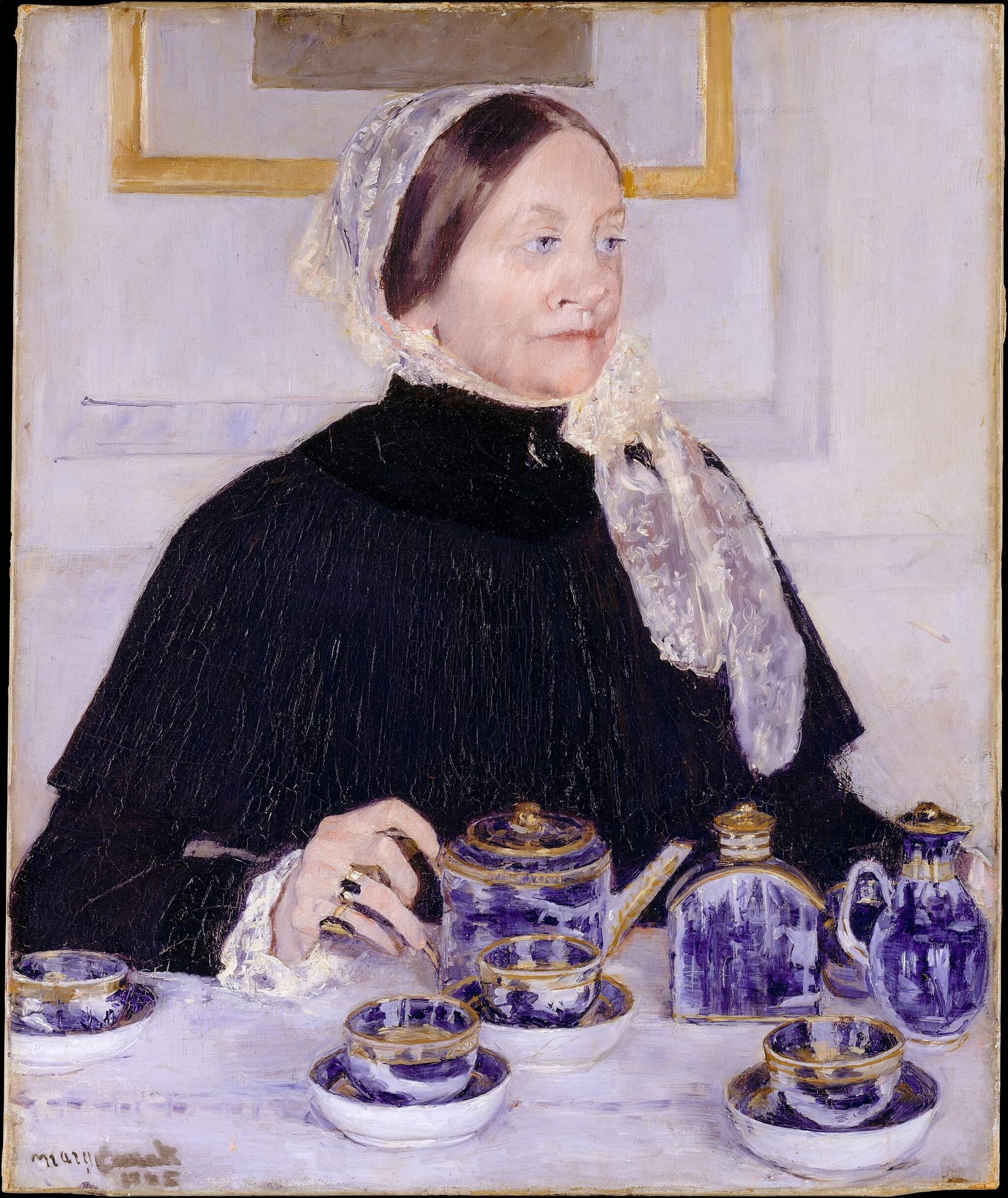
Lady at the Tea Table
Mary Cassatt, 1883–85 (signed 1885) • Oil on canvas
Read full analysis of Lady at the Tea Table →Valuation Analysis
Conclusion: Lady at the Tea Table (1883–85) is a prime-period, museum-caliber oil that encapsulates Mary Cassatt’s most sought-after attributes: an intimate domestic interior, refined Japonisme-influenced patterning, and a psychologically acute portrayal of a modern woman. The painting has been in The Metropolitan Museum of Art since 1923 (gift of the artist), with the sitter identified as Mary Dickinson Riddle, underscoring unimpeachable provenance and art-historical standing [1].
Market anchor and comparables: Cassatt’s current auction record stands at $7,489,000 for the masterpiece pastel Young Lady in a Loge, Gazing to Right (Christie’s, 2022), acquired by the Pola Museum of Art—evidence of deep institutional and private demand for her premier images [2]. Among oils, Children Playing with a Dog realized $4,812,500 at Christie’s in 2018, a key benchmark for strong, family-themed works on canvas [3]. Artnet’s market overview further situates Cassatt as the best-selling female Impressionist of the past decade, with multiple seven-figure results and a consistent premium for her prime 1880s–1890s domestic subjects [4].
Why this work would lead the market: Unlike the majority of works that trade, Lady at the Tea Table is a fully developed, large-format oil (c. 29 x 24 in.) from Cassatt’s most coveted years. Its striking still-life elements (the gilded tea service), flattened patterns, and elegant restraint make it comparable in ambition to the top tier of her oeuvre, while its exceptional visibility—long housed at The Met—confers a museum “halo” that collectors prize [1]. Given the current record is for a work on paper, a best-in-class oil of this period and caliber would reasonably be expected to command a substantial premium if market-fresh and well staged.
Valuation: On a comparable basis, the painting’s hypothetical fair market (auction) value is estimated at $10–17 million, assuming excellent condition, robust global marketing, and appropriate sale placement. This range reflects a realistic step-up over Cassatt’s landmark pastel record and over the strongest published oil benchmarks, acknowledging both scarcity and current demand dynamics for blue-chip Impressionism by women artists [2][3][4]. An indicative retail/insurance replacement value would be higher (see below).
Key sensitivities: Final outcomes would turn on condition (surface, varnish, and restoration profile), timing, and sale structure (e.g., third-party guarantee). Should new scholarship or exhibition history further elevate the work’s canonical status—or should it be offered within a marquee, single-owner context—the upper end of the range, or above, becomes more plausible [1][4].
Key Valuation Factors
Art Historical Significance
High ImpactPainted circa 1883–85, Lady at the Tea Table aligns squarely with Cassatt’s most prized period, when she synthesized Impressionist observation with Japonisme-influenced design. The work’s poised sitter, refined tea service, and flattened decorative rhythms distill themes central to Cassatt’s contribution: the modern woman in the private sphere, rendered with formal rigor and psychological nuance. Its long residence in The Metropolitan Museum of Art and direct gift from the artist further underscore academic importance and unimpeachable pedigree. Within Cassatt’s oeuvre, this ranks as a major, fully realized canvas that articulates her mature language and would be featured prominently in any scholarly narrative of American and French Impressionism.
Quality, Period, and Subject
High ImpactThe painting delivers a complete, ambitious composition at a desirable scale, integrating portraiture and still life with exquisite control of pattern and tone. Collectors and institutions consistently pay premiums for strong 1880s–1890s oils with iconic domestic subject matter—precisely the attributes on display here. The tea service, textiles, and shimmering surfaces showcase Cassatt’s sensitivity to design and light, while the sitter’s self-contained poise evokes the era’s evolving social roles. Compared with smaller, sketch-like works or later-period canvases, this example’s ambition, finish, and period make it highly competitive against the best Cassatt material seen in the market over the last decade.
Rarity and Supply Dynamics
High ImpactMasterpiece-level Cassatt oils from the early–mid 1880s are exceptionally scarce in the marketplace, with many cornerstone examples long embedded in museum collections. The limited flow of works that combine prime date, subject freshness, and scale exerts persistent upward pressure on pricing when blue-chip examples surface. Recent results show strong willingness to compete for top imagery, including a record price for a pastel in 2022 that signals depth of demand at the highest tier. Against this backdrop, a market-fresh, prime-period oil of this caliber would likely attract multiple guarantors and institutional interest, setting up competitive dynamics uncommon in more liquid segments.
Provenance and Visibility
Medium ImpactThe work’s provenance is exemplary: retained by the artist and given directly to The Metropolitan Museum of Art in 1923, with decades of institutional stewardship and frequent reproduction. Such visibility confers a reputational premium—buyers perceive museum-held works as vetted, canonical examples. While deaccession policies make any sale hypothetical, the association enhances perceived importance and underpins confidence in authenticity and significance. The same visibility also concentrates demand among top collectors who value works with established scholarly footprints. In practice, if the painting were ever released, this visibility would support premium placement in an evening sale and strong pre-sale commitments.
Sale History
Lady at the Tea Table has never been sold at public auction.
Mary Cassatt's Market
Mary Cassatt’s market is blue-chip and relatively concentrated at the high end, with strongest demand for prime 1880s–1890s images of women and children rendered in oil or exceptional pastels. Supply of museum-caliber oils is extremely thin, which supports pricing when compelling examples surface. Her auction record—$7.49 million for a masterpiece pastel in 2022—demonstrates institutional and private appetite for best-in-class works and signals capacity for higher prices on exceptional canvases. Mid-tier drawings and later works are more price sensitive, but overall volatility is lower than trend-driven contemporary segments. A well-staged, market-fresh, prime-period oil can command intense competition and potentially set new benchmarks.
Comparable Sales
Young Lady in a Loge, Gazing to Right
Mary Cassatt
Artist auction record; iconic interior depiction of a fashionable woman from Cassatt’s prime years; though on paper (pastel/gouache), it anchors the top end of her market and buyer appetite for masterpiece imagery.
$7.5M
2022, Christie's New York
~$8.2M adjusted
Children Playing with a Dog
Mary Cassatt
Major oil with domestic/familial subject; strong benchmark for Cassatt oils at auction and a key anchor for valuing prime oils.
$4.8M
2018, Christie's New York
~$6.2M adjusted
Baby Charles Looking Over His Mother’s Shoulder (No. 3)
Mary Cassatt
Oil on canvas with classic maternal theme; demonstrates pricing for desirable but less iconic oils and supports the mid–upper seven‑figure band for quality examples.
$1.6M
2021, Sotheby's New York
~$1.9M adjusted
Woman wearing a black and green bonnet, sewing
Mary Cassatt
Oil (c. 1889–90) with intimate domestic subject; day‑sale hammer price (before fees) that helps define the lower bracket for smaller/less iconic oils from a proximate period.
$650K
2025, Christie's New York
Mother Resting Her Cheek on Her Daughter’s Blond Head
Mary Cassatt
Signed oil with maternal subject; illustrates pricing for oils sold outside top-tier houses and underscores the premium for masterpiece‑level examples.
$480K
2023, Guyette & Deeter, Portsmouth
~$507K adjusted
A Goodnight Hug
Mary Cassatt
Top‑tier work on paper (pastel) with tender domestic subject; shows that Cassatt’s best imagery can achieve near‑oil pricing, reinforcing demand at the high end.
$4.5M
2018, Sotheby's New York
~$5.8M adjusted
Current Market Trends
Impressionism and blue-chip Modern have benefited from a flight to quality, with collectors prioritizing rarity, condition, and impeccable provenance. After a cautious 2024, marquee auctions rebounded on the strength of established names and single-owner sales, supported by third-party guarantees. Within this context, top works by historically underrepresented women have drawn increased institutional focus, helping sustain demand at the upper end. Market depth remains selective: mid-tier material can underperform without standout attributes, but masterpiece-level works continue to attract global bidding and, in some cases, record-setting outcomes. This bifurcation favors prime, museum-caliber Cassatts over routine examples.
Sources
- The Metropolitan Museum of Art — Lady at the Tea Table (Object 23.101)
- Christie’s Press Release — Ann & Gordon Getty Collection (includes Cassatt record, Oct 20, 2022)
- Christie’s — Mary Cassatt overview (includes 2018 oil result Children Playing with a Dog)
- Artnet News — Impressionism market overview and Cassatt’s standing