How Much Is Little Girl in a Blue Armchair Worth?
Last updated: January 31, 2026
Quick Facts
- Methodology
- extrapolation
Estimated at $20–35 million, Little Girl in a Blue Armchair (1878) stands as a canonical Mary Cassatt oil—prime-period, large-scale, and uniquely enriched by documented input from Edgar Degas. Given Cassatt’s current public auction record of $7.489 million for a pastel, the work’s art-historical stature, scarcity, and museum-grade provenance justify a substantial masterpiece premium.
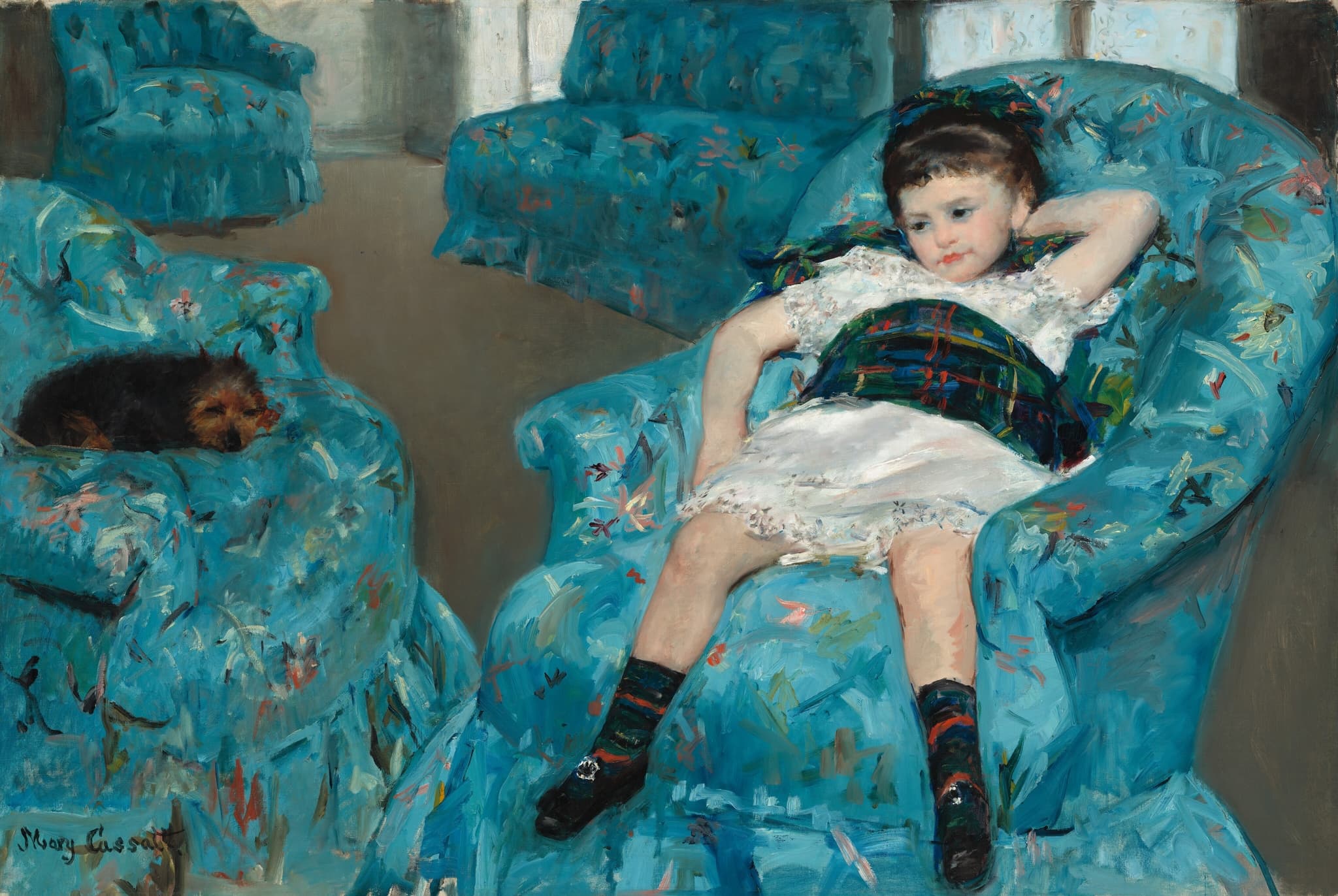
Little Girl in a Blue Armchair
Mary Cassatt, 1878 • Oil on canvas
Read full analysis of Little Girl in a Blue Armchair →Valuation Analysis
Conclusion: We estimate Mary Cassatt’s Little Girl in a Blue Armchair at $20–35 million. This range extrapolates significantly beyond the artist’s public auction record ($7.489 million, work on paper) to account for the painting’s prime 1878 date, oil medium and scale, canonical image recognition, and documented Degas intervention—a combination unmatched within Cassatt’s market. The work’s long residence at the National Gallery of Art and Mellon provenance further position it as a marquee, cross‑category trophy if it were ever to be offered [1][3].
Method and comparables: Public auction benchmarks for Cassatt top out at $7.489 million for a celebrated pastel from her breakthrough years (Christie’s, 2022, Ann & Gordon Getty Collection) [2]. Other high results on paper include the 2018 pastel A Goodnight Hug at $4.5 million [4]. By contrast, universally recognized, museum‑caliber oils by Cassatt—particularly from the late 1870s—are vanishingly scarce in the market; her strongest publicly traded oils have historically achieved high single‑digit millions, constrained more by supply than demand. In this context, we apply a deliberate “masterpiece premium,” extrapolating upward from these records to reflect the subject work’s singular importance.
Why this painting warrants a step-change: Little Girl in a Blue Armchair is widely acknowledged as a touchstone of Cassatt’s mature style and of her Paris period in the 1870s [1]. Technical and documentary evidence presented by the NGA confirms Degas’s collaboration in reworking the background corner—an exceptional art‑historical attribute that broadens demand among top Impressionist collectors and institutions [3]. The painting’s continuous scholarly presence, frequent reproduction, and central role in exhibitions further support an eight‑figure valuation.
Market positioning: The broader Impressionist category has shown resilience, with trophy‑level works continuing to draw deep bidding when fresh, correctly estimated, and supported by scholarship [5]. Recent institutional and curatorial attention around Cassatt (e.g., the Philadelphia Museum of Art’s 2024 survey and subsequent West Coast presentation) reinforces collector focus on her prime‑period achievements and process [6]. Against that backdrop, this painting’s rarity and status would likely catalyze global competition across American and European buyer pools.
Range calibration: The lower bound ($20 million) reflects a conservative private‑treaty context or an auction with modest depth; the upper bound ($35 million) assumes full international promotion in a marquee evening sale, pristine condition, and competitive participation from both private collectors and institutions. This bracket bridges Cassatt’s historical public benchmarks and the plausible “replacement cost” for a once‑in‑a‑generation, museum‑caliber masterpiece by the artist.
Key Valuation Factors
Art Historical Significance
High ImpactPainted in 1878, Little Girl in a Blue Armchair is a touchstone of Cassatt’s mature Paris period—an iconic early oil that crystallizes her modern approach to interior space, point of view, and the psychology of childhood. Its prominence in scholarship and exhibitions positions it among the artist’s most important works. Uniquely, Cassatt acknowledged Degas’s help on the composition; technical studies presented by the National Gallery of Art support his reworking of the back corner, adding a rare and desirable cross‑artist connection within Impressionism. This documented collaboration deepens the painting’s historical resonance and market appeal, expanding the bidder base to collectors focused on Degas and on landmark moments in the formation of the Impressionist canon.
Rarity and Supply
High ImpactPrime‑period Cassatt oils from the late 1870s—especially large, fully resolved compositions of canonical status—are exceptionally scarce in private hands. Many of the best examples, including this painting, have long been in museum collections. By contrast, Cassatt’s market more frequently offers works on paper (pastels, prints), which, while desirable, do not carry the same value ceiling as a top‑tier oil. The paucity of directly comparable, A‑plus oils is the central reason her public records understate the replacement value of a masterpiece of this caliber. When a fresh, museum‑grade Impressionist oil of iconic status appears, competitive tension can push pricing far beyond the artist’s historical benchmarks, justifying a meaningful masterpiece premium.
Provenance and Exhibition History
High ImpactThe painting’s chain of ownership—artist; leading Paris dealers (including Ambroise Vollard and Hector Brame); acquisition by Paul Mellon; gift to the National Gallery of Art—confers exceptional credibility. Its long institutional residence and frequent inclusion in exhibitions and literature amplify familiarity, confidence, and desirability among top buyers. Works with Mellon provenance and NGA stewardship carry a prestige premium that often translates into stronger bidding on the rare occasion analogously pedigreed works come to market. Extensive publication and exhibition histories also help de‑risk acquisition for both private and institutional buyers by demonstrating stable scholarship, visibility, and importance within the oeuvre.
Market Conditions and Demand
Medium ImpactImpressionist masterworks remain a stable blue‑chip segment, with trophy‑level lots showing resilient demand when marketed globally. The past two years saw renewed institutional and curatorial focus on Cassatt, sustaining interest among collectors of American art and Impressionism. Additionally, the secular rise in attention to women artists supports re‑rating of best‑in‑class examples. Offsetting factors include selectivity at the highest price points, the thin supply of prime Cassatt oils (limiting direct comparables), and sensitivity to condition and narrative. Netting these, the market backdrop is supportive, but final pricing would hinge on presentation, guarantees, and the depth of international competition in a marquee evening context.
Condition and Technical Findings
Medium ImpactWhile no public condition report is available, the valuation assumes sound structural condition and a favorable conservation history commensurate with major museum stewardship. The National Gallery of Art’s prior technical work—especially around Degas’s contribution—adds scholarly depth and helps substantiate the painting’s exceptional status. Any future technical note confirming unlined canvas, original surface quality, and minimal retouching would support the high end of the range; conversely, evidence of significant restoration, structural issues, or color change would constrain bidding and skew the outcome toward the lower bound. In sum, condition is a material swing factor but likely a net positive given the work’s custodial history.
Sale History
Little Girl in a Blue Armchair has never been sold at public auction.
Mary Cassatt's Market
Mary Cassatt is a core figure of Impressionism and American art, with a deep, international collector base. Her auction market is robust but thin at the very top because the finest oils are largely in museums. Cassatt’s current public auction record is $7.489 million for an 1878–79 pastel from the Ann & Gordon Getty Collection; strong pastels have achieved $1–5 million, including a $4.5 million result in 2018. Historically, her best publicly traded oils have realized in the high single‑digit millions, but the paucity of prime‑period, canonical oils suppresses observed records. Demand is strongest for prime 1870s–80s subjects (opera boxes, mother‑and‑child, iconic interiors) with excellent provenance and exhibition history, and for works aligned with current scholarship.
Comparable Sales
Young Lady in a Loge, Gazing to Right
Mary Cassatt
Artist record; prime-period (c.1878–79) and iconic subject tied to Cassatt’s breakthrough years—closest in date and stature to Little Girl in a Blue Armchair, though it is a work on paper.
$7.5M
2022, Christie's New York
~$8.1M adjusted
Children Playing with a Dog
Mary Cassatt
Top-tier Cassatt oil result; desirable child subject; public auction benchmark for oils (later date, 1907, but strong indicator for the oil market band).
$4.8M
2018, Christie's New York
~$6.1M adjusted
A Goodnight Hug
Mary Cassatt
Early-date (1880) mother-and-child pastel; among Cassatt’s highest results on paper—useful for bracketing demand for iconic imagery near the 1878 period.
$4.5M
2018, Sotheby's New York
~$5.7M adjusted
Children Playing with a Dog
Mary Cassatt
Earlier sale of the same major oil underscores long-run pricing for significant Cassatt oils; helpful to understand the ceiling for oils in public rooms.
$4.8M
2007, Christie's New York
~$7.4M adjusted
Current Market Trends
Blue‑chip Impressionism remains a resilient category. After volatility in 2023–2024, late‑2025 sales reaffirmed strong demand for historically important masterpieces, especially when fresh to market and well supported by scholarship and marketing. Supply continues to be the binding constraint for top names, and buyers remain selective: narrative strength, condition, and provenance are decisive. Parallel momentum for women artists has expanded the audience for Cassatt’s best works. Against this backdrop, a museum‑caliber, prime‑period Cassatt oil—particularly one with documented Degas involvement—would be positioned to outperform her current public benchmarks and command a pronounced masterpiece premium in a marquee evening sale.
Sources
- National Gallery of Art – Little Girl in a Blue Armchair (object page)
- Christie’s Press – Ann & Gordon Getty Collection totals $150M+ (Cassatt artist record noted)
- National Gallery of Art – Degas/Cassatt exhibition (technical and collaboration context)
- Artsy – 2018 Sotheby’s sale recap noting Cassatt pastel at $4.5M
- Artnet News – The Impressionism auction industry keeps humming (market analysis)
- Philadelphia Museum of Art – Mary Cassatt at Work (2024 exhibition press release)