How Much Is The Child's Bath Worth?
Last updated: January 19, 2026
Quick Facts
- Insurance Value
- $60.0M (Synthesis; replacement-cost benchmark (museum figures not public))
- Methodology
- extrapolation
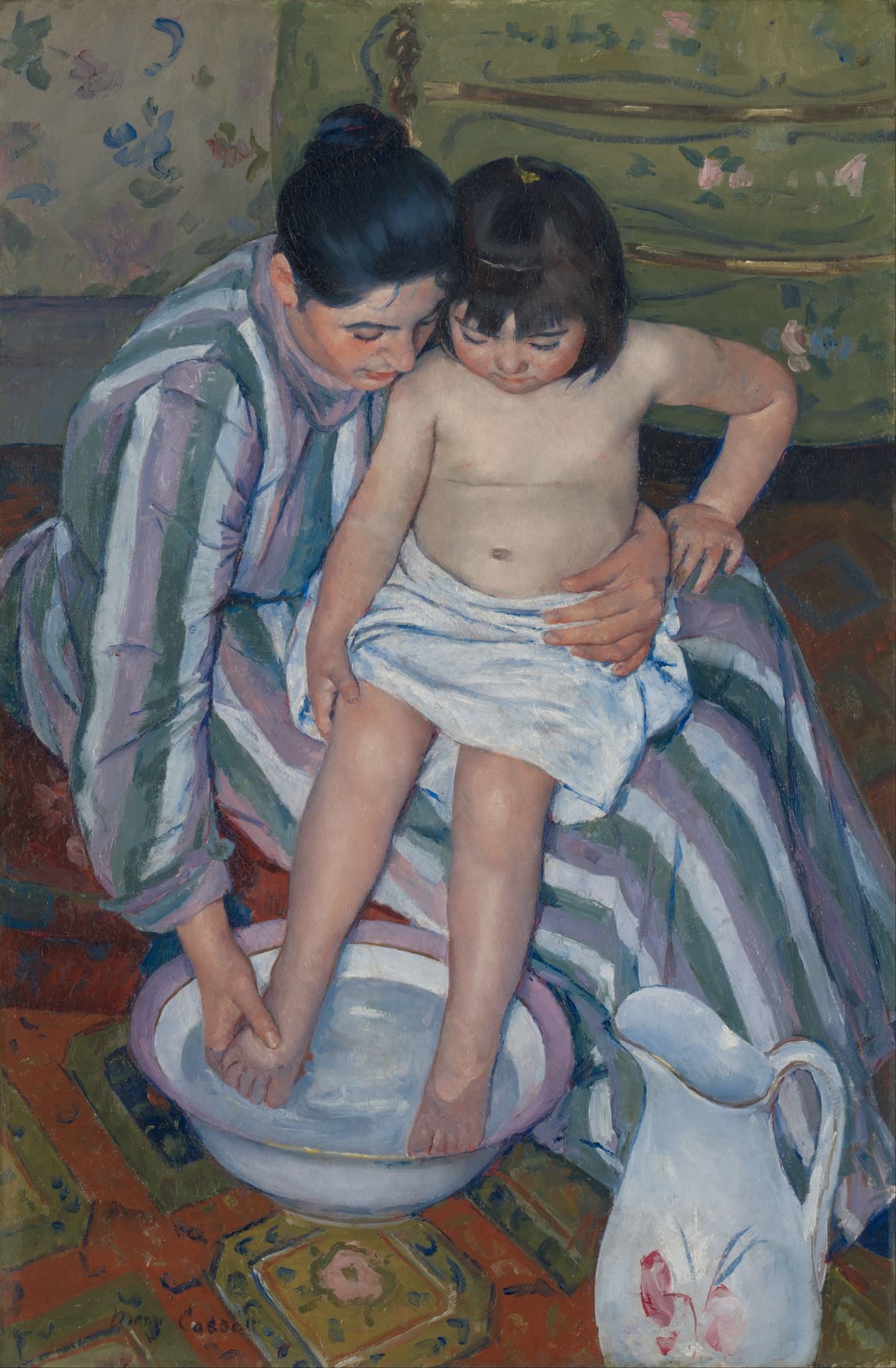
The Child’s Bath is Mary Cassatt’s definitive masterpiece and a highlight of the Art Institute of Chicago. If offered today, it would command $25–45 million, dramatically exceeding the artist’s current $7.5 million auction record due to its singular art-historical stature, peak-period quality, and extreme rarity on the market. For insurance/replacement, a $60 million benchmark is appropriate given its irreplacability.
Valuation Analysis
Conclusion: The Child’s Bath (1893) is Cassatt’s signature painting and among the most reproduced images in Impressionist art. Held by the Art Institute of Chicago since 1910, it epitomizes her mother-and-child theme and Japonisme-inflected, high vantage composition—attributes that make it a cornerstone of her oeuvre and a museum highlight [1][4].
Market anchor and extrapolation: Cassatt’s current auction record is $7.489 million for a prime-period pastel from the Ann & Gordon Getty Collection (Christie’s, 2022) [2]. Strong oils have generally realized mid–single-digit millions publicly, e.g., Children Playing with a Dog at $4.8125 million in 2018 (cited in Artnet’s 2024 analysis), with top-tier pastels also clustered around $4–5 million [3]. None of these publicly traded works approach the canonical status of The Child’s Bath. Given its textbook importance, museum calibration, and peak 1890s date, a substantial “icon premium” over these benchmarks is warranted.
Estimated value today: If brought to market with appropriate global positioning and a financial guarantee, The Child’s Bath would reset the artist’s record by a wide margin. A realistic auction estimate is $25–45 million, reflecting: (i) the painting’s singular art-historical rank; (ii) the virtual absence of truly comparable, peak-period Cassatt oils in private hands; and (iii) the demonstrated ability of marquee Impressionist icons to outperform category averages when trophy-level quality and provenance converge [2][3].
Market positioning and demand: Despite softer aggregate totals for Impressionist/Post‑Impressionist sales in 2023–2024 due to thinner supply of mega-lots, the market remains two‑speed: exceptional, museum-grade masterpieces continue to attract deep, international bidding, while mid-tier works face price sensitivity [6]. Recent scholarship and major exhibitions such as “Mary Cassatt at Work” (PMA/FAMSF, 2024–2025) further elevate her cultural salience and institutional demand, a supportive backdrop for any hypothetical offering of her most iconic image [5].
Insurance/replacement benchmark: For institutional risk management, a replacement-cost framework should exceed auction guidance to reflect irreplacability. A $60 million insurance value is appropriate for a canonical, museum-held Impressionist masterpiece of this caliber—consistent with the premium applied to works for which no equivalent substitute realistically exists [1][6].
Key Valuation Factors
Art Historical Significance
High ImpactThe Child’s Bath is widely regarded as Mary Cassatt’s most iconic painting—an apex statement of her mother-and-child theme and of the Japonisme-influenced, high-angle composition that distinguishes her in the Impressionist canon. Its formal clarity, intimate yet modern viewpoint, and chromatic restraint have made it a staple of art-historical curricula and museum narratives. As a core work in the Art Institute of Chicago’s Impressionist galleries, it functions as a touchstone for Cassatt’s contribution to modern life painting and the visibility of women’s domestic experience. This level of cultural saturation creates demand that is not purely market-driven: institutions and leading private collectors view such icons as definitional holdings, justifying a significant premium over typical results for the artist [1][4].
Rarity and Supply
High ImpactTruly comparable Cassatt oils—peak-period, museum-grade mother-and-child compositions with the distinctive overhead perspective—are effectively off-market, with the vast majority in institutional collections. Public auction pricing for Cassatt is thus built on later or second-tier examples, works on paper, and smaller oils. When an artist’s market lacks supply of the very best, prices for canonical works, if they ever trade, detach from the median and reflect global trophy competition. The Child’s Bath is precisely the category of painting that seldom surfaces; scarcity significantly amplifies value and compresses price elasticity. This supply dynamic underpins the extrapolative jump from mid–single-digit million comps to a $25–45 million range for an unparalleled, textbook masterpiece [1][3].
Comparative Market Benchmarks
High ImpactCassatt’s auction record stands at $7.489 million for a prime pastel (Christie’s Getty Collection, 2022), while serious oils have traded in the $4–6 million zone in recent cycles (e.g., Children Playing with a Dog at $4.8125 million in 2018) [2][3]. These results set credible anchors but do not capture the pricing of an artist’s single most famous work. In blue-chip Impressionism, masterpiece-caliber icons routinely command multiples of an artist’s typical prices when fresh to market and expertly placed. Given The Child’s Bath’s unique status, a 3–6× uplift over Cassatt’s best oil benchmarks is justified. The proposed $25–45 million range situates the painting within the trophy tier for late-19th-century works without overreaching beyond adjacent category precedents [2][3][6].
Provenance, Exhibition, and Institutional Validation
Medium ImpactThe painting’s uninterrupted Art Institute of Chicago ownership since 1910, its early Durand‑Ruel exhibition history (Paris 1893; New York 1895), and its pervasive publication record confer maximal institutional validation [1][4]. Museum-held status enhances confidence in conservation and scholarship, and the work’s constant visibility sustains cultural primacy—factors that underpin demand and justify an icon premium. While museum ownership can limit near-term marketability, it simultaneously elevates perceived quality and authenticity. In the improbable event of a sale or sanctioned exchange, this provenance would be regarded as impeccable and market-positive. Extensive scholarly and exhibition history also strengthens insurance/replacement appraisals by demonstrating the work’s irreplaceable role in the artist’s narrative [1][4][5].
Sale History
The Child's Bath has never been sold at public auction.
Mary Cassatt's Market
Mary Cassatt is a blue-chip Impressionist with especially strong institutional and U.S. private demand. Her auction record is $7.489 million for a prime-period pastel from the Ann & Gordon Getty Collection (Christie’s, 2022). Oils are her most valuable category, with strong examples typically achieving several million dollars, while pastels and works on paper range from mid–six figures to low millions when subject and quality align. Artnet’s recent analyses note that 2018 was a peak year by volume for Cassatt, with multiple high results clustered in the $4–5 million range. Supply of top-tier, museum-caliber oils is extremely limited, which keeps headline pricing dependent on rare masterpiece opportunities rather than consistent public flows [2][3].
Comparable Sales
Children Playing with a Dog
Mary Cassatt
Closest publicly traded Cassatt oil painting with a mother-and-child/children domestic subject (though later, 1907). Medium match (oil on canvas) and strong, named result make it a primary anchor for oil pricing vs. The Child’s Bath (1893).
$4.8M
2018, Christie's New York
~$6.0M adjusted
Young Lady in a Loge, Gazing to Right
Mary Cassatt
Artist auction record; prime-period, museum-caliber work on paper (pastel/gouache/watercolor). While not an oil or mother-and-child, it benchmarks peak demand for a canonical Cassatt composition and sets a ceiling for recent public pricing.
$7.5M
2022, Christie's New York
~$8.1M adjusted
A Goodnight Hug
Mary Cassatt
High-price mother-and-child composition in pastel (1880). Although a work on paper, it is subject-appropriate and prime-period, helping bracket top-tier pricing for iconic Cassatt themes closely related to The Child’s Bath.
$4.5M
2018, Sotheby's New York
~$5.6M adjusted
Sara, with Bonnet Streamers Loose, Feeding Her Dog
Mary Cassatt
Turn-of-the-century pastel featuring a child (1901). Not a mother-and-child and on paper, but it shows current market appetite for intimate domestic subjects by Cassatt in a marquee New York sale.
$914K
2024, Phillips New York
~$942K adjusted
Sketch of “Sara in a Green Bonnet”
Mary Cassatt
Small 1901 pastel study on canvasboard. Included to illustrate the lower bound of Cassatt’s pricing spectrum for secondary, less finished works compared to a fully resolved, iconic oil like The Child’s Bath.
$152K
2025, Christie's New York
Current Market Trends
Impressionist and Post‑Impressionist auctions saw softer totals in 2023 and 2024, driven less by demand erosion than by a shortage of trophy-level consignments and tighter estimate discipline. The market has been two‑speed: mid-tier works face selectivity, while best-in-class masterpieces continue to attract deep bidding and institutional competition. Within this context, historically significant icons—especially by artists with robust museum followings—have remained resilient. Renewed scholarship and major exhibitions around Cassatt reinforce long-term demand. Against this backdrop, a masterpiece like The Child’s Bath would trade at a substantial premium to recent Cassatt results, aligning with the market’s preference for rarity, provenance clarity, and canonical status [5][6].
Sources
- Art Institute of Chicago – The Child’s Bath (object page)
- Christie’s Press – Ann & Gordon Getty Collection totals and Cassatt record
- Artnet News – Impressionism’s market analysis and Cassatt pricing benchmarks
- Encyclopaedia Britannica – The Child’s Bath (history and exhibitions)
- Philadelphia Museum of Art – Mary Cassatt at Work (2024 exhibition)
- Art Basel & UBS – The Art Market 2024: Auctions