How Much Is Raising of the Son of Theophilus and St Peter Enthroned Worth?
Last updated: April 3, 2026
Quick Facts
- Methodology
- comparable analysis
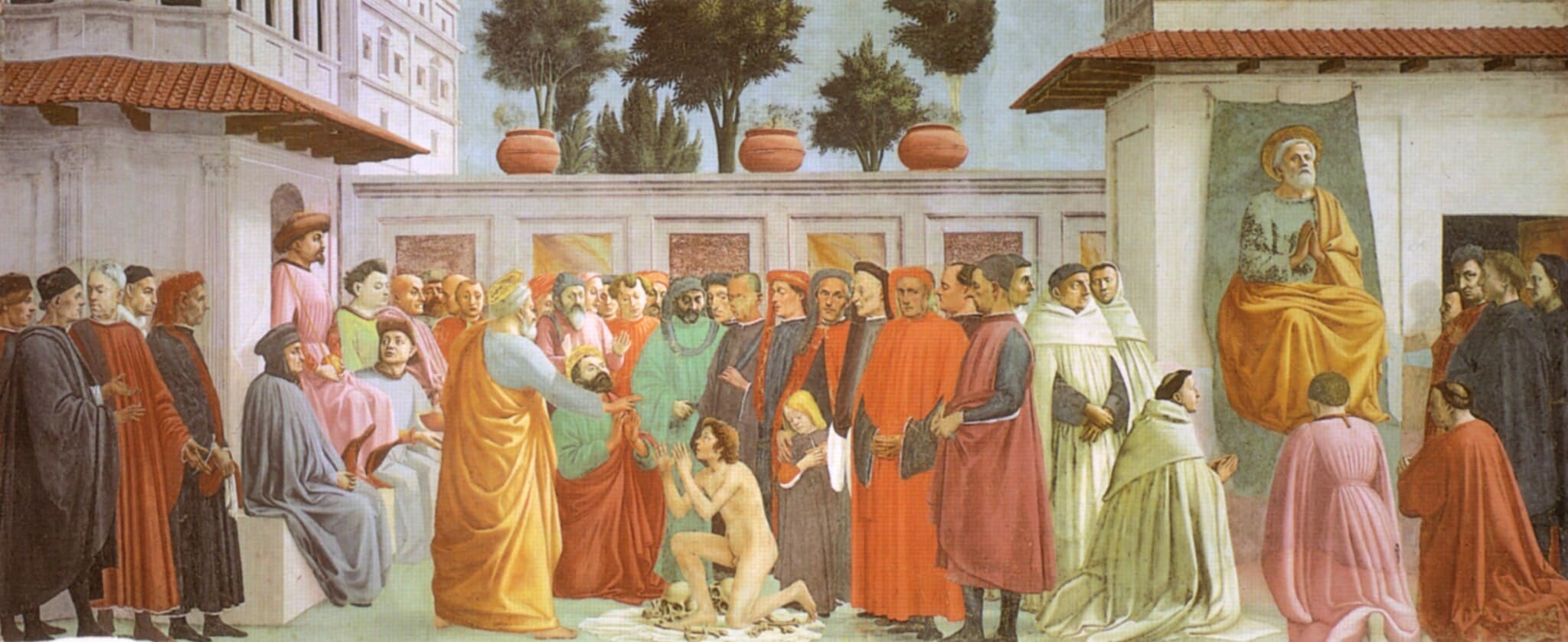
The Raising of the Son of Theophilus and St. Peter Enthroned is an in‑situ Brancacci Chapel fresco by Masaccio and, as a state‑protected wall painting, is effectively not for sale. For a strictly hypothetical market scenario in which a legally permissible detachment, indisputable autograph attribution and export permission were obtained, a comparable‑analysis estimate is approximately $20,000,000–$150,000,000.
Raising of the Son of Theophilus and St Peter Enthroned
Masaccio • Fresco
Read full analysis of Raising of the Son of Theophilus and St Peter Enthroned →Valuation Analysis
Valuation summary: The Raising of the Son of Theophilus and St. Peter Enthroned is an in‑situ fresco within the Brancacci Chapel attributed in major part to Masaccio. As a wall painting in a state‑protected religious site its commercial sale is effectively precluded; the market valuation that follows is strictly hypothetical and predicated on an extraordinary scenario in which a legally permissible detachment, indisputable autograph attribution, and export permission were obtained. For that hypothetical trading scenario, a comparable-analysis approach yields a notional range of approximately $20,000,000–$150,000,000 USD, reflecting very different possible states of attribution, size and transferability [1].
Rationale and comparables: There are essentially no modern auction sales of autograph Masaccio paintings to establish a direct market benchmark. Therefore this estimate is extrapolated from (a) high‑value Old Master rediscoveries and drawings linked to the Florentine tradition (e.g., a Michelangelo drawing 'after Masaccio' sold in 2022 at Christie’s Paris) and (b) rare early‑Renaissance panel sales such as Fra Angelico examples, with the extreme apex of the market demonstrated by unique rediscoveries (e.g., Salvator Mundi) that establish theoretical ceilings [2]. These comparables indicate a very wide potential spread depending on buyer competition and museum interest.
Key value drivers and caveats: Three variables dominate value: secure autograph attribution to Masaccio (or sizable autograph contribution versus Masolino/assistants), physical detachability with acceptable conservation outcome, and legal exportability/permission under Italian cultural patrimony law. If the painting remained in situ the appraisal is academic only and no legitimate sale price exists; if a fragment had uncertain attribution the likely market falls into low six‑figure to mid seven‑figure territory. At the other extreme, a large, indisputably autograph, well‑provenanced, detachable composition could attract institutional or private buyers competing into the tens to low hundreds of millions in exceptional competition.
Conclusion and recommendation: Treat the $20M–$150M range as a conditional ceiling for a transferable, autograph Masaccio composition; for all practical and legal purposes the work as it stands is not marketable and is effectively priceless. To refine this estimate commission technical conservation reports, establish up‑to‑date attribution opinions from leading Masaccio scholars and consult Italian heritage authorities and Old Master departments at major auction houses. These steps would convert this hypothetical valuation into an actionable appraisal or confirm that no legal market exists for the work [1][2].
Technical and legal note: Detachment (stacco or strappo) is technically possible in rare cases but is conservation‑intensive and typically undertaken only with institutional oversight. Successful detachment and transfer would reduce aesthetic integrity and invite intense scholarly and legal scrutiny, factors that both suppress market liquidity and create negotiation leverage for institutional buyers and governments. Insurance, conservation, storage, and legal compliance costs, plus likely retention requests or export refusals by Italian authorities, can materially erode net proceeds and therefore reduce a theoretical hammer price. Any meaningful commercial valuation must therefore include the full costs and legal probability of transfer before being treated as an actionable market estimate.
Key Valuation Factors
Art Historical Significance
High ImpactMasaccio’s Raising of the Son of Theophilus is integral to the Brancacci Chapel cycle, one of the central public commissions that established his reputation for pioneering naturalism and perspective. The composition’s influence on later Florentine masters makes it culturally indispensable and elevates institutional demand, thereby inflating a notional market ceiling for any transferable portion. At the same time, the same cultural importance generates public and governmental pressure for retention, conservation and scholarly access, which reduces tradability. In valuation terms this creates a dual effect: a high theoretical top‑end price if transferable and indisputably autograph, but simultaneously a steep liquidity discount because sale is politically and legally fraught.
Attribution & Authenticity
High ImpactWhether the scene is predominantly autograph Masaccio, a mixed Masaccio‑Masolino execution, or largely a later workshop or Filippino Lippi completion is the single most decisive monetary variable. Secure, consensus attribution to Masaccio would dramatically increase buyer interest and could move a transferable composition into the tens of millions; ambiguous attribution or predominant workshop authorship will typically restrict realizable value to significantly lower levels. Robust authentication requires high‑resolution technical imaging, pigment and mortar analysis, and peer‑reviewed scholarship; residual academic dispute will materially cap competitive bids and therefore lower market value.
Legal/Immutability & Export Controls
High ImpactItalian cultural patrimony law, church ownership and UNESCO/heritage protections render most in‑situ frescoes legally inalienable or subject to strict export controls. Even where detachment has been technically effected in the past, export and sale involve complex permissions that are frequently denied or conditioned by long retention periods and state claims. That regulatory environment dramatically lowers the probability of a lawful commercial sale and therefore depresses the expected realizable cash value. For any practical appraisal the legal probability, timing and cost of transfer must be modeled alongside theoretical market demand.
Condition & Conservation History
Medium ImpactPhysical condition and conservation interventions determine both whether a safe detachment is feasible and the extent to which autograph material survives. Frescoes suffering humidity damage, loss, heavy retouching or structural instability are poor detachment candidates and will command lower prices; conversely, well‑preserved, clearly autograph passages increase market confidence and command a premium within the hypothetical transferable range. Detailed conservation documentation (sinopia, pigment analysis, imaging) is a prerequisite to any reliable commercial valuation because condition directly affects both feasibility of transfer and buyer willingness to pay.
Market Comparables & Rarity
High ImpactMasaccio’s securely attributed corpus is tiny and largely immovable, so direct market comparables are scarce. Recent high‑profile Old Master rediscoveries and high‑value Renaissance drawings demonstrate that when attribution is secure and a work is transferable, buyer competition can drive prices into the multi‑million range and, in exceptional rediscoveries, toward the high tens or low hundreds of millions. This asymmetry produces wide valuation dispersion: rarity inflates theoretical ceilings while simultaneously reducing practical liquidity, meaning provenance, exhibition history and scholarly endorsement carry outsized weight in any price judgment.
Sale History
Raising of the Son of Theophilus and St Peter Enthroned has never been sold at public auction.
Masaccio's Market
Masaccio (c.1401–1428) is a foundational early‑Renaissance master whose surviving autograph works are scarce and principally fresco cycles in public religious settings. Because his most important compositions are immovable and under state or institutional protection, Masaccio has almost no direct auction record; market attention instead attaches to drawings, workshop pieces, or works by artists influenced by him. Consequently his market standing is that of a cultural 'blue chip' with very limited liquidity: strong institutional interest and high notional demand are counterbalanced by legal immovability and a lack of sale precedents. Commercial value therefore depends heavily on attribution certainty and extraordinary transfer permissions.
Comparable Sales
Salvator Mundi
Leonardo da Vinci
A single‑canvas Old Master ‘blockbuster’ that establishes the market ceiling for unique, rediscovered masterpieces; not a direct stylistic match but useful as an apex benchmark for how high demand can push prices for canonical, museum‑quality works.
$450.3M
2017, Christie's New York
~$591.7M adjusted
A nude man (after Masaccio) and two figures behind him
Michelangelo Buonarroti
Directly tied to Masaccio's compositional tradition (a Michelangelo study 'after Masaccio'); shows strong market demand and price levels for high‑quality Renaissance drawings linked to Masaccio's imagery — a nearer‑term, more relevant proxy than apex Leonardo sales.
$24.3M
2022, Christie's Paris
~$26.8M adjusted
Crucifixion (rare early‑Renaissance panel)
Fra Angelico
A rare early‑Renaissance panel sale in the low‑millions; closer in period and devotional subject matter to Masaccio's Brancacci cycle and therefore a useful lower‑end market comparator for movable Quattrocento works when they appear.
$6.4M
2023, Christie's (July 2023 sale)
~$6.8M adjusted
Current Market Trends
High‑quality Old Masters and early‑Renaissance material have seen episodic renewed demand driven by rediscoveries and institutional buying, but supply remains extremely constrained. Market interest favors works with secure attribution, solid provenance and museum validation; rediscoveries of drawings and panels can set headline prices, but these events are infrequent and market movement is episodic. For Masaccio specifically, continued scholarship and restorations have raised profile, yet legal immovability of his major frescoes prevents meaningful transactional liquidity. Short‑term outlook: episodic and cautious.