How Much Is St Peter Healing the Sick with His Shadow Worth?
Last updated: April 3, 2026
Quick Facts
- Methodology
- extrapolation
The Brancacci Chapel fresco 'St Peter Healing the Sick with His Shadow' is an in‑situ Masaccio work and is effectively unsaleable/priceless in its original context. Hypothetically, if a fully authenticated, legally transferable, and conservationally intact Masaccio section or portable equivalent were available, a reasoned market estimate is $100–150 million (very high uncertainty).
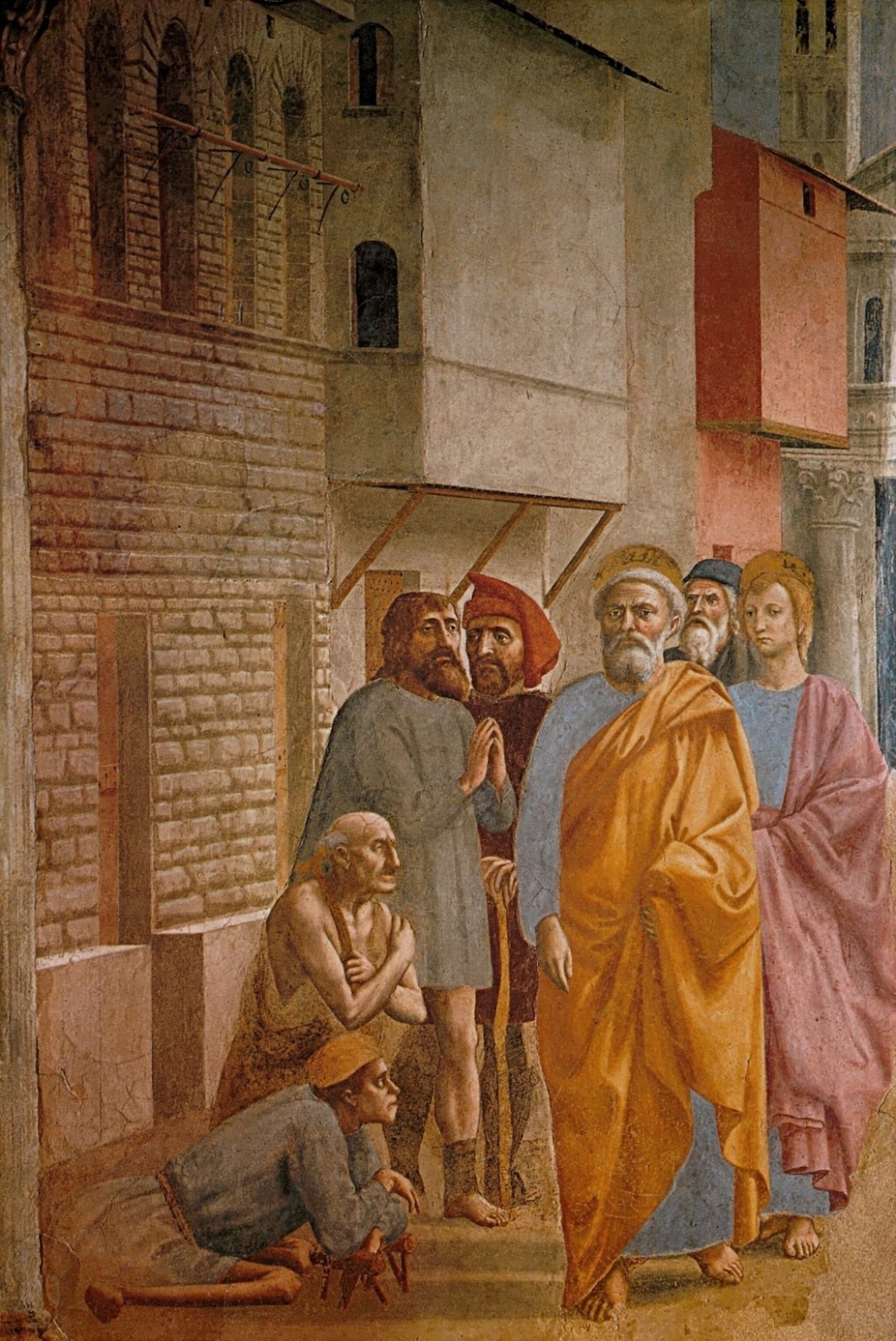
St Peter Healing the Sick with His Shadow
Masaccio • Fresco
Read full analysis of St Peter Healing the Sick with His Shadow →Valuation Analysis
Identification and immediate market posture: The scene commonly called "St Peter Healing the Sick with His Shadow" is part of Masaccio’s Brancacci Chapel cycle in Santa Maria del Carmine, Florence and remains an in‑situ fresco under Italian custodial care — in practical and legal terms the work is not a marketable object and should be treated as priceless in place [1].
Hypothetical transferable valuation and basis: For the purposes of a transferable‑object valuation (i.e., a legally detachable, perfectly authenticated and export‑cleared fragment or panel demonstrably by Masaccio), I estimate a plausible illustrative market range of $100–150 million. This figure is an extrapolation from a combination of (a) headline pre‑1500 rediscovery prices, (b) high‑value sales for works closely tied to Masaccio’s imagery, and (c) the canonical, foundational status of Masaccio in art history that would concentrate institutional and private demand on any legitimately transferable work [2].
Why this scale? Masaccio’s surviving corpus is extremely small and includes works central to the narrative of Renaissance painting; scarcity plus canonical importance typically produces outsized bids when comparable material reaches the open market. Modern comparables—such as high‑profile early‑Renaissance rediscoveries and sales that referenced Masaccio’s compositions—show that competitive bidding can move pre‑1500 material into the multi‑tens of millions, and in extraordinary circumstances push toward the low hundreds of millions for uniquely important pieces [2][4].
Legal and technical constraints that increase uncertainty: True frescoes are painted into wall plaster and are legally and physically immovable without invasive techniques. Italian patrimony law and public stewardship make lawful sale or export of the Brancacci frescoes effectively impossible; even a historic detachment (stacco/strappo) would require ministerial authorization, carry heavy conservation risk and provoke strong legal and institutional barriers [3]. Those constraints both suppress any genuine market and, paradoxically, increase the premium that would attach to any legitimately transferable Masaccio fragment because of the extreme rarity of lawful, exportable provenance.
Practical caveats and recommended next steps: This valuation is highly conditional and should be treated as directional. It assumes: secure, technical authentication; legal clearance for transfer; and museum‑grade condition. Absent those conditions, value falls sharply (fragments: low millions; damaged or dubiously documented pieces: negligible market interest). If you are handling a specific object, immediately secure technical conservation reports, provenance documentation, and legal counsel before taking any market steps; contact Italian cultural authorities and senior Old Master specialists for formal appraisal and clearances.
Key Valuation Factors
Art Historical Significance
High ImpactMasaccio is a foundational figure of the early Quattrocento; his innovations in perspective, naturalism and narrative composition mark the beginning of Renaissance pictorial language. The Brancacci Chapel is the core surviving body of his work and is central to art‑historical pedagogy and exhibition programming. Because the subject belongs to this canonical cycle, any transferable object with secure attribution would be met with intense institutional interest (museums, national collections) and collector competition. That concentrated demand for a work of demonstrable authorship and provenance is the primary driver justifying a very high valuation in the hypothetical transferable scenario.
Scarcity / Supply
High ImpactSurviving works by Masaccio are exceptionally scarce and most are immovable or firmly in public institutions. There are effectively no modern open‑market sales of major autograph Masaccio paintings, which means supply is functionally zero. Economic theory and art‑market practice show that extreme scarcity of a canonically important artist lifts potential prices dramatically when provenance, condition and legality align. The absence of comparable sale history increases uncertainty but also amplifies the auction or private‑treaty premium that would arise from a genuine, market‑fresh Masaccio.
Legal / Provenance / Immovability
High ImpactItalian cultural heritage law (D.Lgs. 42/2004 and related measures), plus church and municipal custodianship, make the Brancacci frescoes legally protected; export or alienation is tightly controlled. True frescoes are integrated into architecture and cannot be lawfully traded in normal circumstances. Any attempt to detach or export a portion would require ministerial authorization, rigorous provenance and export documentation, and would face possible expropriation or preemption. These legal realities drastically reduce market availability and create a conditional premium for any legitimately transferable piece.
Condition & Conservation Feasibility
Medium ImpactTechnical condition is determinative. Fresco detachment (stacco/strappo) can cause irreversible losses; even detached lunettes or patches often suffer damage, retouching and loss of original context. A marketable Masaccio fragment would need comprehensive conservation reporting (mortar/plaster analysis, pigment and binding media tests, imaging) and demonstrable stability. Poor condition materially reduces both the pool of potential buyers (institutions may decline) and the price. Conversely, a well‑preserved, expertly detached and documented section would retain far greater value.
Market Comparables & Demand Dynamics
Medium ImpactDirect auction comparables for original Masaccio frescoes do not exist; the valuation therefore leans on analogous early‑Renaissance rediscoveries and high‑value works tied to Masaccio’s iconography (for example, a Michelangelo drawing referencing Masaccio achieved multi‑tens of millions). Recent markets reward discovery, scholarship and museum‑quality provenance; headline results for rare early works indicate the capacity for multi‑million to low‑hundreds‑of‑millions outcomes in exceptional cases. Buyer profiles would include national museums, major encyclopedic museums and deep‑pocketed private collectors or foundations.
Sale History
St Peter Healing the Sick with His Shadow has never been sold at public auction.
Masaccio's Market
Masaccio (c.1401–1428) is an art‑historical linchpin of the early Renaissance. His securely attributed oeuvre is small and largely institutionalized (Brancacci Chapel, San Giovenale triptych, works in the Uffizi), so there is essentially no modern auction record for major autograph pieces. Market value for Masaccio is therefore theoretical: when early‑Renaissance works do appear with strong provenance and condition they attract fierce institutional interest and can command high prices. The absence of tradable supply amplifies both uncertainty and potential premiums for any legitimately transferable, authenticated work.
Comparable Sales
A Nude Young Man (after Masaccio)
Michelangelo
Directly references a Masaccio composition; shows the high ceiling collectors will pay for works tied to Masaccio's imagery and for autograph works by major Renaissance masters.
$24.3M
2022, Christie's, Paris
~$26.5M adjusted
Christ Mocked
Cimabue
Rare pre-1500 rediscovery that set a high benchmark for very scarce early medieval/early‑Renaissance paintings; useful as a ceiling/comparable for unique, museum‑quality finds from before 1500.
$26.6M
2019, Actéon (Senlis, France)
~$31.4M adjusted
The Crucifixion with the Virgin, St John the Baptist and Magdalene
Fra Angelico
Recent sale of a high-quality early‑Quattrocento panel at auction; demonstrates active market demand for museum‑grade early‑Renaissance panels and strong results for market‑fresh, well‑provenanced works.
$6.4M
2023, Christie's, London (Classic Week)
~$6.7M adjusted
Current Market Trends
The Old Masters/early‑Renaissance market is selective: rediscoveries and museum‑fresh works outperform general lots, while overall volumes have been uneven. Demand concentrates on works with strong scholarship, exhibition history and provenance. Conservation‑driven scholarship and high‑profile exhibitions increase institutional appetite and can precede strong auction outcomes. For pre‑1500 material, headline sales have shown capacity for very high prices, but outcomes remain concentrated in a small number of exceptional lots.