How Much Is The Tribute Money Worth?
Last updated: March 28, 2026
Quick Facts
- Methodology
- extrapolation
Masaccio’s The Tribute Money is legally inalienable and unsaleable in the real market, but on a hypothetical, unconstrained basis it would command roughly $1.0–3.0 billion. This range extrapolates above the top Old Master benchmarks, reflecting the fresco’s canonical status, total scarcity of autograph Masaccio works, and global demand potential among museums and sovereign buyers.
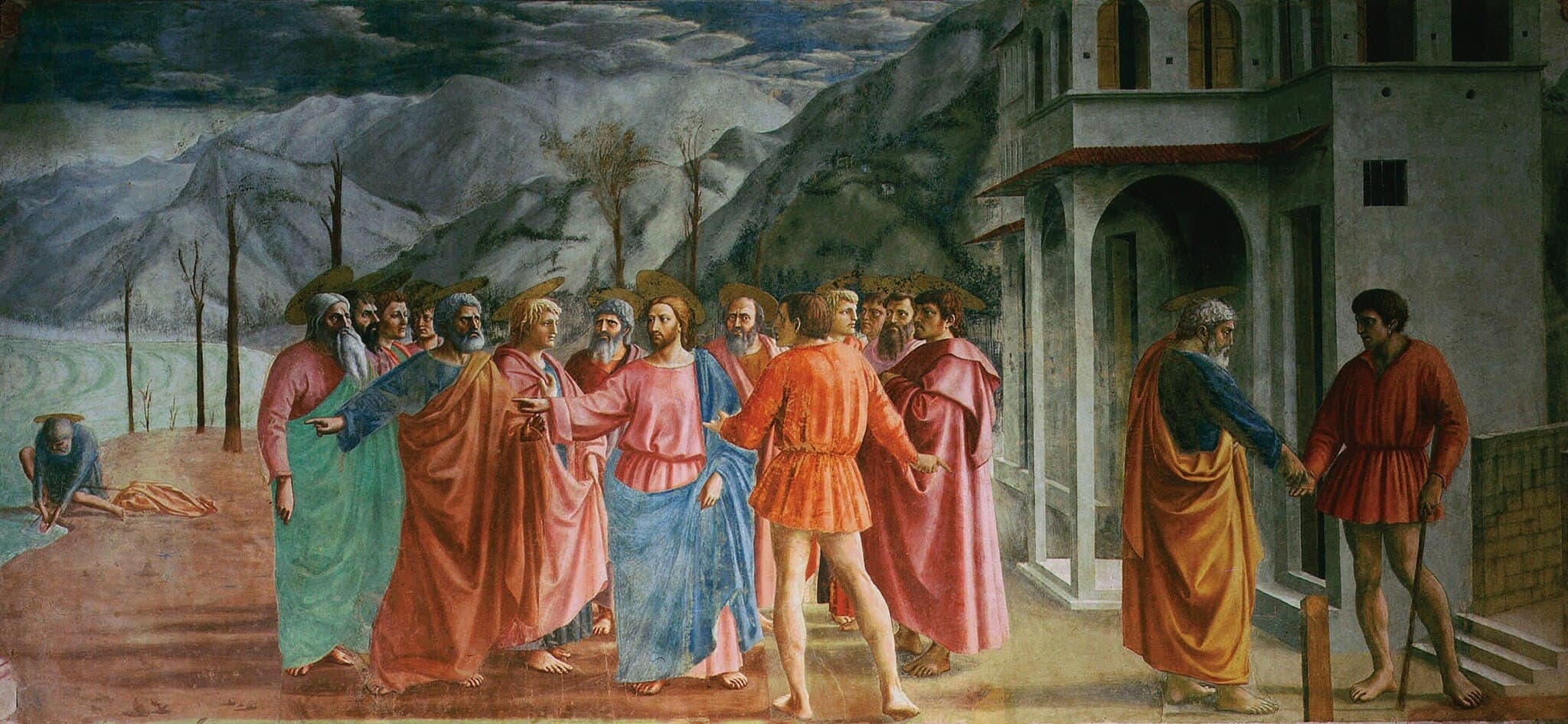
The Tribute Money
Masaccio, c. 1425–1427 • Buon fresco (wall painting)
Read full analysis of The Tribute Money →Valuation Analysis
Conclusion. In the real world, Masaccio’s The Tribute Money is an in-situ, State-protected fresco in the Brancacci Chapel and is not legally saleable under Italy’s Cultural Heritage Code [1]. For decision-making that requires a price proxy (e.g., risk analysis or hypothetical scenario testing), a defensible notional fair-market value is $1.0–3.0 billion. This figure reflects the work’s foundational role in Western art, the non-existent commercial supply of autograph Masaccio works, and the demonstrated ceiling for singular Renaissance masterpieces.
Approach. Because there is no auction record for autograph Masaccio works and no direct market for in-situ quattrocento frescoes, the estimate is derived by extrapolating from apex Old Master comparables and adjusting upward for art-historical centrality and absolute scarcity. Leonardo da Vinci’s Salvator Mundi set the modern benchmark at $450.3 million in 2017, evidencing global, cross-category demand for a once-in-a-generation Renaissance picture [2]. Botticelli’s portrait achieved $92.2 million in 2021, confirming robust appetite for top-tier Florentine Quattrocento works [3]. These were movable, tradable panels; The Tribute Money would surpass them on significance and rarity if it were hypothetically detachable and exportable.
Why this work sits above the benchmarks. The Tribute Money is a keystone of Early Renaissance innovation: rigorous single-point perspective, unified light, and monumental, psychologically convincing figuration that shaped generations from Fra Angelico to Michelangelo. Its art-historical weight, coupled with Masaccio’s tiny surviving oeuvre and the absence of any commercial supply, creates an extreme scarcity premium that a sovereign entity, leading museum consortium, or a small cadre of ultra–high-net-worth collectors would likely recognize in price discovery. Recent top-end signals—such as record Renaissance drawings, including a $27.2 million Michelangelo Sistine study—underscore depth of demand for cornerstone material tied to this lineage [4].
Context and visibility. The multi-year Brancacci Chapel conservation and research program has further amplified scholarly and public attention to Masaccio’s frescoes, reinforcing their status and educational centrality [5]. In any hypothetical sale, narrative power, cultural diplomacy value, and institutional competition would materially influence outcomes, pushing pricing well beyond recent Old Master records.
Result. Synthesizing these factors, the work would, in a frictionless scenario, clear above all known Old Master auction benchmarks and plausibly challenge the highest prices ever paid for art. The $1.0–3.0 billion range consolidates (i) apex comparables, (ii) scarcity and irreplaceability, and (iii) anticipated participation from museums and sovereign buyers. Practically, however, the fresco remains an unsaleable cultural monument under Italian law [1].
Key Valuation Factors
Art Historical Significance
High ImpactThe Tribute Money is a cornerstone of Early Renaissance painting and of Masaccio’s brief but epochal career. Its unified light, coherent single-point perspective, and monumental, psychologically convincing figures fundamentally redirected Western pictorial practice and influenced generations, from Fra Angelico to Michelangelo. As one of a handful of universally taught works that define quattrocento innovation, it carries disproportionate cultural capital. In any hypothetical market, this degree of canonical importance functions like a blue-chip multiple, elevating it above even top-tier period peers. The work’s central position within a masterwork ensemble (the Brancacci cycle) further reinforces its primacy and makes it the key visual and intellectual touchstone of Masaccio’s oeuvre.
Extreme Rarity and Supply Scarcity
High ImpactThere is no modern auction market for autograph Masaccio works: his surviving output consists of in-situ frescoes and museum panels. Zero circulating supply creates a scarcity premium well beyond typical Old Master dynamics, where even A-list names occasionally appear. Comparable apex prices for Leonardo and Botticelli demonstrate what the market will bear for once-in-a-generation Renaissance pictures; The Tribute Money surpasses those in rarity because there is effectively no pathway for another Masaccio masterpiece to trade. In a hypothetical bidding environment, this scarcity would likely trigger institutional and sovereign competition, compressing price elasticity and supporting a valuation at or beyond record Old Master levels.
Legal/Physical Constraints (In Situ Fresco)
High ImpactAs part of a protected church interior in Florence, the fresco is legally inalienable and non-exportable under Italy’s Cultural Heritage Code, and frescoes are inherently difficult to detach and transport without risk. These constraints eliminate real-world saleability, which is why this valuation is notional. In a counterfactual scenario where legal and logistical barriers were waived and conservation risks deemed manageable, the work’s site-specific origin could paradoxically add aura and prestige, similar to the way dissolved altarpieces with famed provenance command premiums. That said, any residual condition or detachment uncertainty would be priced into the upper bound, which is reflected in a range rather than a single point.
Demand Potential and Buyer Universe
High ImpactAt the very top of the market, demand is concentrated among global museums, sovereign entities, and a small number of collectors who pursue singular, civilizational objects. Recent record prices for Renaissance masterworks and drawings confirm depth of capital and appetite for cornerstone material when supply appears. The Tribute Money’s scholarly centrality, brand recognition in art history, and diplomatic value would catalyze unprecedented institutional consortia and sovereign interest. Such competition, combined with philanthropic or nation-brand motivations, typically expands budget constraints beyond conventional private collecting thresholds. These dynamics are consistent with a price outcome that would exceed all known Old Master benchmarks in a hypothetical sale.
Sale History
The Tribute Money has never been sold at public auction.
Masaccio's Market
Masaccio has effectively no commercial market: securely attributed works are either frescoes in situ (notably the Brancacci Chapel) or panels held by major museums. No autograph Masaccio painting or drawing has a modern public auction record. As a result, price discovery must be inferred from adjacent Old Master benchmarks rather than from the artist’s own trading history. This radical scarcity creates a paradox—no transactional data, yet extraordinary perceived value driven by unmatched art-historical standing. In any hypothetical scenario where an autograph Masaccio could trade, the buyer universe would likely include leading museums, sovereign wealth actors, and a handful of UHNW collectors, implying pricing above the Old Master category’s historical records.
Comparable Sales
Salvator Mundi
Leonardo da Vinci
Apex Old Master benchmark: a canonical Renaissance painting by a foundational Florentine master; shows the market ceiling for once‑in‑a‑generation, museum‑caliber works.
$450.3M
2017, Christie's New York
~$576.4M adjusted
Portrait of a Young Man Holding a Roundel
Sandro Botticelli
Top‑tier 15th‑century Florentine master; record price for a blue‑chip Quattrocento panel, indicating demand for prime early Renaissance pictures.
$92.2M
2021, Sotheby's New York
~$107.9M adjusted
A nude man (after Masaccio) and two figures behind him (drawing)
Michelangelo
High Renaissance drawing explicitly after Masaccio; demonstrates market appetite for works tied to the Brancacci legacy and cornerstone Renaissance innovation.
$24.3M
2022, Christie's Paris
~$26.2M adjusted
The Crucifixion with the Virgin, Saint John the Baptist and the Magdalen
Fra Angelico
Record for another cornerstone Quattrocento painter; period and religious subject align, though the work is a small tempera panel (different medium/scale).
$6.4M
2023, Christie's London
~$6.7M adjusted
The Return of the Bucintoro to the Molo on Ascension Day
Canaletto
Not Quattrocento but the 2025 Old Masters bellwether; evidences depth of bidding for museum‑caliber Old Masters when supply is exceptional.
$43.9M
2025, Christie's London
Current Market Trends
Old Masters have shown selective strength at the top end despite a broader market dip in 2024, rebounding in 2025–2026 when supply was exceptional. Record and near-record results for Renaissance blue chips (e.g., Leonardo’s 2017 benchmark, a 2026 Michelangelo drawing record) signal deep demand for canonical material. Museums and states continue to intervene on export and acquisitions, tightening supply and intensifying competition when great works surface. For quattrocento pictures of unquestioned quality and provenance, bidding remains robust and globally diversified. In this context, a hypothetical, tradeable Masaccio masterpiece would likely command prices beyond prior Old Master highs due to its singular importance and absolute scarcity.
Sources
- Italian Cultural Heritage Code (d.lgs. 42/2004)
- Christie’s Press Release: Leonardo da Vinci, Salvator Mundi sells for $450.3m (2017)
- DW: Botticelli portrait sold for record $92 million (2021)
- Artnet News: Michelangelo Sistine Chapel study sells for $27.2m (2026)
- Art History News: Brancacci Chapel restoration completed