How Much Is Boy in a Red Vest (Le Garçon au gilet rouge) Worth?
Last updated: March 10, 2026
Quick Facts
- Methodology
- comparable analysis
For a large, authenticated, museum‑quality oil of Paul Cézanne’s Boy in a Red Vest (c.1888–90) I estimate a working market range of $100–150 million. This assumes unquestioned attribution, exemplary condition, strong catalogue‑raisonné and exhibition/provenance documentation; deviations on those points materially reduce the price.
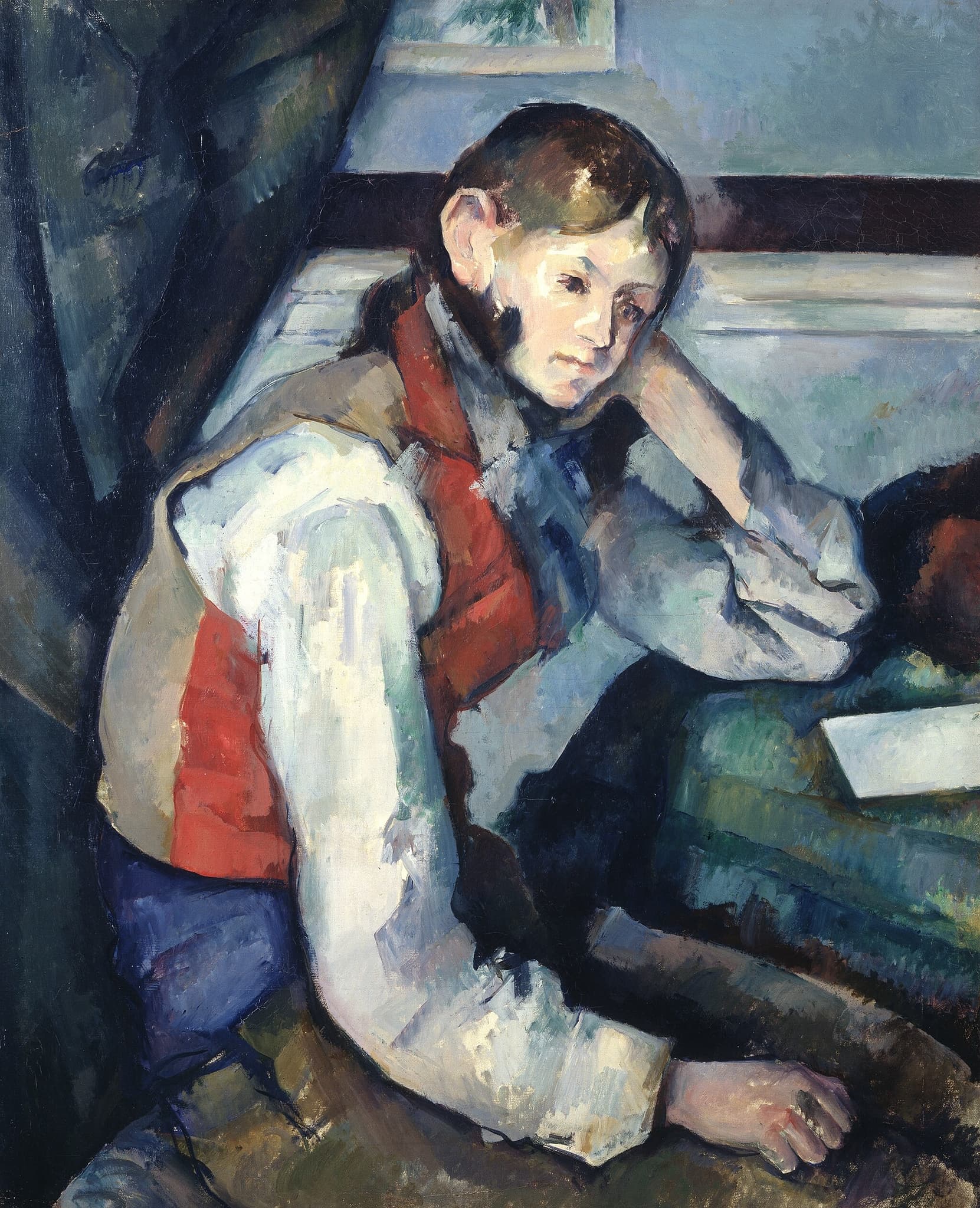
Boy in a Red Vest (Le Garçon au gilet rouge)
Paul Cézanne, 1889 • Oil on canvas
Read full analysis of Boy in a Red Vest (Le Garçon au gilet rouge) →Valuation Analysis
Valuation conclusion: Using a comparable‑analysis anchored to recent Cézanne market benchmarks and the fact that several finished versions of this motif are held by major institutions, my working estimate for a market‑ready, museum‑quality Boy in a Red Vest (c.1888–90) is $100–150 million (USD). This valuation presumes unequivocal attribution, a large finished format, excellent condition and published provenance; any gaps reduce value materially.
Several prime examples of the motif reside in leading collections (notably MoMA and the National Gallery of Art), which means market‑ready, top‑tier versions are extremely scarce and attract intense institutional interest when they appear [1][3]. That scarcity combined with Cézanne’s blue‑chip status concentrates demand among a relatively small group of museums, major foundations and ultra‑high‑net‑worth collectors. In practice, this concentration can drive competitive bidding that pushes prices into the low‑to‑mid nine‑figure band for canonical works.
Pricing is anchored to recent, high‑quality comparables. The auction record set in November 2022 when Christie’s sold a major Cézanne (La Montagne Sainte‑Victoire) for about $137.8M is the clearest public market signal for the current upper auction band for museum‑quality Cézannes [2]. Historical public‑sale benchmarks and widely reported private transactions (for example the reported 2011 private transfer of a Card Players canvas) provide a ceiling context for exceptional private treaty outcomes [4]. Against those data points, a prime, well‑documented Boy in a Red Vest would be expected to trade toward the lower‑end to mid‑range of those top results, hence the $100–150M band.
The principal variables that will move a firm price are: authentication (catalogue‑raisonné listing and technical corroboration), provenance and exhibition history, and condition (including conservation history). Technical dossiers (X‑radiography, infrared reflectography, pigment and binding media analysis) that confirm period materials and working method materially increase market confidence. Conversely, provenance gaps, restitution exposures or a history of theft/restoration (a high‑profile theft/recovery has affected another Bührle‑held version) can materially suppress bids or eliminate key buyers [5].
Sale format and marketing are also critical. Auctions can generate competitive buyer tension that maximises public transparency and hammer price; private treaty sales can exceed auction results when a motivated buyer is identified in advance. Final pricing therefore depends on the dossier presented to the market and the seller’s ability to attract institutional and private bidders simultaneously.
Bottom line: For a large, authenticated, excellently conserved and well‑provenanced Boy in a Red Vest by Cézanne, expect a realistic working market range of $100–150M. Absent those conditions (study, small scale, uncertain attribution, poor condition), value can be materially lower and requires a separate, condition‑specific appraisal.
Key Valuation Factors
Art Historical Significance
High ImpactCézanne occupies a pivotal position between Impressionism and modernism; his late‑1880s portraits demonstrate the painterly logic and formal reduction that prefigure 20th‑century developments. While the 'Boy in a Red Vest' motif is not as singularly iconic as the Bathers or Card Players, a high‑quality, finished example is nonetheless an important document of Cézanne's mature portrait practice. Institutional and scholarly interest in such works is strong because they illustrate transitions in his handling of form, structure and modulation of color. That art‑historical weight translates directly into market value: museums and top collectors prize canonical works that illuminate an artist’s critical development.
Provenance & Exhibition History
High ImpactProvenance is a primary value driver. A clean, well‑documented chain that traces ownership through respected dealers and collectors (e.g., early appearances in Vollard, Rosenberg, Mellon, or Bührle inventories) and extensive exhibition/publication history substantially increases price by reducing buyer risk. Works with catalogue‑raisonné entries and prominent scholarly citation typically attract institutional buyers and the highest private collectors. Conversely, gaps in ownership, potential restitution claims or histories of theft/restoration create legal and reputational risk that depresses buyer confidence and can trigger heavy discounts or preclude sale.
Condition & Technical Attributes
High ImpactThe physical state and technical verification of the painting strongly condition market value. A surface with original paint, minimal later overpainting, stable canvas and conservative conservation supports top prices. Significant structural interventions (extensive relining, heavy inpainting, or damage) materially reduce value. Technical analyses—X‑ray, infrared reflectography, pigment and binder testing—that corroborate period materials and Cézanne’s hand are essential to convert a working estimate into a firm presale estimate. Buyers will typically insist on a full conservation report before committing at the top end.
Rarity & Market Scarcity
High ImpactAlthough Cézanne painted several variants of the 'boy in a red vest' motif, genuinely museum‑quality canvases with published provenance and exhibition histories are rare on the open market. The scarcity of top‑tier examples concentrates demand and elevates prices whenever a canonical work becomes available. High‑net‑worth collectors and institutions compete directly in a thin market, which can cause rapid escalation in price under competitive sale conditions. Scarcity is therefore a persistent and positive value multiplier for a first‑rate version.
Sale Format & Market Timing
Medium ImpactWhether the work is offered at public auction or private treaty matters. Auctions can create transparent, competitive tension that maximises visible price discovery, while private sales can yield higher realized prices when a motivated buyer is already identified. Macroeconomic conditions, currency strength, and institutional buying budgets (or deaccession cycles) also influence final outcomes. Timing a sale to coincide with scholarly exhibitions or a major Cézanne show can enhance visibility and improve results; conversely, weaker market conditions suppress top bids.
Sale History
Boy in a Red Vest (Le Garçon au gilet rouge) has never been sold at public auction.
Paul Cézanne's Market
Paul Cézanne is an unequivocal blue‑chip artist whose works are core holdings for major modern art collections worldwide. Demand for canonical, well‑provenanced Cézannes is intense and the supply of high‑quality, market‑available canvases is extremely limited. Public auction records and major private transactions demonstrate that top examples regularly reach the high eight to low nine‑figure range; record public results in 2022 and prominent private sales in the last two decades illustrate both the market ceiling and the depth of institutional appetite. Cézanne remains among the most sought after late‑19th‑century painters.
Comparable Sales
La Montagne Sainte‑Victoire
Paul Cézanne
Record auction for Cézanne (Nov 2022). A top‑tier, late‑career finished Cézanne that demonstrates the upper auction ceiling for museum‑quality works of this artist; relevant as a market ceiling even though subject is landscape rather than portrait.
$137.8M
2022, Christie's New York
~$148.4M adjusted
Rideau, Cruchon et Compotier
Paul Cézanne
High‑profile 1999 auction benchmark for Cézanne still life; shows historical market value growth for major Cézannes and provides a mid‑range auction comparable for a high‑quality, museum‑level picture (different subject but similar market tier).
$60.5M
1999, Sotheby's New York
~$114.9M adjusted
The Card Players
Paul Cézanne
Reported private‑market sale often cited as the artist's private‑sale ceiling. A major figure composition by Cézanne — directly relevant as a ceiling for exceptionally rare, museum‑quality works in private transactions (date/terms approximate because it was a private sale).
$250.0M
2011, Private sale (widely reported sale to a Qatari buyer, 2011)
~$353.4M adjusted
Current Market Trends
The top tier of the global art market remains robust for blue‑chip works despite episodic macro volatility. Institutions and ultra‑wealthy collectors continue to compete for canonical pieces, supporting record and near‑record outcomes for scarce masterpieces. Private treaty sales are active at the upper end and can exceed auction results when sellers secure focused buyer interest. Overall, demand for museum‑quality Cézannes is stable to strong; timing and marketing will determine whether a particular canvas reaches the high‑end estimate.
Sources
- Museum of Modern Art — Boy in a Red Vest (Le Garçon au gilet rouge)
- Bloomberg — Paul Allen auction results: Cézanne painting sets $138 million record (Nov 2022)
- National Gallery of Art — Boy in a Red Waistcoat (Le Garçon au gilet rouge)
- Vanity Fair — Reports on private sale of Cézanne’s The Card Players (2011, widely reported)
- ABC News — Stolen Cézanne recovered (Bührle version) — theft and recovery reporting