How Much Is Madame Cézanne in a Red Armchair Worth?
Last updated: January 28, 2026
Quick Facts
- Methodology
- comparable analysis
Madame Cézanne in a Red Armchair (c. 1877) is a canonical, museum-grade portrait from Cézanne’s most important portrait series and one of the best-known images of Hortense Fiquet. Anchored by the artist’s $137.8m auction record and reinforced by strong recent results for prime Cézanne oils, a realistic auction range today is $95–135 million.
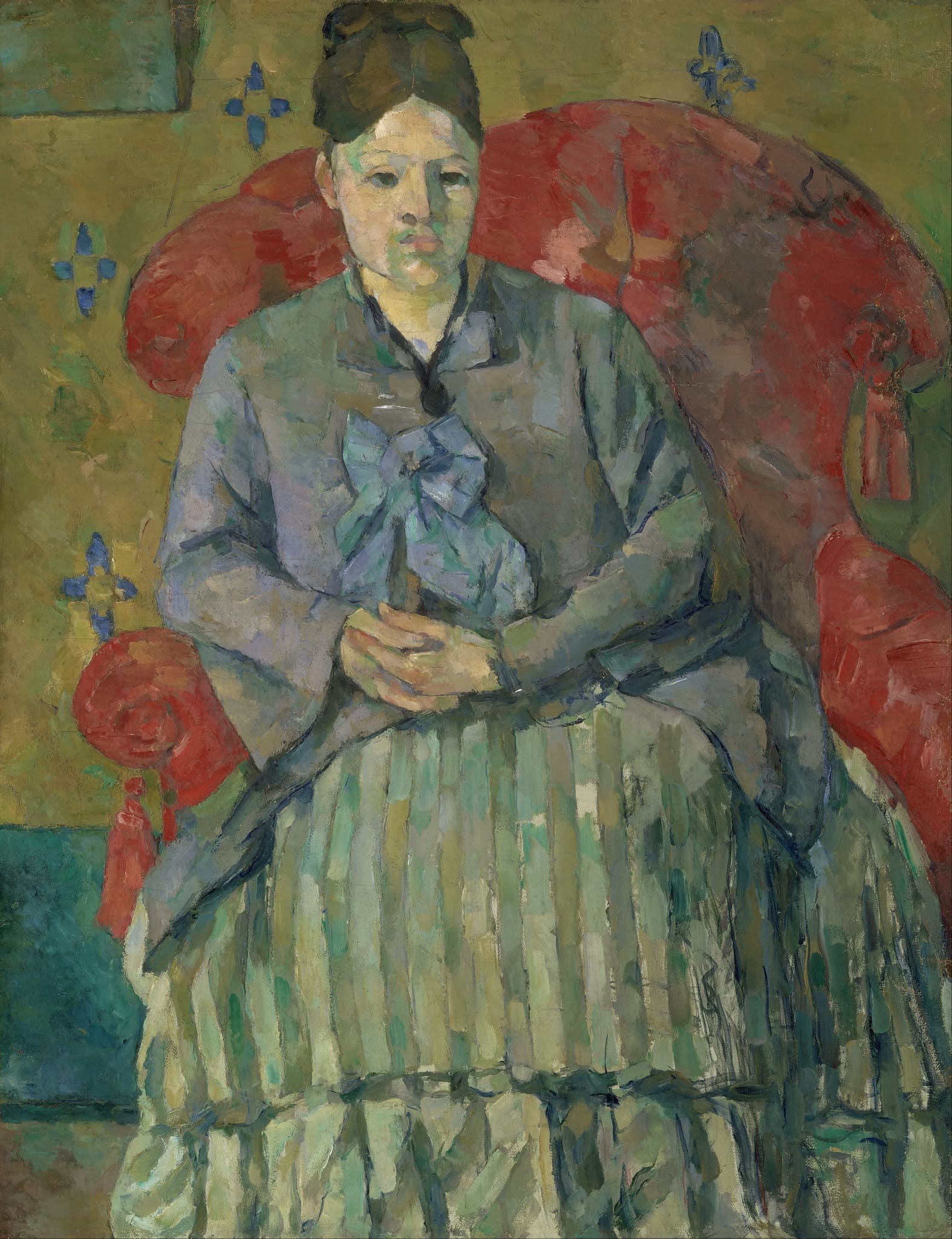
Madame Cézanne in a Red Armchair
Paul Cézanne, about 1877 • Oil on canvas
Read full analysis of Madame Cézanne in a Red Armchair →Valuation Analysis
Conclusion: If deaccessioned and offered at auction today, Paul Cézanne’s Madame Cézanne in a Red Armchair (c. 1877; 72.4 × 55.9 cm) would most likely realize $95–135 million. The picture is among the most widely reproduced portraits of Hortense Fiquet, central to the approximately two‑dozen‑work Madame Cézanne series, and long held by the Museum of Fine Arts, Boston—contributing to its stature as a museum‑grade, scholarly touchstone [1].
Market anchors and how they map to this work: The current auction ceiling for Cézanne is $137.79 million for La Montagne Sainte‑Victoire (Paul G. Allen Collection, Christie’s, 2022), which establishes an upper bound for even the finest portraits in typical market conditions [2]. A widely reported private sale of The Card Players at $250+ million underscores the theoretical apex for the artist’s most coveted series [3]. Recent public benchmarks include a top still life, Fruits et pot de gingembre, at $38.94 million in 2023 [4], and, within the same portrait subject, a small bust‑length Portrait de Madame Cézanne at $7.37 million in 2025, illustrating how scale and icon status drive valuation within the series [6]. Historically, a closely related variant—Madame Cézanne in a Yellow Chair—made $23.1 million in 1997 (roughly mid‑eight figures in today’s dollars), demonstrating the long-standing demand for first‑class examples from this cycle [5].
Positioning this painting: Red Armchair is one of the signature images of Hortense and a frequent reference point in Cézanne literature. Its three‑quarter seated format, period (c. 1877), and pictorial authority place it at the top tier of the portrait corpus. While market peaks for Cézanne typically favor late landscapes and a handful of still lifes, this painting’s art‑historical importance and image recognition justify a valuation well above routine portraits and plausibly into the lower nine figures, yet still below the artist’s top landscape record in most scenarios. The $95–135 million band respects those category dynamics, with the high end contingent on pristine condition, first‑rate marketing, and competitive third‑party guarantees.
Market climate and execution risk: The high end of the Impressionist/Post‑Impressionist market has shown resilient demand for blue‑chip trophies, aided by selective supply and strong guarantee frameworks; results since late 2022 confirm willingness to pay for best‑of‑category material [2][4][7]. Upside catalysts include fresh condition, compelling scholarly/loan history, and optimal timing within a marquee New York season. Downside risks include material condition issues (lining, overpaint), supply of competing trophies in the same week, or macro volatility that reduces risk appetite. Overall, given the painting’s canonical status, scarcity, and series‑defining profile, the proposed range reflects the most likely outcome in today’s market.
Key Valuation Factors
Art Historical Significance
High ImpactMadame Cézanne in a Red Armchair sits at the heart of Cézanne’s portrait practice and is among the most reproduced images of Hortense Fiquet. The painting’s c. 1877 date places it within a formative moment when Cézanne was consolidating the structural innovations that would influence modern art. Its synthesis of planar modeling, chromatic restraint, and psychological reserve makes it a keystone for scholars and museums alike. Works that both define an artist’s development and serve as canonical teaching images command a significant premium. This depth of significance narrows the pool of direct substitutes, amplifying competitive tension if the picture were to be offered.
Series Iconicity and Scale
High ImpactWithin roughly two dozen portraits of Hortense, a handful—of which Red Armchair is one—have achieved near‑icon status. The three‑quarter, seated format at approximately 72 × 56 cm offers a commanding presence compared with bust‑length variants, directly affecting marketability and price. Series‑defining works benefit from cross‑collector demand: Impressionist/Post‑Impressionist buyers, portrait collectors, and institutions seeking to anchor narratives of modernism. This broader buyer base supports higher price elasticity. In contrast, smaller or less resolved variations in the series can trade at a fraction of the price, underlining the premium for this combination of image recognition, scale, and painterly authority.
Comparable Sales and Record Context
High ImpactCézanne’s public auction record of $137.79 million for a Mont Sainte‑Victoire (2022) establishes the present ceiling for museum‑grade works [2]. A top still life realized $38.94 million in 2023, showing strong liquidity for A‑quality oils [4]. Direct series comparables include the 1997 Madame Cézanne in a Yellow Chair at $23.1 million (much lower market and earlier date) [5], and a small 2025 bust‑length Madame Cézanne at $7.37 million [6]. Calibrating across these data points places Red Armchair—by quality, scale, and icon status—well above routine portraits and below the top landscapes, supporting the $95–135 million range under contemporary auction conditions.
Provenance and Institutional Status
Medium ImpactLong-term stewardship by the Museum of Fine Arts, Boston enhances scholarly profile and public recognition, factors that typically strengthen demand and confidence at sale. Museum holding also implies robust publication and exhibition histories, increasing buyer comfort with attribution and condition. While deaccessioning introduces logistical and reputational variables, the market consistently rewards museum‑grade, well‑documented masterpieces. The main uncertainty remains condition and conservation history; absent any material issues, an institutional pedigree generally supports pricing at the top of the valuation band by signaling a work’s cultural importance and curatorial vetting to bidders and guarantors.
Sale History
Madame Cézanne in a Red Armchair has never been sold at public auction.
Paul Cézanne's Market
Paul Cézanne is a cornerstone of Post‑Impressionism and among the most coveted names in the field. His auction record stands at $137.79 million for a Mont Sainte‑Victoire sold in 2022, while a widely reported private sale of The Card Players exceeded $250 million, underscoring the apex for his most iconic series. Liquidity is deep for prime oils, with top still lifes and late landscapes commanding strong results and sustained global demand. Supply is structurally scarce, particularly for museum‑grade works with first‑rate provenance. Collectors view Cézanne as a bedrock of art‑historical significance, supporting resilient pricing across market cycles and strong competition for A‑material.
Comparable Sales
Madame Cézanne in a Yellow Chair
Paul Cézanne
Same artist and sitter; closely related variant from the Madame Cézanne series and similar late‑1870s period; comparable three‑quarter seated format and museum‑level quality.
$23.1M
1997, Christie's New York
~$46.2M adjusted
Portrait de Madame Cézanne (bust-length)
Paul Cézanne
Same artist and sitter; similar c.1877 date; smaller bust‑length format provides a recent, like‑for‑like portrait benchmark in 2025 market conditions.
$7.4M
2025, Sotheby's New York
Fruits et pot de gingembre
Paul Cézanne
Same artist; top‑tier late still life demonstrating where A‑quality Cézanne oils have traded recently; helpful price anchor for major subjects even if not a portrait.
$38.9M
2023, Christie's New York
~$40.9M adjusted
La Montagne Sainte-Victoire
Paul Cézanne
Same artist; record‑setting landscape establishes the current auction ceiling for museum‑grade Cézanne oils and frames the upper bound for a marquee portrait.
$137.8M
2022, Christie's New York (Paul G. Allen Collection)
~$151.1M adjusted
The Card Players
Paul Cézanne
Same artist; canonical series and widely reported private transaction, indicating the absolute apex for Cézanne; used as a category ceiling even though subject differs.
$250.0M
2011, Private sale
~$356.8M adjusted
Current Market Trends
The upper tier of the Impressionist/Post‑Impressionist market remains robust, exhibiting a sustained flight to quality since late 2022. Marquee evening sales continue to attract aggressive bidding and third‑party guarantees for blue‑chip names, even as mid‑market segments are more selective. Trophy‑caliber works with strong provenance, fresh condition, and scholarly visibility have outperformed, while secondary examples face disciplined pricing. Paris has grown in importance for Modern and Post‑Impressionism, but New York still sets price discovery at the very top. In this context, a series‑defining Cézanne portrait would likely encounter deep international demand and competitive bidding.
Sources
- Google Arts & Culture – Madame Cézanne in a Red Armchair (MFA Boston)
- Christie’s – Paul G. Allen Collection sale results (includes Cézanne record)
- Vanity Fair – Qatar buys Cézanne ‘Card Players’ for over $250m (report)
- Christie’s Press – 20th Century Evening Sale totals; includes Cézanne still life at $38.94m
- Washington Post – At the Auctions (1997) – Cézanne ‘Madame Cézanne in a Yellow Chair’ $23.1m
- Sotheby’s – Portrait de Madame Cézanne (bust-length) – $7.37m (2025)
- The Art Newspaper – Christie’s 20th Century Evening Sale defies jitters (market context)