How Much Is Mont Sainte-Victoire Worth?
Last updated: January 28, 2026
Quick Facts
- Current Location
- The Metropolitan Museum of Art
- Methodology
- comparable analysis
Hypothetical market value for Paul Cézanne’s Mont Sainte‑Victoire (1902–06, The Met) is estimated at $120–180 million. The range is anchored to the $137.8m 2022 auction record for a Sainte‑Victoire and reflects the motif’s centrality to Cézanne’s oeuvre, scarcity of late, museum‑quality examples, and persistent global demand.
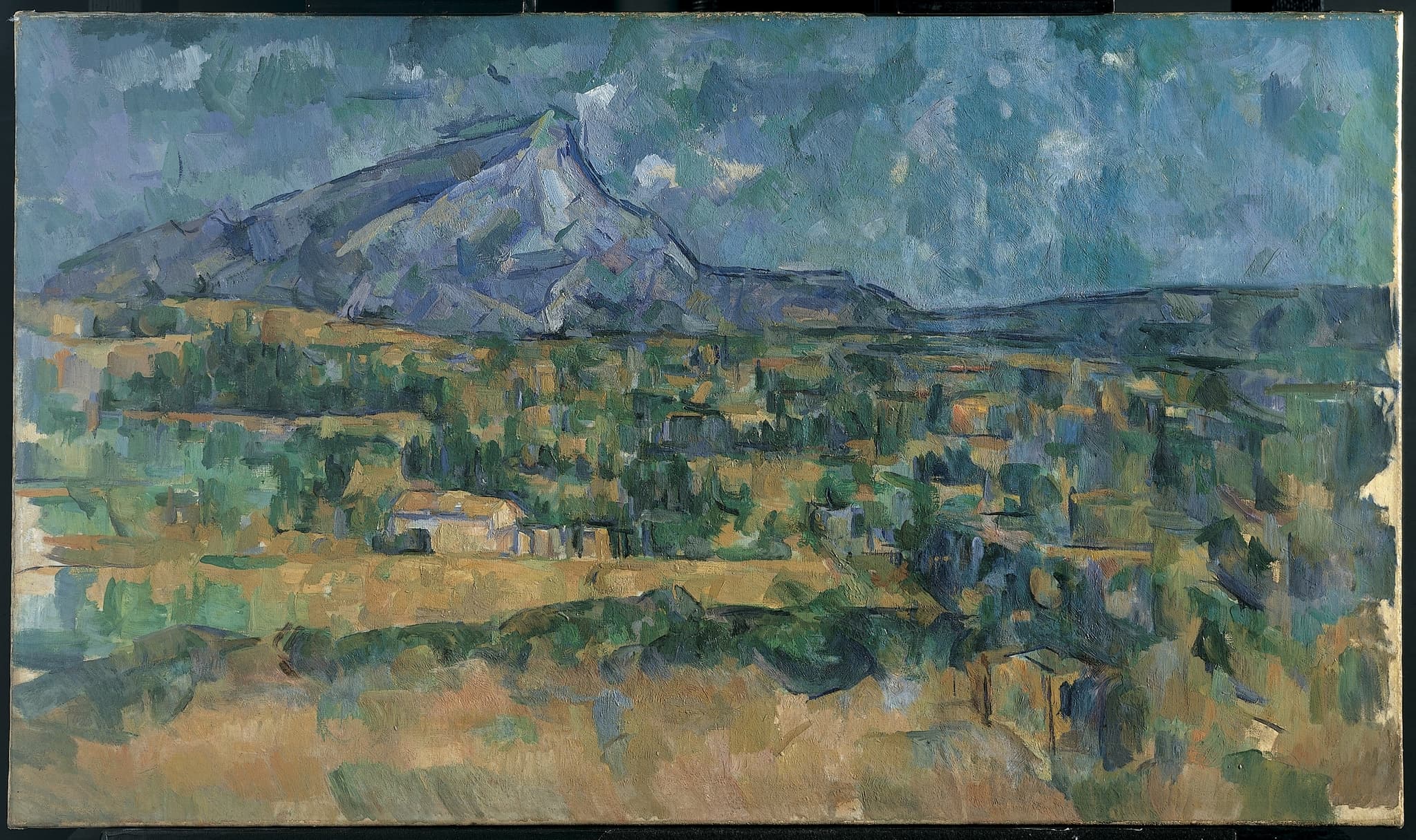
Mont Sainte-Victoire
Paul Cézanne, 1902–1906 • Oil on canvas
Read full analysis of Mont Sainte-Victoire →Valuation Analysis
Conclusion: If The Metropolitan Museum of Art’s Mont Sainte‑Victoire (1902–06) were hypothetically brought to market today, a fair estimate is $120–180 million. This range is anchored to the $137.79 million price (with fees) achieved by a closely comparable Sainte‑Victoire at Christie’s from the Paul G. Allen Collection in November 2022 and adjusted for the enduring scarcity and iconic status of late, museum‑quality examples [2][3].
Artwork profile and significance: The Met’s painting is a prime late landscape in Cézanne’s signature motif, measuring approximately 57.2 × 97.2 cm and held in New York via the Annenberg gift and bequest [1]. The Sainte‑Victoire series is foundational to Cézanne’s project of building form through color and structure; the late canvases (circa 1902–06) are especially prized for their architectonic brushwork and proto‑Cubist construction. As a widely reproduced, museum‑caliber example in a top U.S. institution, this work sits at or near the apex of the artist’s landscape market hierarchy.
Pricing logic and comparables: The most probative comp is the 2022 Allen Montagne Sainte‑Victoire at $137.79 million (with fees), which established the artist’s auction record and validated deep demand for the motif at the nine‑figure level [2][3]. Secondary benchmarks show the steep subject‑matter premium: an important still life realized $38.94 million in 2023, underscoring how Sainte‑Victoire canvases clear a far higher bar than even strong Cézanne still lifes [4]. With limited supply of masterpiece‑grade Cézannes since 2022, and the subject’s unrivaled salience to the artist’s legacy, the Met painting would command intense competition were it ever to be deaccessioned.
Market context and timing: The broader Impressionist/Post‑Impressionist segment saw fewer trophy consignments in 2023–24, with a late‑2025 rebound focused on blue‑chip masterpieces. The current cycle remains a “flight to quality,” in which canonical, fresh‑to‑market works attract premium pricing [5]. Additional tailwinds include heightened institutional attention around the 2025–26 exhibition cycle (Aix‑en‑Provence in 2025; Fondation Beyeler in 2026), which sustains scholarly and collector focus on Cézanne’s late period [6][7].
Range rationale: The $120–180 million band brackets the 2022 Sainte‑Victoire record, allowing for condition, perceived ranking within the late series, and sale timing. A best‑in‑class condition report, standout aesthetic punch against peer examples, and a robust single‑owner or marquee context would bias toward the upper half of the range. Conversely, any notable condition or restoration issues would pull the valuation toward the lower bound.
Notes: The work has no public auction record; The Met does not publish insurance values for individual objects [1]. This valuation reflects public benchmarks and market comparables and assumes standard museum‑grade condition.
Key Valuation Factors
Art Historical Significance
High ImpactMont Sainte‑Victoire is Cézanne’s most emblematic landscape motif and a cornerstone of his late project to “construct” nature through color and planar brushwork. The 1902–06 variants are especially prized for their architectonic clarity and proto‑Cubist structure, directly influencing Matisse, Picasso, and the emergence of Modernism. The Met’s canvas is a mature statement from this final period, widely reproduced and institutionally enshrined. Works of this stature sit near the peak of the artist’s market hierarchy—below the ultra‑rare Card Players tier, but at parity with or above most still lifes and portraits—supporting nine‑figure demand in the current market.
Iconic Motif Scarcity
High ImpactLate, museum‑quality Sainte‑Victoire oils are exceptionally scarce in private hands, with many of the finest examples in major museums. The limited pipeline of comparable works creates a structural supply imbalance relative to global top‑tier demand. The 2022 Paul G. Allen result affirmed that collectors will compete at the highest level for prime Sainte‑Victoire paintings. Given that most late variants of equivalent caliber are institutionally held, a fresh example of this stature would likely trigger broad international bidding across the U.S., Europe, and the Middle East/Asia, supporting pricing at or above the 2022 benchmark depending on condition and presentation.
Condition and Physical Qualities
Medium ImpactAt approximately 57.2 × 97.2 cm, the Met work sits in a highly desirable landscape format for Cézanne collectors: substantial enough for wall power, yet not so large as to limit placement. As an oil on canvas from the late period, it should exhibit the signature interlocking brushwork and luminous, unblended color planes prized by the market. While the museum does not publish condition reports, longstanding institutional care typically correlates with stable condition. For valuation, we assume clean, structurally sound condition consistent with museum standards; any material structural or restoration concerns would meaningfully impact the range.
Provenance and Institutional Endorsement
High ImpactThe painting’s Annenberg provenance and long‑term placement at The Metropolitan Museum of Art confer exceptional credibility and visibility. Institutional ownership signals scholarly importance and ensures the work has been conserved and documented at a high standard. Works with this level of provenance, publication, and display history typically command a premium over comparable examples with weaker chains of title or limited exhibition histories. If hypothetically deaccessioned and marketed within a top single‑owner or marquee evening context, the institutional imprimatur would be a major value amplifier.
Market Liquidity and Timing
Medium ImpactPost‑2022, supply of masterpiece‑grade Cézannes has been thin, reinforcing demand concentration at the very top. The category saw fewer trophy consignments in 2023–24, followed by a late‑2025 rebound concentrated in blue‑chip Modern/Impressionist names. In a flight‑to‑quality environment, canonical works like a late Sainte‑Victoire benefit from deep, globally diversified bidder pools. Near‑term institutional programming around Cézanne in 2025–26 further supports mindshare. Optimal sale timing would align with marquee weeks and strong single‑owner narratives to maximize international competition and pricing tension.
Sale History
Mont Sainte-Victoire has never been sold at public auction. It has been held by The Metropolitan Museum of Art.
Paul Cézanne's Market
Paul Cézanne is a cornerstone of the blue‑chip Modern canon, with deep global demand across the U.S., Europe, and the Middle East/Asia. His auction record stands at $137.79 million (with fees) for La Montagne Sainte‑Victoire (Christie’s, Nov 2022), confirming nine‑figure depth for the iconic motif. Top still lifes and portraits typically trade in the tens of millions, with a strong 2023 still life at $38.94 million. Supply of masterpiece‑grade oils is limited; many best examples are in museums, creating a scarcity premium when prime works appear. Private‑market lore places The Card Players series at the absolute pinnacle, but among tradeable categories, late Sainte‑Victoire landscapes remain the most coveted and price‑elastic.
Comparable Sales
La Montagne Sainte‑Victoire (c. 1888–1890)
Paul Cézanne
Direct motif match (Sainte‑Victoire), major oil on canvas, museum‑caliber; establishes current auction apex for the series and the artist.
$137.8M
2022, Christie's New York
~$152.9M adjusted
La Montagne Sainte‑Victoire (c. 1888–1890)
Paul Cézanne
Same painting later sold in 2022; long‑run price benchmark for the Sainte‑Victoire motif and top‑tier Cézanne oils.
$38.5M
2001, Phillips, de Pury & Luxembourg, New York
~$70.5M adjusted
Bouilloire et fruits (c. 1888–1890)
Paul Cézanne
Prime still life oil from the same high period; museum‑quality Cézanne trophy establishing upper‑tier pricing outside the Sainte‑Victoire motif.
$59.3M
2019, Christie's New York
~$75.3M adjusted
Fruits et pot de gingembre (c. 1890–1893)
Paul Cézanne
Strong still life oil, recent marquee sale; gauges current depth of demand for important Cézanne oils just below the absolute trophy tier.
$38.9M
2023, Christie's New York
~$41.3M adjusted
La mer à l’Estaque (catalogued c. 1878–79 or c. 1897)
Paul Cézanne
Landscape oil by Cézanne but not the Sainte‑Victoire motif; illustrates the significant subject‑matter premium commanded by Sainte‑Victoire.
$3.2M
2023, Christie's New York
~$3.4M adjusted
Current Market Trends
The Impressionist/Post‑Impressionist segment saw fewer trophy consignments in 2023–24, yet the late‑2025 rebound reaffirmed a flight to quality: canonical, museum‑caliber works drew intense competition while mid‑tier material remained selective. Cézanne fits squarely into this dynamic: masterpiece‑grade supply is scarce, but when it surfaces, it commands premium pricing. The 2022 Sainte‑Victoire record underscores enduring depth at the top end; recent sales confirm healthy demand for strong but non‑iconic works. Near‑term exhibition cycles focused on Cézanne (2025–26) provide additional tailwinds, sustaining scholarly attention and collector appetite for late, architectonic landscapes.
Sources
- The Metropolitan Museum of Art – Mont Sainte‑Victoire (1902–06) object page
- Christie’s – Paul G. Allen Collection sale results overview (includes Cézanne record)
- The Art Newspaper – Paul Allen evening sale sets $1.5bn record; Cézanne at $137.8m
- Christie’s Press – 20th Century Evening Sale results (includes 2023 Cézanne still life at $38.94m)
- Art Basel & UBS – The Art Market 2025 (Auctions overview and trends)
- CÉZANNE 2025 – Aix‑en‑Provence program overview
- Fondation Beyeler – Cézanne (special exhibition listing, 2026)