How Much Is Still Life with Apples and Oranges Worth?
Last updated: January 28, 2026
Quick Facts
- Methodology
- comparable analysis
Hypothetical market value for Paul Cézanne’s Still Life with Apples and Oranges (Musée d’Orsay) is estimated at $120–200 million. The range brackets the artist’s $137.8m auction record and reflects the work’s status as a canonical, large late still life of exceptional quality and recognition.
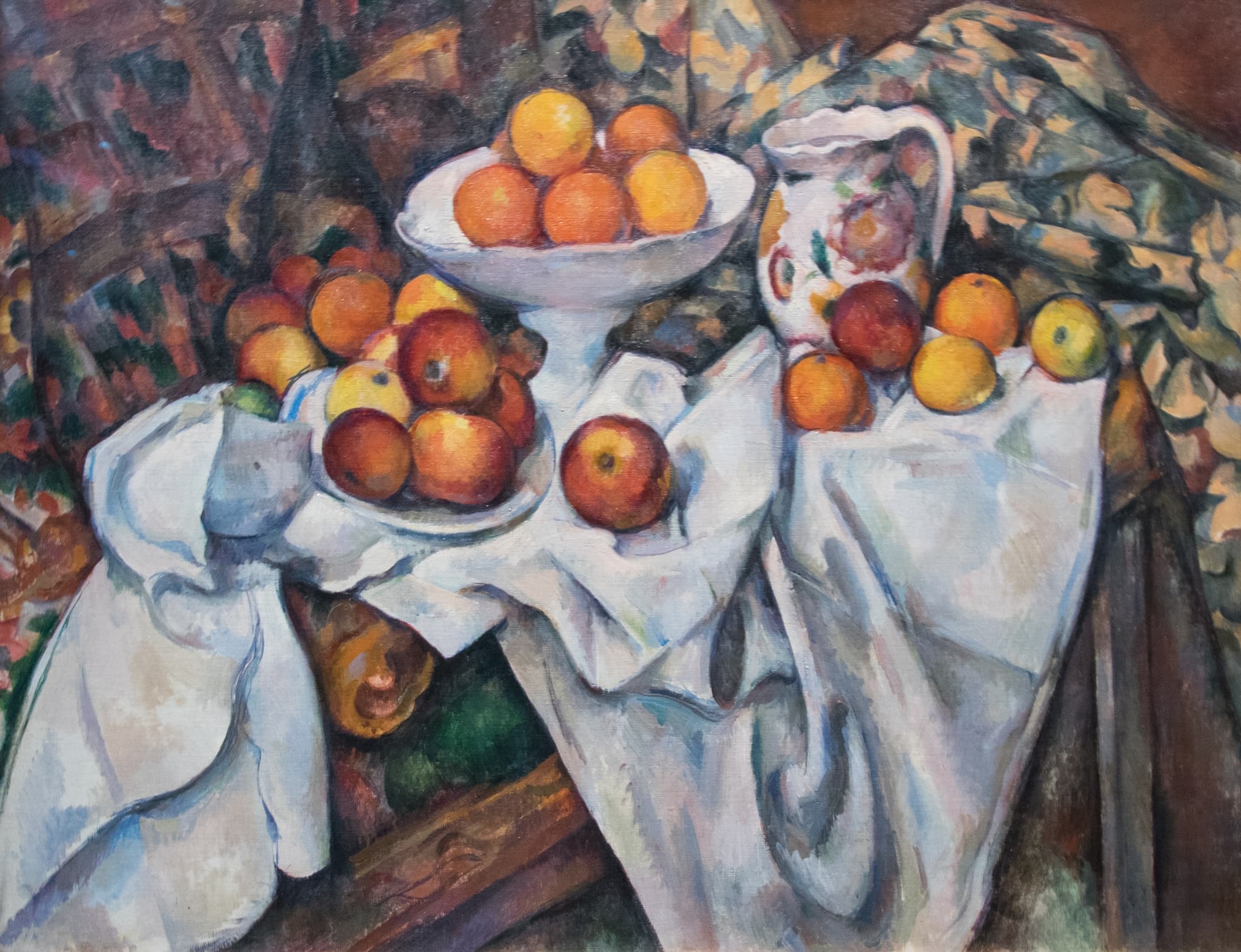
Still Life with Apples and Oranges
Paul Cézanne, c. 1899 • Oil on canvas
Read full analysis of Still Life with Apples and Oranges →Valuation Analysis
Work and status. Paul Cézanne’s Still Life with Apples and Oranges (c. 1899; oil on canvas, 74 x 93 cm) at the Musée d’Orsay is widely cited by the museum as the most important still life from the late 1890s, and part of a focused series of large, complex tabletop compositions from 1899 [1]. The painting entered France’s national collections via the Isaac de Camondo bequest in 1911 and has never been offered at auction. As public property, it is inalienable under French law; any valuation is therefore hypothetical and intended as a market/insurance indication [2].
Comparable benchmarks. The current public auction record for Cézanne is $137.79 million for La montagne Sainte-Victoire (Christie’s, Paul G. Allen Collection, 2022) [3]. Among still lifes, a landmark comp is Rideau, cruchon et compotier, sold for $60.5 million in 1999—approximately the low nine figures in today’s dollars, underscoring the long-standing premium for large, ambitious examples [5]. Recent, directly relevant late still lifes have achieved $38.94 million (Fruits et pot de gingembre, Christie’s, 2023), despite smaller scale and less iconic status than the Orsay canvas [4]. Together these data points frame a logical range for a best-in-class late still life that is larger, more complex, and more culturally prominent.
Trophy dynamics and ceiling. While subject preferences vary, Cézanne’s still lifes are central to his legacy and foundational for 20th-century modernism. The Orsay painting’s scale, multi-point perspective, complex drapery, and archetypal apples/oranges motif place it at the apex of the type. The widely reported private-sale apex for the oeuvre—The Card Players at over $250 million—shows that absolute trophy demand for the artist can reach well beyond the public auction record, even though the subjects differ and that series carries unique rarity and political cachet [6]. Against this backdrop, a canonical, museum-defining still life of this caliber would plausibly contend around or above the public record if it were legally transferable.
Conclusion. Balancing the artist’s public auction ceiling ($137.79m), the historical still-life benchmark (~$60.5m in 1999), and the 2023 late still-life result ($38.94m) with the Orsay work’s singular stature, we estimate a hypothetical market value of $120–200 million. The lower bound acknowledges current, observable late still-life pricing; the midpoint brackets the auction record for the oeuvre; and the upper bound reflects the painting’s canonical status, scale, and near-total supply scarcity at this level. As with any masterpiece valuation, final price would be sensitive to condition and sale dynamics, but on qualitative grounds this work securely occupies a nine-figure tier [1][3][4][5].
Key Valuation Factors
Art Historical Significance
High ImpactApples and Oranges epitomizes Cézanne’s late still-life practice—tilted planes, unorthodox perspective, complex drapery, and a tightly orchestrated arrangement of fruit and vessels. The Musée d’Orsay identifies it as the most important still life of the late 1890s, and it is among the most reproduced images in Cézanne scholarship and teaching. The painting’s synthesis of observation and structure is pivotal to the development of modernism, directly informing Cubist experiments by Picasso and Braque. This deep art-historical centrality elevates it from a strong example to a canonical one, ensuring competition from top collectors and institutions in any hypothetical sale and supporting a nine-figure valuation premium.
Rarity and Supply
High ImpactLarge, late Cézanne still lifes of this ambition (74 x 93 cm) are exceptionally scarce in private hands; many of the finest are long embedded in museum collections. Apples and Oranges has been in France’s national collections since 1911 and is legally inalienable, effectively removing it from market circulation. That structural scarcity forces buyers to compete intensely for any broadly comparable work, and it justifies extrapolating value above routine auction outcomes for smaller or less complex still lifes. In trophy markets, rarity of type—here, a definitive late still life with complex drapery and multiple viewpoints—carries a significant scarcity premium and compresses price elasticity at the top end.
Provenance and Ownership
High ImpactThe painting’s provenance is exemplary: early ownership by critic Gustave Geffroy, acquisition by top dealer Bernheim-Jeune, then by the legendary collector Isaac de Camondo, whose 1911 bequest to the Louvre (now Musée d’Orsay) cemented its institutional stature. This chain provides bulletproof documentation, long exhibition and publication history, and virtually eliminates provenance-related risk. While public ownership precludes sale, the same status amplifies the painting’s scholarly profile and brand recognition, which would translate into intense trophy-level demand if hypothetically offered. Such ‘A’ provenance often differentiates masterpieces within an artist’s oeuvre and supports pricing at or above the artist’s public auction records.
Scale, Complexity, and Quality
High ImpactAt 74 x 93 cm, the work is markedly larger than most Cézanne still lifes, and its ambitious construction—sweeping cloth, stacked planes, multiple vessels, and abundant fruit—displays the artist at full command. This complexity is not mere embellishment; it demonstrates the structural logic and spatial experimentation that define Cézanne’s late period. Museums and top private collectors prize this combination of size, bravura handling, and compositional sophistication. Quality at this level is a powerful price driver and explains why superficially similar subjects of smaller scale or simpler design trade far below. In a trophy context, this configuration pushes values decisively into the nine-figure range.
Market Benchmarks
Medium ImpactPublic benchmarks anchor the estimate: $137.79m for La montagne Sainte-Victoire (2022), $60.5m for Rideau, cruchon et compotier (1999), and $38.94m for a smaller late still life in 2023. A widely reported private-sale apex of >$250m for The Card Players evidences capacity for higher absolute demand. While landscapes and The Card Players series occupy unique positions, a canonical late still life of this scale and recognition could reasonably trade around the auction record or higher, especially under competitive conditions. These data justify bracketing the estimate around the public record while allowing for a scarcity and iconography premium for an example of this caliber.
Sale History
Still Life with Apples and Oranges has never been sold at public auction.
Paul Cézanne's Market
Paul Cézanne is an absolute blue-chip cornerstone of the Modern canon with deep, global demand from institutions and top-tier private collectors. His current public auction record is $137.79 million for La montagne Sainte-Victoire (Christie’s, 2022), while a widely reported private sale of The Card Players exceeded $250 million in 2011–12. At auction, prime late still lifes and major landscapes typically command from the high eight figures to low nine figures, with smaller or simpler works trading at lower levels. Supply of masterpiece-level paintings is extremely thin, and competition is strongest for canonical subjects—Sainte-Victoire, late still lifes, and emblematic portraits—supporting resilient pricing even through broader market cycles.
Comparable Sales
Fruits et pot de gingembre
Paul Cézanne
Same artist; late still life (c. 1890–93) with apples on a complex tabletop; very close in subject and period to Apples and Oranges, though a smaller format. Provides a recent market benchmark for prime late still lifes.
$38.9M
2023, Christie's New York
~$40.3M adjusted
Nature morte: pommes et poires
Paul Cézanne
Same artist; late‑1880s still life with apples/pears; closely related subject and era. Smaller format and simpler construction than Apples and Oranges, showing the lower bound for quality late still lifes.
$20.0M
2021, Sotheby's New York
~$23.3M adjusted
Rideau, cruchon et compotier (Still Life with Curtain, Pitcher and Bowl of Fruit)
Paul Cézanne
Same artist; landmark large, complex still life from the 1890s; historically the key public benchmark for Cézanne still lifes. Closest in ambition and complexity to Apples and Oranges among auctioned works.
$60.5M
1999, Sotheby's New York
~$114.7M adjusted
La montagne Sainte‑Victoire
Paul Cézanne
Same artist; prime large-format masterpiece (1888–90) that set the artist’s auction record. While a landscape, it provides the current ceiling for top-tier Cézanne market demand and trophy pricing.
$137.8M
2022, Christie's New York
~$148.8M adjusted
Clairière (The Glade)
Paul Cézanne
Same artist; 1895 landscape from the same late period. Not a still life, but a proximate-date, substantial canvas indicating late‑period pricing for high‑quality works.
$41.7M
2022, Sotheby's New York
~$45.0M adjusted
Current Market Trends
Impressionist and Post‑Impressionist markets saw values contract in 2023–2024 on thinner supply of megaworks, followed by a selective rebound at the very top end in 2025 as trophy lots re‑emerged and marquee single‑owner sales energized bidding. Liquidity remains strongest for historically validated, globally recognizable masterpieces, while mid‑market works transact steadily but without froth. In this environment, Cézanne benefits from sustained institutional programming, a maturing global buyer base, and acute scarcity of museum‑quality examples. When truly exceptional works appear—especially large, late still lifes or major Sainte‑Victoire canvases—competition concentrates, supporting nine‑figure outcomes and a premium over routine late‑period sales.
Sources
- Musée d’Orsay – Pommes et oranges (object record)
- Legifrance – Code du patrimoine, Article L451-5 (inalienability of national collections)
- Christie’s – Paul G. Allen Collection sale results (includes Cézanne $137.79m record)
- Christie’s Press – 20th Century Evening Sale, Nov 9, 2023 (Cézanne Fruits et pot de gingembre $38.935m)
- Guinness World Records – Most expensive still life (Cézanne, 1999, $60.5m)
- Vanity Fair – Report on Cézanne’s The Card Players private sale