How Much Is The Basket of Apples Worth?
Last updated: January 28, 2026
Quick Facts
- Methodology
- extrapolation
The Basket of Apples is a canonical Cézanne masterpiece whose market value would exceed the artist’s public auction record if it ever came to market. Extrapolating from the $137.79m record for Montagne Sainte-Victoire, landmark still-life comparables up to $59.3m, and the privately reported ~$250m Card Players, we estimate a fair-market value of $180–240 million.
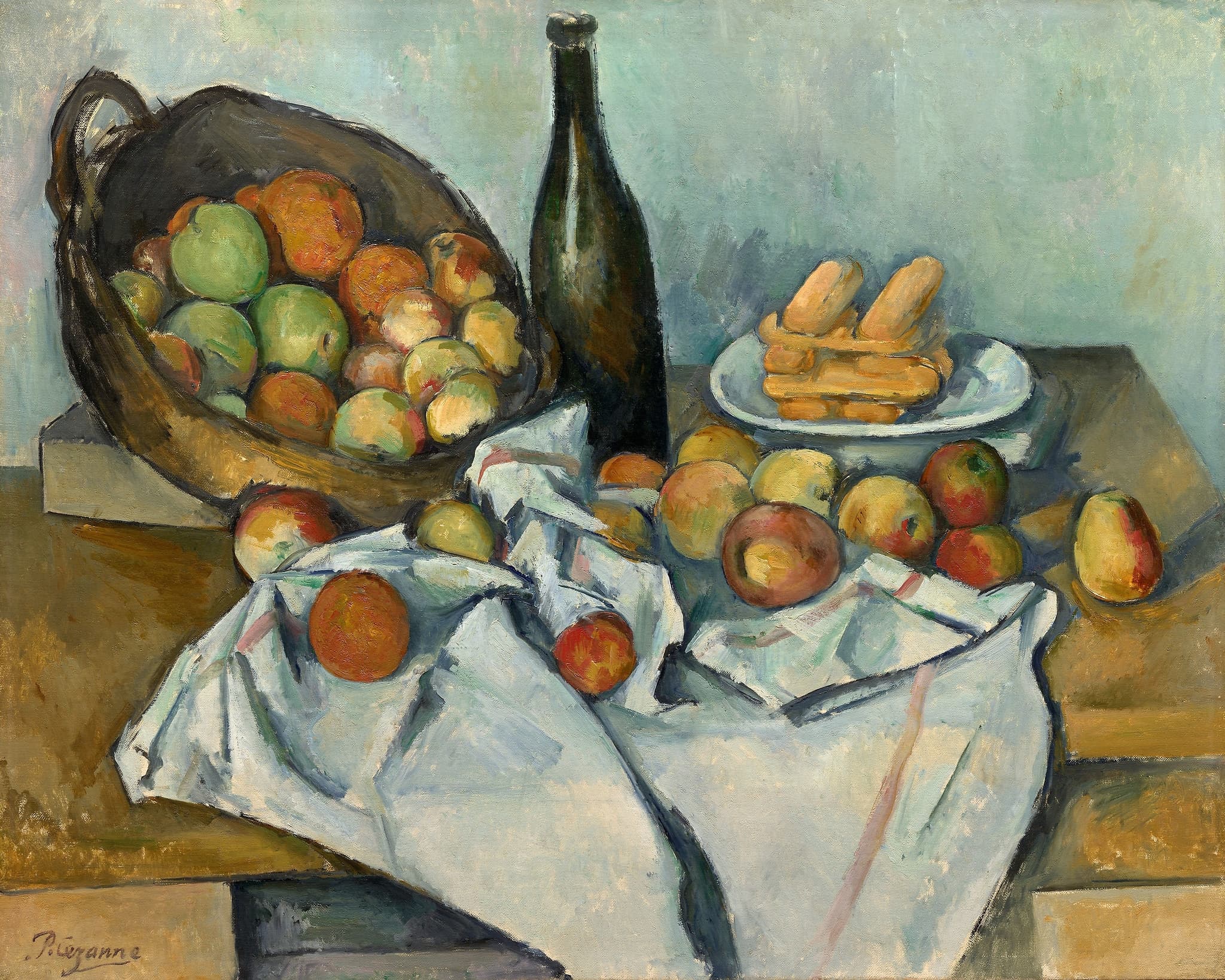
The Basket of Apples
Paul Cézanne, c. 1893 • Oil on canvas
Read full analysis of The Basket of Apples →Valuation Analysis
Conclusion: If hypothetically offered today, Paul Cézanne’s The Basket of Apples (Art Institute of Chicago) would command a trophy premium and likely achieve a price in the $180–240 million range. This estimate reflects the work’s canonical status within Cézanne’s still-life corpus, its continuous museum ownership since 1926, and its centrality in the development of modern painting. It is one of the most reproduced and discussed images in the artist’s oeuvre, featured prominently by the Art Institute and linked to Cézanne’s pivotal 1895 Vollard exhibition—pedigree that confers exceptional cultural and market weight [1].
Method: We employ an extrapolation-based approach anchored to the artist’s public and private price benchmarks. Cézanne’s standing auction record is $137.79 million for La Montagne Sainte‑Victoire (Christie’s, Paul G. Allen Collection, 9 Nov 2022) [2]. At the very top of the private market, The Card Players reportedly transacted around $250 million, establishing the willingness of global buyers to pay a quarter‑billion dollars for an apex Cézanne [3]. The Basket of Apples, while a still life rather than a figure group or landscape, is an icon of comparable art-historical magnitude.
Comparable evidence: Recent marquee sales of strong still lifes include Bouilloire et fruits at $59.3 million (Christie’s, 2019) and Fruits et pot de gingembre at $38.94 million (Christie’s, 2023, Museum Langmatt deaccession) [4]. Historically, Rideau, cruchon et compotier realized $60.5 million in 1999—long a benchmark for Cézanne still lifes [5]. These results, while far below the present estimate, involve works that are materially less renowned than The Basket of Apples and lack the same level of scholarly centrality and public recognition. The step‑change from ~$40–60 million for excellent still lifes to ~$180–240 million for this specific picture is justified by its singular emblematic status and the way the market prices global cultural symbols.
Demand and scarcity: Masterpiece‑level Cézannes are extraordinarily scarce; most peak examples reside in museums and are effectively off market. When trophies appear, deep international bidding, often underpinned by irrevocable bids or guarantees, creates competitive tension that lifts prices toward or beyond the artist’s record. The Basket of Apples is exactly the kind of cross‑category masterpiece that mobilizes institutional interest and top private collectors, with recognition far outside specialist circles [1][2].
Positioning: Placing this work between Cézanne’s public record ($137.79m) and the private apex (~$250m) triangulates a realistic outcome for a unique, era‑defining still life. Our $180–240 million range presumes museum‑grade condition typical of AIC holdings and contemporary sale mechanics. On today’s evidence set, this is the most probable clearing zone for a guaranteed, globally marketed offering of The Basket of Apples [2][3][4].
Key Valuation Factors
Art Historical Significance
High ImpactThe Basket of Apples is one of Cézanne’s most discussed and reproduced images, encapsulating his constructive brushwork, radical tabletop tilts, and spatial recalibrations that set the stage for Cubism. It is a staple of art‑historical discourse and museum education, and it participated in the artist’s 1895 Vollard exhibition—an early moment when Cézanne’s importance crystallized. Works that distill an artist’s breakthrough methodology command a premium because they function as cultural touchstones as much as artworks. The Art Institute of Chicago’s stewardship since 1926 further embeds the picture in the public imagination, amplifying its global recognition and institutional endorsement. In market terms, this level of canonical status reliably elevates value beyond what formal attributes alone would warrant.
Rarity and Market Scarcity
High ImpactMuseum‑quality Cézannes at this level almost never trade. The very top echelon—major Mont Sainte‑Victoire landscapes, The Card Players variants, and a handful of defining still lifes—are concentrated in institutions or long‑term private holdings. This scarcity creates a structural supply constraint that magnifies demand whenever a top example surfaces. Still lifes comparable in subject but not in renown have achieved $40–60 million at auction; the gap between those and The Basket of Apples reflects the rarity of a universally recognized masterpiece. In practical terms, the picture’s de facto inaccessibility intensifies hypothetical buyer interest, as ownership would confer a level of cultural capital rarely available in the market, encouraging aggressive bidding and strong guarantee terms.
Subject and Quality
High ImpactCézanne’s still lifes with apples, drapery, and skewed tabletops are among his most coveted subjects, and The Basket of Apples is often cited as a definitive statement of that motif. Its controlled palette, structural brushwork, and compositional invention exemplify the qualities collectors equate with the artist’s prime. Scale and pictorial ambition align with museum standards, and the work’s resolution—neither sketch nor variant—adds to its attractiveness. Within the hierarchy of Cézanne subjects, this still life stands in the first rank, just behind the absolute apex of Card Players/Bathers ensembles, but arguably on par with a top Mont Sainte‑Victoire in terms of broader public recognition and educational ubiquity, which supports a significant premium.
Provenance and Exhibition History
Medium ImpactThe painting has been in the Art Institute of Chicago since 1926 (Helen Birch Bartlett Memorial Collection), and it was included in Cézanne’s pivotal 1895 Vollard show. Such long, unbroken, blue‑chip provenance minimizes transactional and legal risk, bolsters scholarly confidence, and underscores institutional validation. AIC’s ongoing research, conservation standards, and visibility keep the work at the center of public discourse. Deep publication and exhibition histories typically correlate with stronger bidding pools because they reduce uncertainty and increase cultural recognition. While museum ownership makes a real‑world sale unlikely, the same provenance and exhibition credentials would be powerful value drivers in a hypothetical offering, differentiating it from otherwise strong but less pedigreed works.
Market Benchmarks and Trophy Demand
High ImpactCézanne’s auction record is $137.79 million (Christie’s, 2022), while the privately reported Card Players sale around $250 million establishes the top end of buyer willingness for apex works. Strong still-life comparables have realized $59.3 million (2019) and $38.94 million (2023), indicating robust demand even for examples below the absolute pinnacle. Trophy buyers—private collectors, family offices, and occasionally institutions—compete fiercely when a universally recognized masterpiece appears, often under guarantee structures that compress downside and support aggressive bidding. The Basket of Apples sits squarely in this ‘trophy’ tier. Bracketing the 2022 auction record and the private Card Players price logically places its fair market clearing range in the $180–240 million band.
Sale History
The Basket of Apples has never been sold at public auction.
Paul Cézanne's Market
Paul Cézanne is a top‑tier, blue‑chip cornerstone of the Modern canon with deep, global demand across private and institutional buyers. His standing auction record is $137.79 million for a Mont Sainte‑Victoire from the Paul G. Allen Collection (Christie’s, 2022). Supply of A‑plus oils is exceptionally thin; when they surface, competition is intense and supported by guarantees. Prime still lifes and Mont Sainte‑Victoire landscapes command the highest prices, while watercolors and drawings transact reliably in the six‑ and low‑seven‑figure range depending on subject and quality. Recent marquee sales, including a $38.94 million still life in 2023, confirm consistent appetite and price discipline for strong examples, with true masterpieces capable of resetting the artist’s public benchmarks.
Comparable Sales
Rideau, cruchon et compotier (Curtain, Jug and Fruit Bowl)
Paul Cézanne
Same artist; canonical 1890s still life with apples and tabletop distortions; long‑standing benchmark for Cézanne still lifes.
$60.5M
1999, Sotheby's New York
~$117.0M adjusted
Bouilloire et fruits (Kettle and Fruits)
Paul Cézanne
Same artist; prime museum‑level still life with fruit and vessel; recent marquee sale that calibrates late‑career still‑life demand.
$59.3M
2019, Christie's New York
~$74.7M adjusted
Fruits et pot de gingembre
Paul Cézanne
Same artist; late‑19th‑century still life with fruit and ginger jar; fresh 2023 result shows current pricing for strong still lifes.
$38.9M
2023, Christie's New York
~$41.1M adjusted
Nature morte aux fruits et pot de gingembre
Paul Cézanne
Same artist; c. 1895 still life closely aligned in subject and period (fruit/ginger jar); useful historical benchmark.
$37.0M
2006, Sotheby's New York
~$59.0M adjusted
La Montagne Sainte‑Victoire
Paul Cézanne
Same artist; different subject but A+ masterpiece and standing auction record; establishes current public ceiling for top Cézanne oils.
$137.8M
2022, Christie's New York
~$151.6M adjusted
Current Market Trends
At the very top of the Impressionist/Post‑Impressionist/Modern market, demand for singular, culturally resonant masterpieces remains strong despite cyclical variability. After a period of thinner supply and cautious bidding in 2024, recent seasons reaffirmed that buyers will stretch for museum‑quality icons, particularly under clear, well‑guaranteed sale structures. Lot volumes have risen at mid‑levels, but trophy‑level supply remains scarce, a dynamic that supports pricing when great material appears. For names like Cézanne, where the pool of truly A+ works is minuscule, a fresh-to-market masterpiece can catalyze global competition and challenge standing records. In this context, The Basket of Apples would be positioned to draw broad, cross‑category bidding and premium pricing.
Sources
- Art Institute of Chicago — The Basket of Apples
- Christie’s — Paul G. Allen Collection Sale Results (Nov 9, 2022)
- Vanity Fair — Qatar Buys Cézanne’s The Card Players for More Than $250 Million (2012)
- Christie’s — 20th Century Evening Sale Results (Nov 9, 2023)
- Guinness World Records — Most expensive painting of a still life (1999)