How Much Is The House of the Hanged Man Worth?
Last updated: January 20, 2026
Quick Facts
- Last Sale
- $1K (1899, Galerie Georges Petit, Paris (Vente Veuve Chocquet))
- Methodology
- comparable analysis
Hypothetical open‑market value for Cézanne’s The House of the Hanged Man (1873) is $120–180 million. The estimate is anchored to the $137.8m auction record for a Cézanne landscape and the work’s canonical status as a landmark of his early Auvers period, assuming unrestricted marketability and strong condition.
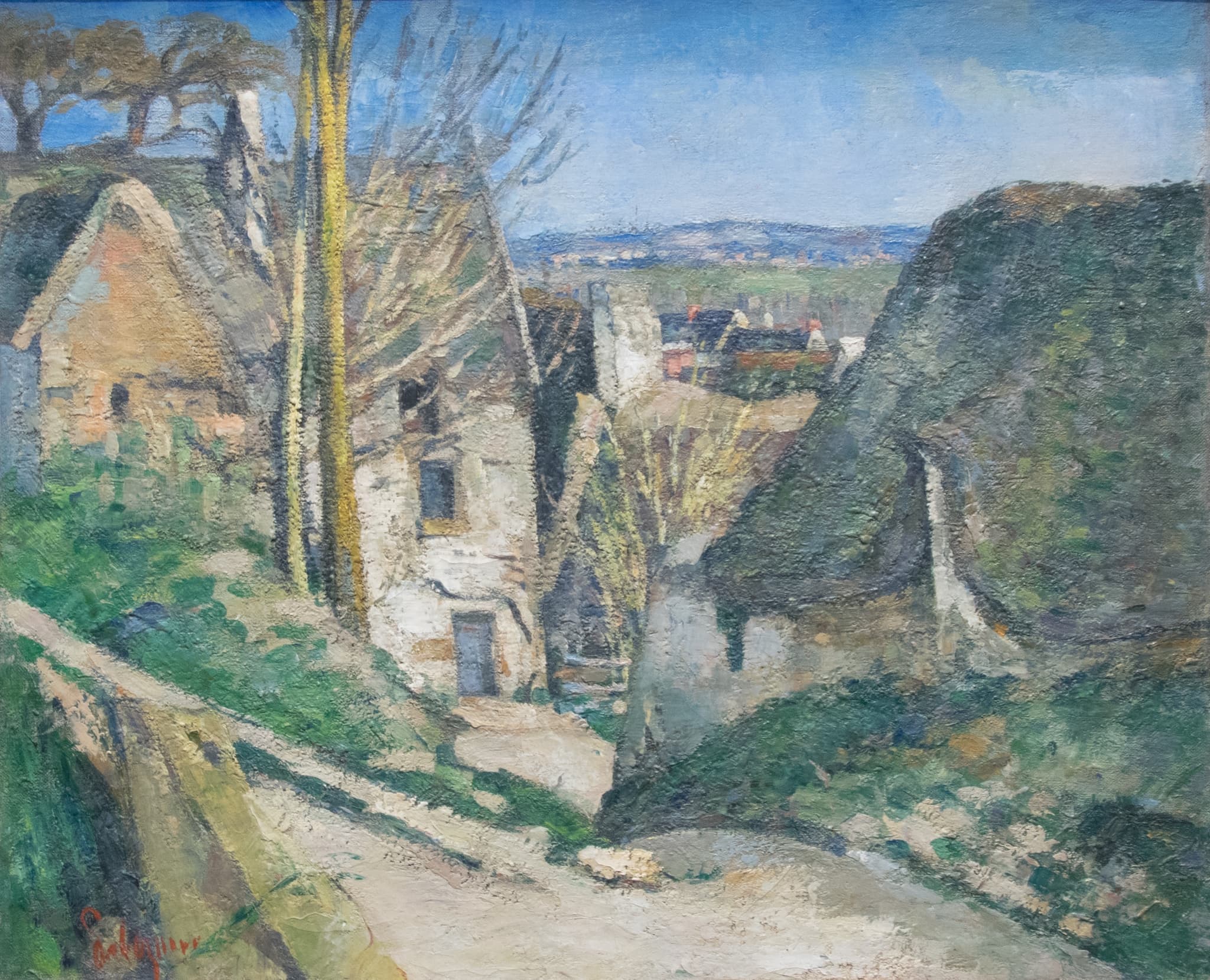
The House of the Hanged Man
Paul Cézanne, 1873 • Oil on canvas
Read full analysis of The House of the Hanged Man →Valuation Analysis
Conclusion: Our synthesized open‑market estimate for Paul Cézanne’s The House of the Hanged Man (La Maison du pendu, 1873) is $120–180 million. This range reflects the painting’s museum‑canonical status, seminal role in the artist’s development, and the current price architecture for masterpiece‑level Cézannes, while recognizing that the work is state property at the Musée d’Orsay and effectively off‑market [1][6].
Comparables and price architecture: The principal public benchmark is Christie's 2022 sale of La Montagne Sainte‑Victoire at $137.8 million (with fees), which reset Cézanne’s auction apex and establishes a contemporary ceiling for a trophy landscape by the artist [2]. At the private‑sale extreme, The Card Players reportedly traded for $250m+ in 2011, framing the ultimate ceiling for the most iconic subjects [3]. Against these anchors, The House of the Hanged Man is not a late, structurally distilled Sainte‑Victoire, yet it is a landmark of his early Auvers period, widely reproduced, and frequently cited in scholarship—supporting a value that overlaps the current auction record radius.
Art‑historical significance and provenance: Painted in 1873 in Auvers‑sur‑Oise, the work was shown in the First Impressionist Exhibition of 1874 and is often noted as the first Cézanne acquired by a collector. Its chain of ownership—from Doria to Chocquet to Isaac de Camondo’s bequest to the French state—confers exemplary pedigree and museum validation [1]. This deep exhibition and literature history materially enhances insurability and price confidence at the top end of the market.
Scarcity and market conditions: Supply of museum‑grade Cézannes is extremely thin; most top works reside in institutions. When trophy examples surface, bidding is highly competitive. Although the broader Impressionist/Post‑Impressionist segment experienced value contraction in 2023–24, recent cycles show a flight to quality: blue‑chip, canonical works continue to command premium pricing amid scarcity of top consignments [4]. In that context, La Maison du pendu would likely generate cross‑border museum and private‑collector competition.
Important caveat: As an inalienable French national collection object at the Musée d’Orsay, any transactional valuation is hypothetical and framed for insurance or academic benchmarking only [6]. The $120–180 million range assumes clear, unrestricted marketability, standard irrevocable‑bid/guarantee structures, and strong condition supported by modern technicals. Upside into record‑territory remains plausible with multiple trophy‑level bidders; conversely, any material condition compromise or legal/marketability constraint could narrow the outcome toward the lower band.
Key Valuation Factors
Art Historical Significance
High ImpactLa Maison du pendu is a cornerstone of Cézanne’s early 1870s Auvers period under Pissarro’s influence and a key exhibit from the First Impressionist Exhibition of 1874. It signals the shift from Impressionist observation toward the structural innovations that define Cézanne’s legacy and his critical role in the emergence of modern art. The work’s frequent reproduction in scholarship and textbooks cements its canonical status. This centrality within the oeuvre—while not as globally symbolic as the late Sainte‑Victoire series—still places it among the artist’s most studied landscapes. Such institutional and academic validation supports a valuation within striking distance of the artist’s top auction benchmark.
Rarity and Supply Dynamics
High ImpactMasterpiece‑quality Cézannes are exceptionally scarce on the open market; the majority are held by museums or long‑term private collections. When works of this stature surface, they attract global trophy buyers and often institutions, creating compressed, competitive bidding environments. The paucity of truly comparable early landscapes of this caliber heightens substitution pressure from adjacent categories (e.g., still lifes, late landscapes), further supporting pricing toward the top of the artist’s range. The 2022 record for a major landscape underscores the depth of demand when high‑quality examples are available, a dynamic that would likely recur for a museum‑grade early landmark.
Subject and Period Prestige
Medium ImpactWhile late Mont Sainte‑Victoire canvases tend to command the absolute apex with collectors, this 1873 Auvers subject carries powerful narrative weight: it captures Cézanne’s breakthrough moment integrating Impressionist practice with the structural, architectonic approach that shaped modernism. Collectors prize such “turning‑point” works for their historical resonance. That said, some buyers prioritize the late period’s crystalline formal language, which can slightly moderate pricing relative to late‑period icons. Even so, the painting’s status as a textbook early masterpiece, its 1874 exhibition history, and widespread recognition make it a top‑tier target within the oeuvre.
Provenance, Exhibition, and Institutional Validation
High ImpactThe work’s provenance—passing from Doria to Chocquet and then to Isaac de Camondo before entering the French national collection—constitutes a gold‑standard ownership chain. Its inclusion in foundational exhibitions and sustained museum display at the Musée d’Orsay provide unparalleled institutional validation. Such factors reduce transactional risk, bolster buyer confidence, and support strong insurance valuations. In a hypothetical sale, this pedigree would be prominently marketed, likely deepening the pool of potential bidders and justifying pricing in the upper band of the proposed range, subject to a corroborating modern condition report and technical imaging.
Sale History
Galerie Georges Petit, Paris (Vente Veuve Chocquet)
Sold as part of lot 106; realized 6,200 FRF; adjudicated to Isaac de Camondo. USD figure is an approximate 1899 conversion.
Paul Cézanne's Market
Paul Cézanne sits in the ultra–blue‑chip tier with extremely limited supply at the top end and sustained, global demand from museums and leading private collections. His current auction record is $137.8 million for La Montagne Sainte‑Victoire (Christie’s, 2022), which more than doubled his long‑standing prior peak and re‑set the market’s ceiling for a trophy landscape. Private‑sale reporting places The Card Players above $250 million (2011), framing the ultimate brand ceiling for the artist’s most iconic subjects. High‑quality still lifes regularly occupy the $40–60 million band, and smaller works trade well below that, underscoring a steep, quality‑driven price curve. In short, competition is deepest for canonical, museum‑grade examples with ironclad provenance.
Comparable Sales
La Montagne Sainte‑Victoire
Paul Cézanne
Same artist and category (landscape); a museum‑caliber, canonical motif that sets the current public apex for a Cézanne landscape.
$137.8M
2022, Christie's New York
~$154.3M adjusted
L’Aqueduc du canal de Verdon au nord d’Aix
Paul Cézanne
Same artist and subject type (landscape); mid‑period work with strong provenance, illustrating pricing for non‑trophy Cézanne landscapes.
$8.6M
2023, Christie's London
~$9.2M adjusted
La mer à l’Estaque
Paul Cézanne
Same artist and subject type (landscape); 1870s view offering a lower‑tier early‑period landscape benchmark.
$3.2M
2023, Christie's New York
~$3.4M adjusted
Fruits et pot de gingembre
Paul Cézanne
Same artist; blue‑chip still life category used by the market to price peak Cézanne quality even when subject differs from landscape.
$38.9M
2023, Christie's New York
~$40.9M adjusted
Bouilloire et fruits
Paul Cézanne
Same artist; top‑tier still life indicating sustained demand for A‑quality Cézannes near the $60m band (pre‑2022 record reset).
$59.3M
2019, Christie's New York
~$74.1M adjusted
Rideau, cruchon et compotier
Paul Cézanne
Same artist; category‑defining still life and long‑standing auction record prior to 2022, framing the upper bound for masterpiece‑level Cézannes.
$60.5M
1999, Sotheby's New York
~$118.0M adjusted
Current Market Trends
Impressionist/Post‑Impressionist auctions softened in value through 2024 on fewer trophy consignments, even as lot volumes rose. In 2025, momentum improved selectively, with a clear flight to quality: blue‑chip, institutionally validated works outperformed while speculative segments lagged. Scarcity remains the defining feature—especially for masterpieces by canonical names like Cézanne—so when works of high importance emerge, competition intensifies and pricing remains resilient. Guarantees and irrevocable bids continue to shape outcomes at the top end. In this environment, a museum‑caliber early Cézanne would likely clear at or above recent artist benchmarks, provided condition, market access, and sale orchestration are optimal.
Sources
- Musée d’Orsay – La Maison du pendu, Auvers‑sur‑Oise
- Christie’s – Paul G. Allen Collection sale results (Cézanne record)
- Vanity Fair – Qatar Buys Cézanne’s The Card Players for $250 Million
- Art Basel & UBS – The Art Market report (Auctions overview)
- Société Cézanne – 1899 Chocquet sale (press tallies)
- Joconde (French national collections) – Object record and legal status