How Much Is The Descent from the Cross Worth?
Last updated: February 25, 2026
Quick Facts
- Methodology
- comparable analysis
Peter Paul Rubens’s The Descent from the Cross (central panel of the Antwerp Cathedral triptych) has never been commercially traded, but it is a career-defining Baroque masterpiece. Anchored to Rubens’s top auction benchmarks and major state-backed Old Master acquisitions, a realistic open‑market estimate is $150–300 million, assuming clear title and export permission.
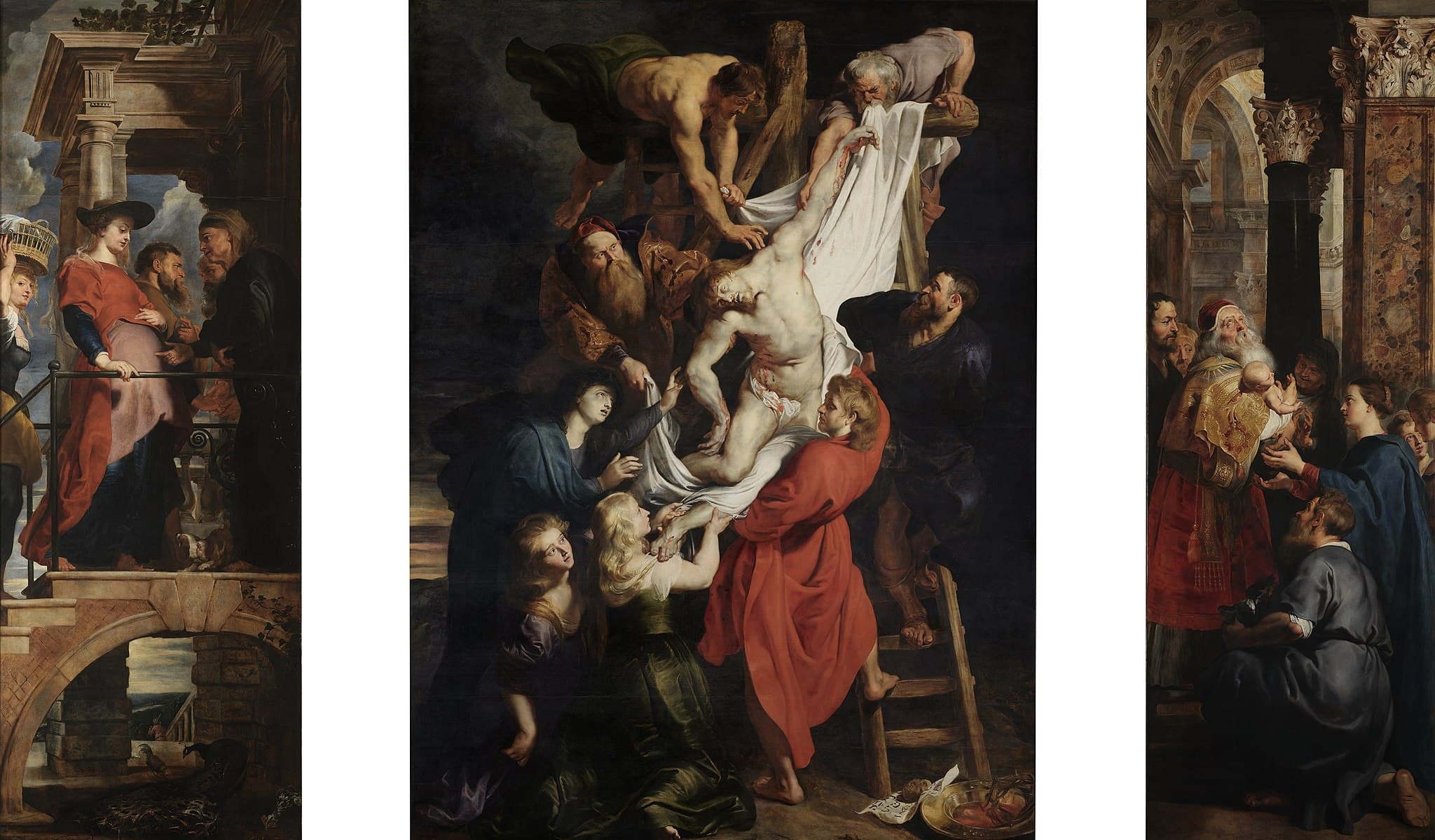
The Descent from the Cross
Peter Paul Rubens, 1611–1614 • Oil on panel (oak)
Read full analysis of The Descent from the Cross →Valuation Analysis
Overview and status: Rubens’s The Descent from the Cross (central panel of the triptych for the Confraternity of the Arquebusiers) was designed for, and remains in, the Cathedral of Our Lady in Antwerp. Commissioned in 1611 and installed by 1614, it has never been sold; wartime seizures in the 1790s and 1914 were followed by restitutions, not market transactions [1][2]. As a premier heritage object, it would fall under Flemish Masterpieces (Topstukken) protections that severely restrict export, making any real‑world sale extraordinarily unlikely [3].
Market anchors for a hypothetical valuation: Because there is no sale history for this altarpiece, the estimate is derived from best‑available comparables. Rubens’s auction apex is The Massacre of the Innocents, sold for £49.5m in 2002 (≈$76.7m then) [4]. Subsequent marquee results include Lot and his Daughters at £44.88m in 2016 (≈$58.2m) [5] and Salome Presented with the Head of Saint John the Baptist at $26.9m in 2023 [6]. The Antwerp Descent is more ambitious, celebrated, and institutionally coveted than any of these traded works, warranting a substantial premium over Rubens’s public record.
Cross-artist benchmarks and ceiling: For state‑caliber Old Masters, the Louvre/Rijksmuseum’s joint €160m acquisition of Rembrandt’s pendant portraits (≈$180m at 2016 rates) and the UK’s joint purchases of Titian’s Diana and Actaeon and Diana and Callisto for a combined ~£95m (≈$150m) set relevant guideposts [7][8]. Leonardo’s Salvator Mundi at $450.3m is the outlier ceiling for a uniquely rare Renaissance trophy [9]. A canonical, fully autograph Rubens altarpiece logically prices above his own auction records and within the institutional‑acquisition band established by Rembrandt/Titian, but below the Leonardo outlier.
Conclusion and range: Assuming clear, unrestricted title and export permission, we estimate an open‑market value of $150–300 million. The lower bound reflects a conservative premium over Rubens’s auction record, adjusted for the work’s unmatched renown; the upper bound anticipates competition from multiple sovereign or museum‑backed buyers. Condition, technical findings, and any authorship nuance would be decisive within this band. In practical terms, Flemish heritage law would likely preclude an exportable sale, but on a pure market basis this is a $150–300 million picture [1][3][4][7][8].
Key Valuation Factors
Art Historical Significance
High ImpactThe Descent from the Cross stands among Rubens’s most important achievements, a Baroque masterwork that codifies Counter‑Reformation drama, color, and pathos at monumental scale. Paired historically with The Elevation of the Cross, it is a defining image of Rubens’s Antwerp years and widely reproduced, taught, and exhibited. The central panel’s luminous choreography of bodies, its theological resonance, and its pivotal place in Rubens’s development mean that it sits at the very apex of his oeuvre. Works with this degree of canonicity typically attract universal institutional interest, translating directly into price leadership. In short, art‑historical weight for this painting is maximal, justifying a substantial premium over any traded Rubens of lesser renown.
Rarity and Market Liquidity
High ImpactLarge, fully autograph Rubens altarpieces of unassailable provenance almost never appear on the market. The artist’s public auction record—set by a prime, multi‑figure biblical scene—underscores how infrequently true masterpieces trade and how deep bidding can be when they do. By contrast, most available Rubens works today are oil sketches, studies, or smaller panels, typically in the low‑ to mid‑seven figures. This scarcity dynamic compounds for a work of this fame and scale: it would activate both the institutional and private‑museum buyer base globally. In valuation terms, extreme rarity and universal demand for a singular masterpiece create the conditions for a meaningful step‑up from the artist’s existing auction benchmarks.
Condition and Authorship
High ImpactFor an early‑seventeenth‑century oil‑on‑panel of this size, panel stability, surface condition, varnish, and the extent of historical restoration materially affect value. The central panel is widely accepted as autograph Rubens; any credible challenge to authorship, or evidence of excessive overpaint, structural movement, or compromised passages, would depress price. Conversely, a clean technical bill of health with tasteful historic interventions and strong underdrawing/hand evidence would support the top of the range. Given the absolute caliber of the work and its constant ecclesiastical custody, the presumption is of rigorous care; however, a current technical report would be price‑critical in real‑world negotiations for values in the hundreds of millions.
Legal and Heritage Constraints
Medium ImpactThe painting is protected as premier Flemish cultural heritage. Under the Masterpieces (Topstukken) Decree, export can be refused, with the government retaining pre‑emption rights at international market value. In practice, such protections make a private, exportable sale extraordinarily improbable and could redirect any transaction into a state acquisition framework. For a hypothetical open‑market valuation, we assume clear title and export permission; nonetheless, awareness of this legal backdrop matters because it narrows the practical buyer universe and introduces procedural timelines and funding mechanisms that can modulate price discovery. The effect is less on intrinsic value and more on the likelihood and structure of any realization at the top end.
Sale History
The Descent from the Cross has never been sold at public auction.
Peter Paul Rubens's Market
Peter Paul Rubens is a top‑tier Old Master whose fully autograph, large‑scale history paintings are exceptionally scarce on the market. His auction record stands with The Massacre of the Innocents at £49.5m (Sotheby’s London, 2002), followed by Lot and his Daughters at £44.88m (Christie’s London, 2016), and Salome Presented with the Head of Saint John the Baptist at $26.9m (Sotheby’s New York, 2023). While oil sketches and studies remain relatively liquid in the seven‑figure band, eight‑figure results are reserved for prime, museum‑quality works. Institutional interest is consistently strong, and sovereign or museum‑backed buyers often surface for the rarest pictures. Against a selective Old Masters market, Rubens retains broad, cross‑regional demand and a robust ceiling for masterpieces with bullet‑proof provenance and attribution.
Current Market Trends
Old Masters experienced a broad soft patch in 2024, with fewer $10m+ auction lots, before rebounding in 2025–2026 as best‑in‑class consignments returned and institutional buyers re‑engaged. Category depth remains selective: drawings and rediscoveries performed strongly, and headline works by canonical names attracted vigorous competition. For Baroque painting in particular, supply is the primary constraint; when significant pictures appear—especially with secure authorship and strong condition—prices remain resilient to broader market volatility. State and museum acquisitions continue to set credible price references at the high end, while private buyers emphasize due diligence and trophy quality. In this environment, a canonical Rubens altarpiece would command substantial premiums over the artist’s auction record.
Sources
- Encyclopaedia Britannica — Descent from the Cross by Rubens
- Wikipedia — The Descent from the Cross (Rubens, 1612–1614)
- Flemish Government — Topstukkendecreet (Masterpieces Decree)
- The Independent — Lost Rubens fetches record £49.5m at auction (2002)
- Christie’s Press — Rubens’s Lot and his Daughters achieves £44,882,500 (2016)
- Sotheby’s — Rubens and Bronzino Lead Masters Week to $100m Sales (2023)
- The Art Newspaper — France and Netherlands finalise €160m Rembrandt treaty (2016)
- National Galleries of Scotland — Titian’s Diana and Actaeon and Diana and Callisto
- Christie’s — Leonardo da Vinci, Salvator Mundi (2017 sale highlight)