How Much Is The Garden of Eden with the Fall of Man Worth?
Last updated: February 25, 2026
Quick Facts
- Methodology
- comparable analysis
The Mauritshuis Garden of Eden is a co-signed collaboration by Jan Brueghel the Elder and Peter Paul Rubens, widely regarded as the preeminent ‘paradise’ composition of the Flemish Baroque. Anchored by Rubens’s top auction benchmarks and rare Old Master trophies that have crossed $90m at auction and ~€160m privately, a fully marketed, unconstrained sale would command $120–200 million.
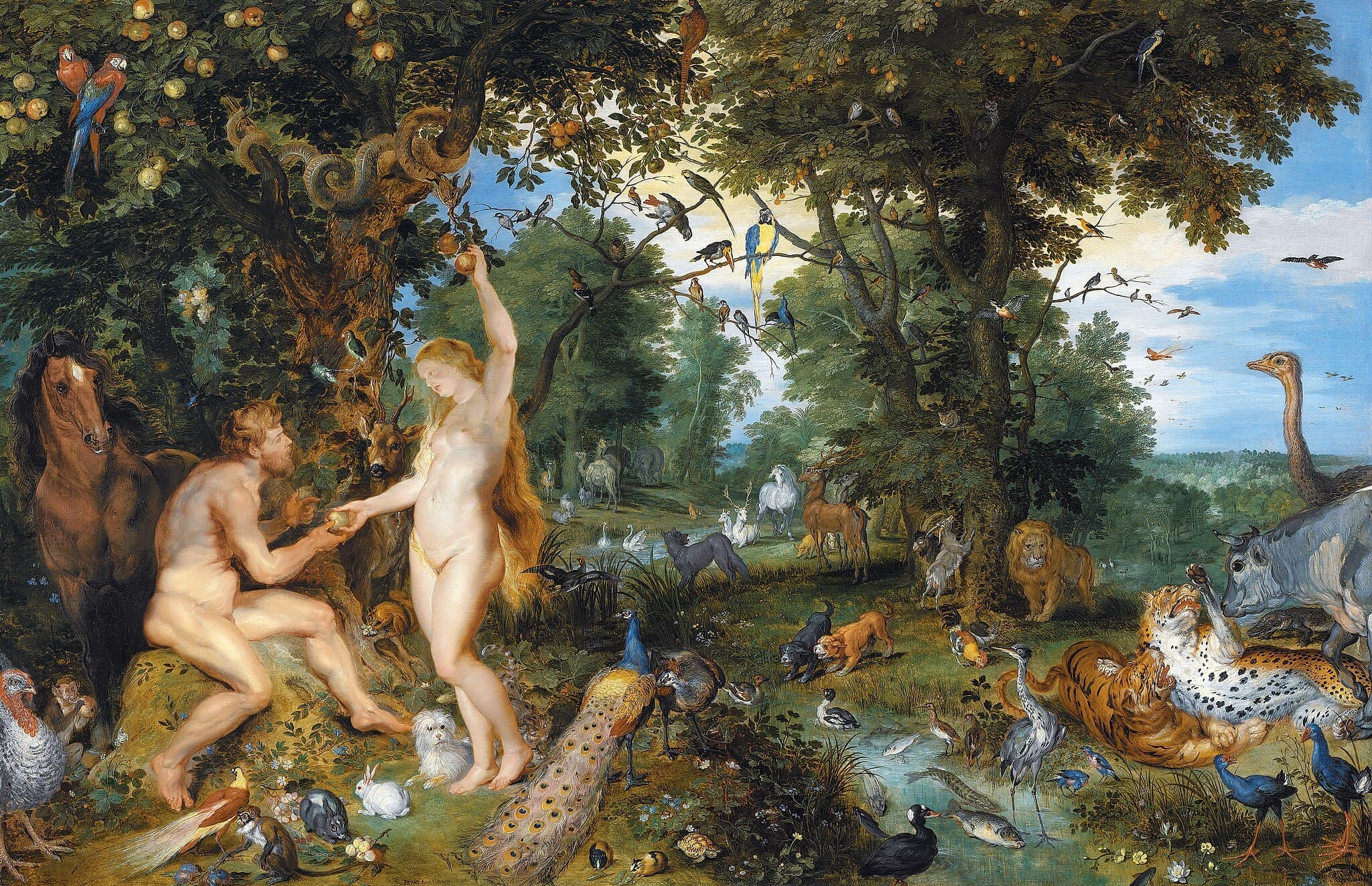
The Garden of Eden with the Fall of Man
Peter Paul Rubens, c. 1615 • Oil on panel
Read full analysis of The Garden of Eden with the Fall of Man →Valuation Analysis
Estimate: $120–200 million (theoretical). This valuation synthesizes top-tier Old Master benchmarks and the painting’s singular status as a co-signed masterpiece by Jan Brueghel the Elder and Peter Paul Rubens, circa 1615, oil on panel, 74.3 × 114.7 cm, Mauritshuis, The Hague [1]. While the work is not for sale and is subject to museum stewardship and likely national protections, the estimate reflects what a fully marketed, unconstrained international sale could achieve.
Method and anchors. The range is derived from comparable analysis across two axes: (i) Rubens’s apex auction prices and (ii) the broader ceiling for museum-grade Old Masters. Rubens’s public auction record remains The Massacre of the Innocents at £49.5m (about $76.7m at the time) [2], with Lot and His Daughters at $58.2m in 2016 [3] and a recent high-water mark at $26.9m for Salome in 2023 [4]. Cross-category signals include Botticelli’s Portrait of a Young Man Holding a Roundel at $92.2m (2021) [5] and the private, joint acquisition of Rembrandt’s pendant full-lengths for ~€160m (c.$180m) in 2016 [6]. Together, these results confirm that canonical, widely recognized pre-1800 masterworks can transact in the nine figures.
Why this work warrants a premium. The Mauritshuis panel is arguably the most famous Brueghel–Rubens collaboration, co-signed by both artists, marrying Brueghel’s zoological ‘paradise’ virtuosity with Rubens’s Adam-and-Eve figuration in a prime-period conception [1]. Such collaborations are exceptionally scarce on the market and carry an art-historical scarcity premium above most single-author cabinet pictures. The subject—Creation, the Fall, and a tour-de-force menagerie—has unusually broad cross-collector appeal (Old Master, biblical narrative, courtly/animalia, and natural-history audiences), supporting deep demand at the trophy level.
Positioning within the comps. On qualitative grounds, this painting sits above the bulk of single-author Rubens works seen at auction over the past two decades. It would be expected to exceed the $50–80m band typical of large autograph Rubens auction records and to compete in the zone established by the most visible Old Master trophies of the past decade. Hence the $120–200m range: the lower bound reflects thinner liquidity for nine-figure Old Masters; the upper bound acknowledges the work’s iconic status, double authorship, and extreme rarity, while remaining below the Rembrandt pair’s private-treaty apex [2–6].
Key sensitivities. This estimate assumes clear title, exportability, and top condition consistent with a major Mauritshuis holding. Any material condition, attributional, or legal/export constraint would compress the outcome. Conversely, intense global competition in a guarantee-backed, fully marketed sale could test the upper band or beyond. Given its stature and co-signed authorship, the painting would be among the most valuable Flemish Baroque works hypothetically available today [1–6].
Key Valuation Factors
Art Historical Significance
High ImpactThis painting is a keystone in the Brueghel–Rubens partnership: a co-signed tour de force uniting Brueghel the Elder’s consummate paradise menagerie with Rubens’s Adam and Eve. It is among the most frequently reproduced and discussed Eden images of the seventeenth century and a touchstone for both artists’ oeuvres. The painting encapsulates major currents of the Flemish Baroque—Catholic narrative, courtly taste, natural-history curiosity—within a single, highly legible icon. Its placement in the Mauritshuis canon and extensive scholarly literature amplify its cultural and pedagogical weight, elevating it above most single-author cabinet pictures and supporting a trophy-level valuation that competes with the top tier of Old Masters.
Rarity and Market Scarcity
High ImpactFully co-signed Brueghel–Rubens paradise compositions are exceptionally rare in private hands; the handful of top-quality collaborations of this type are institutionally held. Scarcity is even more acute for works that remain canonical in survey texts and permanent displays. Rubens’s market at the apex level is also supply-constrained: only a few autograph, prime-period, large-scale works have surfaced in recent decades. This double scarcity—of the collaboration and of blue-chip Rubens trophies—creates a strong scarcity premium. When a masterwork with these credentials hypothetically enters an unconstrained sale, competition from global collectors and institutions tends to compress price resistance and push results into the nine-figure range.
Subject, Scale, and Aesthetic Appeal
High ImpactThe Garden of Eden with the Fall of Man unites a universally recognized biblical narrative with an encyclopedic array of animals, fruits, and flora—elements that broaden appeal beyond traditional Old Master buyers to cross-category collectors. The format (approx. 74 × 115 cm) is large enough for significant wall presence while remaining manageable for private display and museum loan rotations. The composition’s narrative clarity, coloristic richness, and detail density invite prolonged viewing and scholarly engagement. These attributes align with recent top-performing Old Master trophies: compelling subjects with immediate visual impact, rich surface quality, and broad cultural resonance that catalyze competitive bidding.
Provenance, Exhibition, and Institutional Cachet
Medium ImpactThe picture’s distinguished history—long associated with princely and national collections before entering the Mauritshuis—adds reputational weight and reduces due-diligence friction. Continuous museum visibility and extensive literature strengthen confidence in attribution and condition oversight. While institutional ownership means the work is not practically for sale, that very cachet reinforces its standing as a definitive masterpiece. In a hypothetical transaction, such pedigree enhances underwriting confidence, supports robust guarantees, and expands the buyer pool to leading private collections and institutions, all of which are consistent with nine-figure outcomes for canonical Old Masters.
Condition, Authorship Balance, and Technical State
Medium ImpactValue at the top tier is highly sensitive to condition and the extent of direct authorship. Here, both artists are credited and sign the panel, and current scholarship places Rubens’s hand in the principal figures and Brueghel’s in the landscape and animals. A recent, transparent conservation record with IRR/X‑ray would be expected. The present estimate assumes stable support, legible original surface, and minimal later intervention relative to age. Any significant structural issues, overpaint, or reduction in the clarity of the two hands would compress the upper bound; conversely, exemplary condition and fresh technical scholarship would reinforce the premium attached to this collaboration.
Sale History
The Garden of Eden with the Fall of Man has never been sold at public auction.
Peter Paul Rubens's Market
Peter Paul Rubens sits at the pinnacle of the Old Master market, with deep, global demand from top private collectors and institutions. His all-time auction record is The Massacre of the Innocents at £49.5m (c.$76.7m at the time), followed by Lot and His Daughters at $58.2m, demonstrating sustained capacity for $50m–$80m auction outcomes for large, autograph masterpieces. More recently, Salome presented with the head of Saint John the Baptist achieved $26.9m (2023), underscoring appetite when high-quality, fresh works appear. Supply tightly governs results: many major Rubens paintings are in museums, so public offerings skew to oil sketches and rediscoveries. When a museum-caliber painting surfaces, competition is intense and guarantees are common, supporting strong price formation.
Comparable Sales
The Massacre of the Innocents
Peter Paul Rubens
Same artist; early 1610s autograph masterpiece of grand scale and renown; top public auction benchmark for Rubens and for Baroque trophies; calibrates the upper tier for a museum‑grade Rubens painting.
$76.7M
2002, Sotheby's London
~$136.5M adjusted
Lot and His Daughters
Peter Paul Rubens
Same artist; high‑quality, large Old Testament subject from Rubens’s maturity; recent blue‑chip auction result setting a major modern anchor for autograph Rubens paintings.
$58.2M
2016, Christie's London
~$77.4M adjusted
Salome presented with the head of Saint John the Baptist
Peter Paul Rubens
Same artist; major Baroque narrative painting with strong condition and rediscovery story; most recent third‑highest public auction price for Rubens, showing current demand for prime works.
$26.9M
2023, Sotheby's New York
~$28.3M adjusted
Portrait of a Young Man Holding a Roundel
Sandro Botticelli
Cross‑artist Old Master trophy with global name recognition; establishes recent nine‑figure auction ceiling for pre‑1800 masterpieces and helps frame potential for a celebrated, museum‑grade work.
$92.2M
2021, Sotheby's New York
~$108.8M adjusted
Portraits of Marten Soolmans and Oopjen Coppit (pair)
Rembrandt van Rijn
Cross‑artist, same era; apex Old Master private‑treaty benchmark showing that canonical 17th‑century masterpieces with exceptional provenance can command mid‑to‑high nine figures.
$180.0M
2016, Private sale (joint acquisition by the Louvre and Rijksmuseum)
~$239.4M adjusted
Current Market Trends
The Old Master category experienced a muted 2024 amid light supply, then regained momentum in 2025 on quality consignments and disciplined estimates. Top results cluster around works with watertight attributions, marquee subjects, and strong provenance, and there is increasing reliance on private sales for the very best material. Nine-figure outcomes remain rare but feasible for canonical names with global recognition, evidenced by Botticelli’s $92m portrait at auction and Rembrandt’s pendant portraits selling privately around €160m. In this context, a co-signed Brueghel–Rubens ‘paradise’ masterpiece—if hypothetically free to trade—would sit at the apex of demand, with cross-collector appeal and limited direct competition.
Sources
- Mauritshuis – The Garden of Eden with the Fall of Man (Jan Brueghel the Elder and Peter Paul Rubens)
- Forbes – Rubens Painting Sells For Record $76 Million (2002)
- Christie’s Press – Rubens’s Lot and His Daughters achieves £44,882,500 (2016)
- Sotheby’s – Rubens and Bronzino Lead Masters Week to $100m Sales (2023)
- Sotheby’s – Botticelli Portrait achieves $92.2 Million (2021)
- The Art Newspaper – France and Netherlands finalise €160m Rembrandt treaty (2016)