How Much Is The Judgement of Paris Worth?
Last updated: March 20, 2026
Quick Facts
- Methodology
- comparable analysis
For a museum-quality, fully-autograph The Judgement of Paris by Peter Paul Rubens offered to market today, I estimate a realized range of $100–$150 million. This presumes unambiguous autograph attribution, large scale, excellent condition and strong provenance; workshop or copy attributions will reduce value sharply.
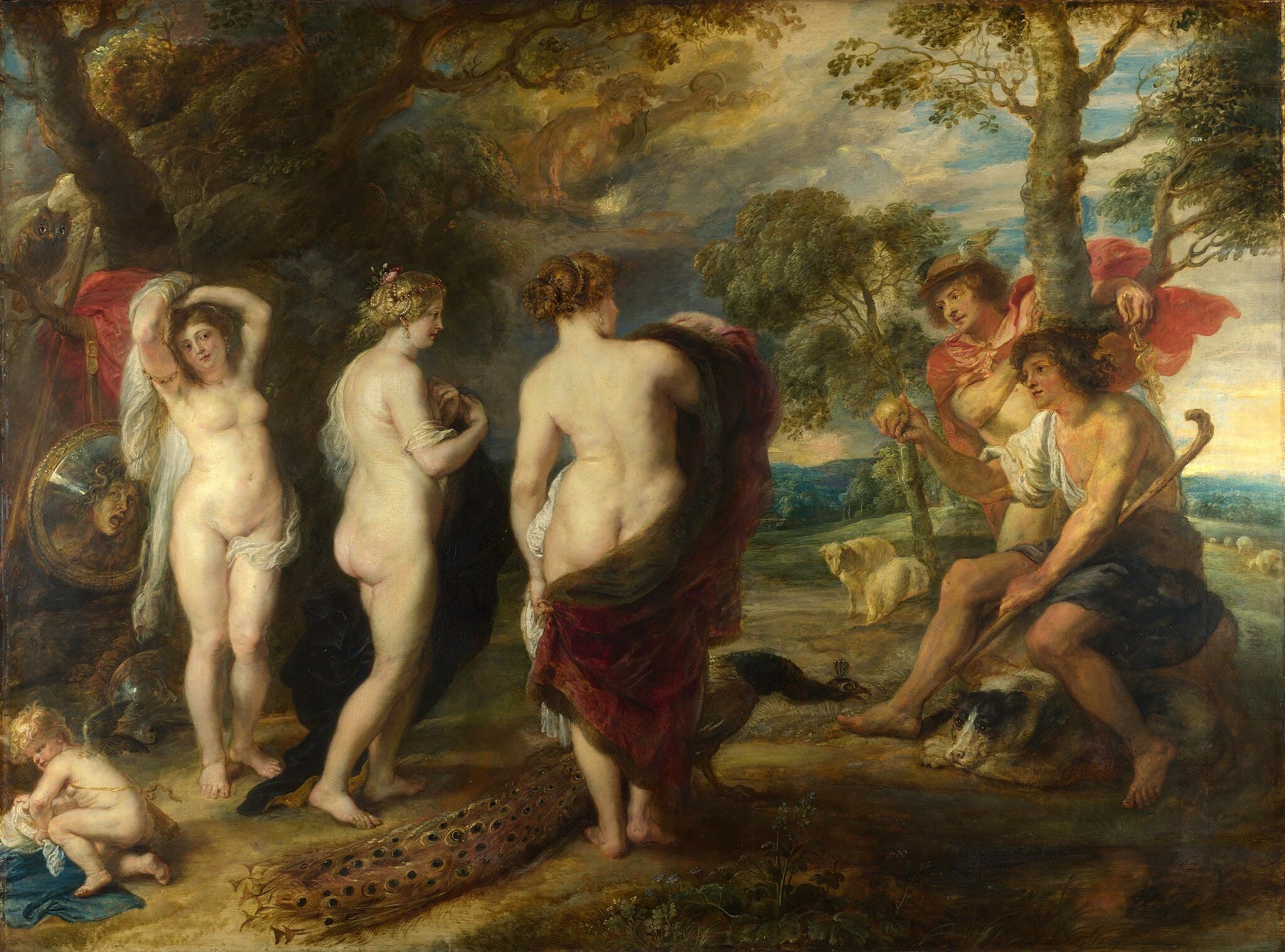
The Judgement of Paris
Peter Paul Rubens • Oil on canvas
Read full analysis of The Judgement of Paris →Valuation Analysis
Valuation conclusion: For a museum-quality, fully autograph version of Peter Paul Rubens' The Judgement of Paris offered to the market today, I place a realistic realized range at $100–$150 million. This estimate assumes unquestioned autograph attribution to Rubens, large scale and excellent condition, plus a continuous or demonstrably important provenance and catalogue raisonne entry. It is based on comparable auction anchors, recent high-value rediscoveries, and the scarcity of comparable multi-figure mythological canvases in private hands [1][2].
The market ceiling for Rubens is established by marquee sales that continue to function as the principal anchor points. The 2002 sale of The Massacre of the Innocents remains the artist's highest benchmark; it sold in 2002 for a reported £49,506,648 (about $77M at the time) and, when inflation-adjusted to recent dollars, underpins a low-hundreds-of-millions upper bound for a canonical Rubens masterpiece [3]. More recent authenticated rediscoveries and sales (for example results in 2023 near the mid-to-high tens of millions) show strong demand for properly attributed single-canvas Rubens works but also demonstrate dispersion by condition, provenance and scale [2]. These anchors together justify a $100–$150 million band for a top-tier Judgement that meets all scholarly, technical and provenance tests.
Attribution and condition are decisive. A fully confirmed Rubens attribution, supported by infrared reflectography, X-radiography, varnish and pigment analysis and acceptance in the Corpus Rubenianum or a modern catalogue raisonne, is a precondition for the 100–150 million band. Any suggestion of substantial studio participation, significant repainting, or unresolved authorship will reduce the value spectrum dramatically to the workshop and follower bands, typically in the low hundreds of thousands to a few million. A comprehensive technical and conservation dossier is therefore essential before marketing the work [1].
Provenance and exhibition history materially alter market outcomes. Works tied to early inventories, major European collections, or sustained exhibition histories invite institutional participation and competitive bidding; the fact that autograph Judgement compositions are held by major museums explains why privately offered examples are exceptionally rare and attract concentrated demand [1][4]. When a true masterpiece does appear, auction houses and dealers commonly deploy guarantees, pre-sale institutional outreach and private-treaty options, all of which influence final realized proceeds and the buyer pool.
Conclusion and next steps: Given auction anchors, rarity and buyer dynamics, a defensible realized range for a top-tier, fully authenticated The Judgement of Paris by Rubens is $100–$150 million. If you are advising an owner, immediate priorities are a full technical report, provenance consolidation, authoritative catalogue raisonne placement and confidential pre-sale consultations with leading Old Master specialists and the major auction houses to choose the optimal sales channel and any guarantees. If the work proves to be workshop or later copy, expect valuations to fall into the substantially lower bands previously outlined.
Key Valuation Factors
Art Historical Significance
High ImpactThe Judgement of Paris is a central mythological subject in the Baroque repertoire and a vehicle for Rubens' virtuoso handling of the nude, color and complex figural grouping. In Rubens' oeuvre large mythological canvases occupy a privileged position because they demonstrate compositional invention, narrative complexity and the integration of workshop practice. A canonical autograph Judgement appeals strongly to museums and top private collectors because it fills curatorial and scholarly needs, can anchor exhibitions and generate major catalogue and interpretive work. Auction houses and institutions prize such works for their ability to draw audiences and justify acquisition budgets, which translates directly into higher market valuation when attribution and documentation are secure.
Attribution and Authenticity
High ImpactAttribution is the single most important determinant of value. A market-leading result requires concordant evidence from connoisseurship and technical methods: infrared reflectography to reveal underdrawing and compositional pentimenti, X-radiography for paint layers and alterations, pigment and ground analyses to verify period materials, and placement in the Corpus Rubenianum or a modern catalogue raisonne. Where these lines of evidence are complete and accepted by leading specialists, market confidence supports top-tier pricing. Where authorship is contested or significant areas are demonstrably by studio hands, price expectations collapse, often by an order of magnitude.
Condition and Conservation
Medium ImpactCondition strongly influences marketability and price. Important issues include structural canvas stability, relining history, varnish discoloration, inpaint and overpainting, paint loss and craquelure patterns. Even with firm attribution, heavy or poorly documented restoration reduces institutional appetite and competitive bidding. A clear conservation history and a current condition report mitigate buyer risk and support higher estimates, whereas unresolved conservation problems or unstable paint layers will diminish value and restrict the buyer pool. Investment in professional conservation documentation is therefore essential before going to market.
Provenance and Exhibition History
High ImpactProvenance and exhibition/publication history materially lift value. A well-documented chain of ownership, especially links to early inventories, major European collections or notable private collectors, reduces legal and attributional risk and increases institutional interest. Inclusion in exhibitions, loans to major museums and scholarly catalogues further legitimizes attribution and creates wider buyer recognition. Gaps, contested ownership or lack of publication introduce due diligence risk and typically depress estimates. For a work of this importance, provenance that enables placement in historical inventories or the Corpus Rubenianum is especially valuable.
Rarity and Market Demand
High ImpactLarge, fully-autograph Rubens canvases in private hands are rare because many prime examples are held by museums. This scarcity concentrates demand among major museums, national collections and deep-pocketed private collectors, creating the potential for competitive bidding and premium pricing. The Old Masters market operates as a two-speed market: canonical masterpieces attract institutional competition, while mid-tier studio works face more selectivity and weaker liquidity. The rarity of a sale-ready autograph Judgement therefore supports a significant premium and justifies the higher valuation band.
Sale History
The Judgement of Paris has never been sold at public auction.
Peter Paul Rubens's Market
Peter Paul Rubens is one of the most bankable Old Master names. His large-scale, museum-quality canvases are rare on the market and command concentrated interest from institutions and elite collectors. Headline sales and rediscoveries have produced multimillion-dollar results and established a high auction ceiling for the artist. Because many of Rubens' finest works reside in major collections and museums, when a securely attributed, large Rubens appears it attracts intense attention and competitive bidding, often producing results that far exceed typical Old Master lots.
Comparable Sales
The Massacre of the Innocents
Peter Paul Rubens
Rubens' auction record — large, museum‑quality multi‑figure canvas; sets the high end for what a top autograph Rubens can achieve when it appears on the market.
$77.2M
2002, Sotheby's London
~$139.0M adjusted
Lot and His Daughters
Peter Paul Rubens
High‑value Rubens multi‑figure painting sold in 2016 — comparable in scale and market interest to a large mythological composition like The Judgement of Paris.
$58.2M
2016, Major London auction (2016)
~$78.5M adjusted
Salome Presented with the Head of Saint John the Baptist
Peter Paul Rubens
Recent high‑profile 2023 Rubens sale (rediscovered/autograph) — shows current institutional/collector demand and pricing for museum‑quality Rubens canvases.
$26.9M
2023, Sotheby's New York
~$28.6M adjusted
Portrait of a Man as Mars
Peter Paul Rubens
Another 2023 top‑tier Rubens result; while a portrait (different subject/format), it demonstrates buyer willingness to pay mid‑to‑high tens of millions for authenticated autograph Rubens.
$26.2M
2023, Sotheby's New York
~$27.8M adjusted
Rediscovered Rubens (reported provincial sale)
Peter Paul Rubens
Example of a smaller rediscovery selling in the low‑millions — illustrates the lower end of the market for works of uneven provenance/lesser condition or contested attribution.
$2.7M
2025, Regional French saleroom (reported)
Current Market Trends
The current Old Masters market is selective: canonical masterpieces and authenticated rediscoveries continue to command premium prices while mid-tier studio and ambiguous attributions face constrained demand. Recent high-profile Rubens sales validated appetite for top examples, but overall liquidity is cautious and buyer pools are more concentrated. Institutional exhibitions and scholarly attention through 2026–2027 are likely to support interest, yet successful commercialization will hinge on clean attribution, documented provenance and excellent condition.