How Much Is The Massacre of the Innocents Worth?
Last updated: March 20, 2026
Quick Facts
- Last Sale
- $77.2M (2002, Sotheby's London)
- Methodology
- comparable analysis
For a securely attributed, museum‑quality, history‑scale 'Massacre of the Innocents' by Peter Paul Rubens the estimated market value is $100–150 million (USD). This estimate is anchored to the 2002 rediscovery sale of the composition and calibrated against recent high‑end Rubens comparables; any compromise in attribution, provenance, or condition will reduce value sharply.
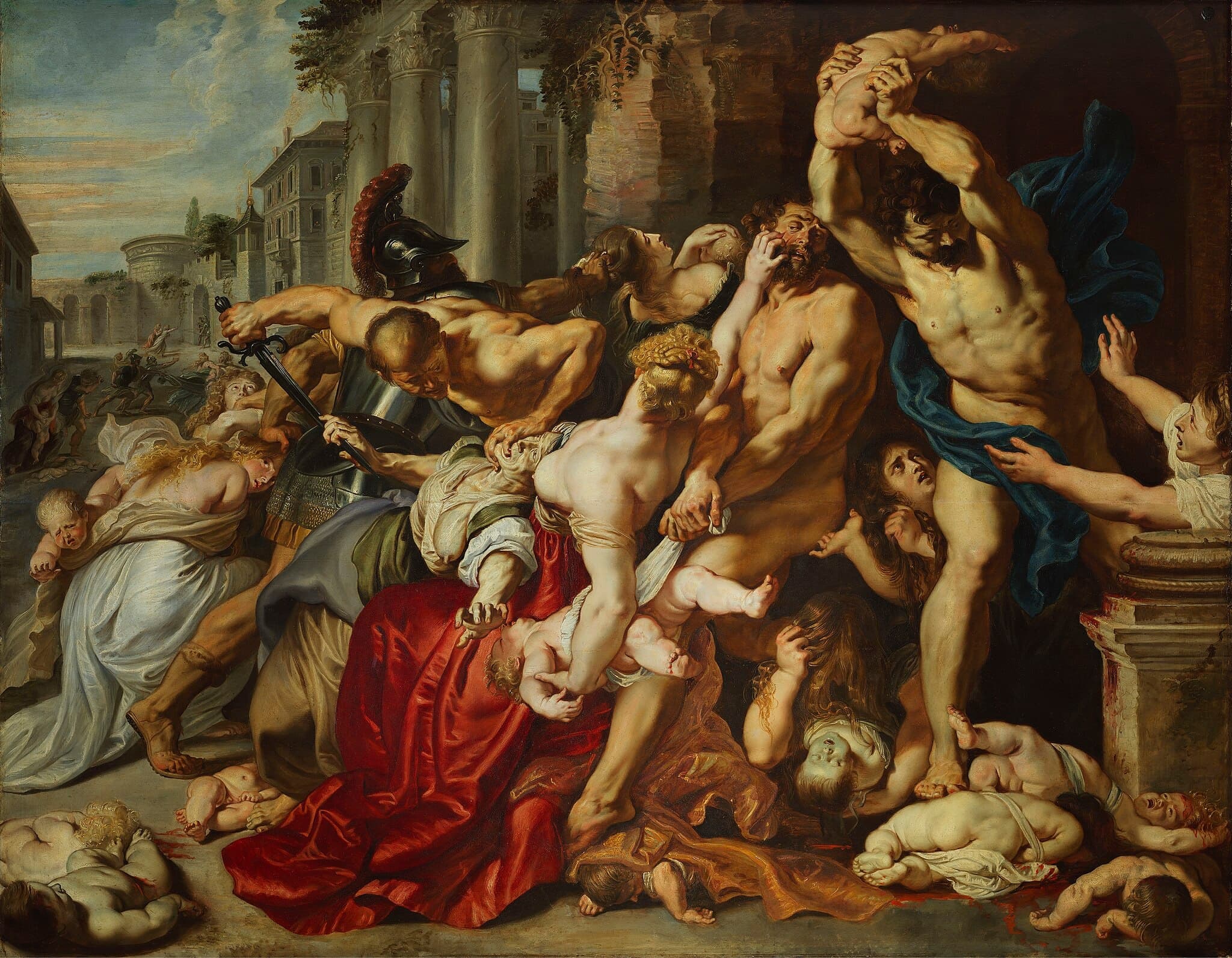
The Massacre of the Innocents
Peter Paul Rubens • Oil on panel
Read full analysis of The Massacre of the Innocents →Valuation Analysis
Valuation conclusion: For a securely attributed, museum‑quality, history‑scale "Massacre of the Innocents" by Peter Paul Rubens I place the current market value at $100–150 million. This assumes an autograph work in stable condition with clean, published provenance and catalogue‑level scholarship; anything short of those standards materially reduces the estimate.
This conclusion is reached through a comparables‑led approach anchored to the high‑profile 2002 rediscovery and sale of this composition at Sotheby’s London (realised approximately $77.2M at the time), which functions as the primary market benchmark for this subject [1]. That anchor is then contextualised with subsequent high‑quality Rubens results (for example, strong early‑Rubens sales in major houses and the $26.9M Salome sale in 2023), which inform the realistic ceiling and mid‑market expectations for autograph works of this scale and importance [2].
Primary value drivers are: firm autograph attribution (technical confirmation of original underdrawing/pentimenti), fully documented provenance and exhibition/publication history, history‑scale dimensions and subject rarity, and condition/degree of conservation intervention. A painting that satisfies those criteria will command institutional interest and competitive private bids; conversely, evidence of substantial studio participation, heavy non‑original overpaint, or gaps/legal provenance concerns will typically reduce realizations to the low millions or less.
Range logic and risks: the $100M floor reflects the premium a leading museum‑quality autograph work will command in a selective Old Masters market; the $150M top band is conservative relative to an inflation‑adjusted reading of the 2002 rediscovery sale plus scarcity and renewed institutional demand for canonical Rubens history paintings. Major downside risks are attribution reversal, unresolved title/provenance issues, or condition problems revealed by technical study; upside events are fresh scholarly confirmation, high‑profile exhibitions, or a heated competitive sale environment.
Recommended next steps to firm this valuation: obtain high‑resolution recto/verso photography, lab IRR and X‑ray, pigment and binder analysis (and dendrochronology if panel), a full conservation condition report, and a provenance audit. With those data a major‑house Old Masters department can provide a presale opinion and a precise reserve/estimate strategy (private treaty vs selective evening sale). Institutional outreach should run in parallel if the work is fully authenticated.
Key Valuation Factors
Art Historical Significance
High ImpactThe 'Massacre of the Innocents' is a cornerstone subject in Rubens’s narrative repertoire, showcasing his compositional virtuosity, dramatic figuration and Baroque theatricality. An autograph, history‑scale example is rare on the market and carries outsized museum and scholarly interest because it encapsulates Rubens’s handling of mass movement, violent chiaroscuro and emotional intensity. That rarity and cultural prominence directly translate into higher price elasticity: museums and blue‑chip private collectors are willing to compete strongly for canonical works that fill gaps in institutional holdings or anchor exhibitions and publications. Consequently, art historical significance is a high‑impact value driver for this composition.
Attribution & Technical Evidence
High ImpactSecure attribution materially changes valuation — technical markers such as characteristic underdrawing, pentimenti, brushwork consistent with Rubens’s hand, period pigments and support dating (dendrochronology for panel) are decisive. Infrared reflectography, X‑radiography and cross‑section/pigment analysis can demonstrate original work versus later studio additions; evidence of a Rubens hand elevates a painting from the studio/circle price bracket into the multi‑tens (or hundreds) of millions domain. Given the historical prevalence of studio replicas and followers, technical confirmation is indispensable and is among the most influential determinants of final market value.
Provenance & Exhibition History
High ImpactA continuous, well‑documented provenance — ideally with collection entries, sale catalogues, and exhibition/publication history — underpins buyer confidence and institutional interest. The 2002 rediscovery example demonstrates how re‑attribution combined with strong provenance can unlock substantial market value; conversely, gaps, contested title, or wartime provenance complications suppress buyer appetite and increase legal/insurance friction. Publication in the Corpus Rubenianum, inclusion in major exhibitions, and prior museum loans materially enhance marketability and typically support a premium over similar, less documented works.
Condition & Conservation
High ImpactSurface integrity, stability of the support (panel or canvas), presence and extent of overpaint, inpainting and historic restorations are central to value. Pristine or conservatively restored pictures retain maximum marketability; conversely, heavy non‑original repainting, structural damage or repeated restorations reduce authenticity signals and can deter institutional bidding. A detailed conservation report that documents original paint survival and recent interventions is essential: in some cases conservation can recover original passages and materially increase value, but invasive historical restorations remain a negative factor.
Scale, Composition & Rarity
Medium ImpactHistory‑scale works (large format, complex figural groupings) command premiums compared with small cabinet pictures because of their rarity and institutional demand for exhibition impact. The 'Massacre' as a dramatic, multi‑figure composition is particularly prized; however, multiple studio variants exist, meaning that rarity is tied to confirmed autograph status and the specific compositional variant. A unique, large autograph composition will sit at the top of the market; smaller or workshop examples are common and trade at significantly lower price points.
Sale History
Sotheby's London
Christie's London
Sotheby's New York
Sotheby's New York
Peter Paul Rubens's Market
Peter Paul Rubens occupies the top tier of the Old Masters market. His autograph history paintings — especially early, large narrative compositions — are institutionally desirable and have produced the artist’s highest auction realisations. Sales are lumpy: blockbuster rediscoveries and securely authenticated works can reach tens of millions to well over $50–100M, while studio, workshop or later copies trade in the low millions or below. Institutional demand, scholarly interest, and the rarity of museum‑quality autograph Rubens pieces sustain a broadly robust top‑end market.
Comparable Sales
The Massacre of the Innocents
Peter Paul Rubens
Direct match: identical composition by Rubens (early‑17th century), large history painting and the best‑documented market benchmark for this subject (rediscovered Liechtenstein panel sold after re‑attribution).
$77.2M
2002, Sotheby's London
~$134.4M adjusted
Lot and His Daughters
Peter Paul Rubens
Large, museum‑quality early Rubens history painting sold at the market's high end; useful as a near‑contemporary, high‑value Rubens comparable showing demand for monumental compositions.
$58.2M
2016, Christie's London
~$75.6M adjusted
Salome Presented with the Head of Saint John the Baptist
Peter Paul Rubens
Recent high‑quality early Rubens history painting sold in a major market (NY); demonstrates continued appetite for autograph early Rubens and sets a modern mid‑to‑upper market reference.
$26.9M
2023, Sotheby's New York
~$28.0M adjusted
Annunciation (Rubens)
Peter Paul Rubens
Recent sale (2025) of an autograph Rubens at a materially lower price point than the blockbuster examples; useful to show how attribution, scale and provenance separate top‑end results from mid‑market Rubens.
$4.8M
2025, Sotheby's New York
Rediscovered provincial Rubens (example reattribution sale)
Peter Paul Rubens
Illustrative low‑end comparable: a small/lesser or recently reattributed Rubens resurfacing in a provincial sale — shows the floor for works with weaker provenance, smaller scale, or greater workshop participation.
$2.7M
2025, Regional French auction (reported)
Current Market Trends
The Old Masters market is currently selective: institutional and high‑net‑worth buyers concentrate on museum‑quality, well‑provenanced works. Recent years have shown continued appetite for authenticated Rubens at the top end, while attribution uncertainty and provenance/legal issues have increased buyer caution. Institutional programming (notably anniversary exhibitions) and fresh technical scholarship are likely to support demand over the next 12–24 months.